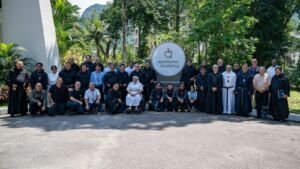

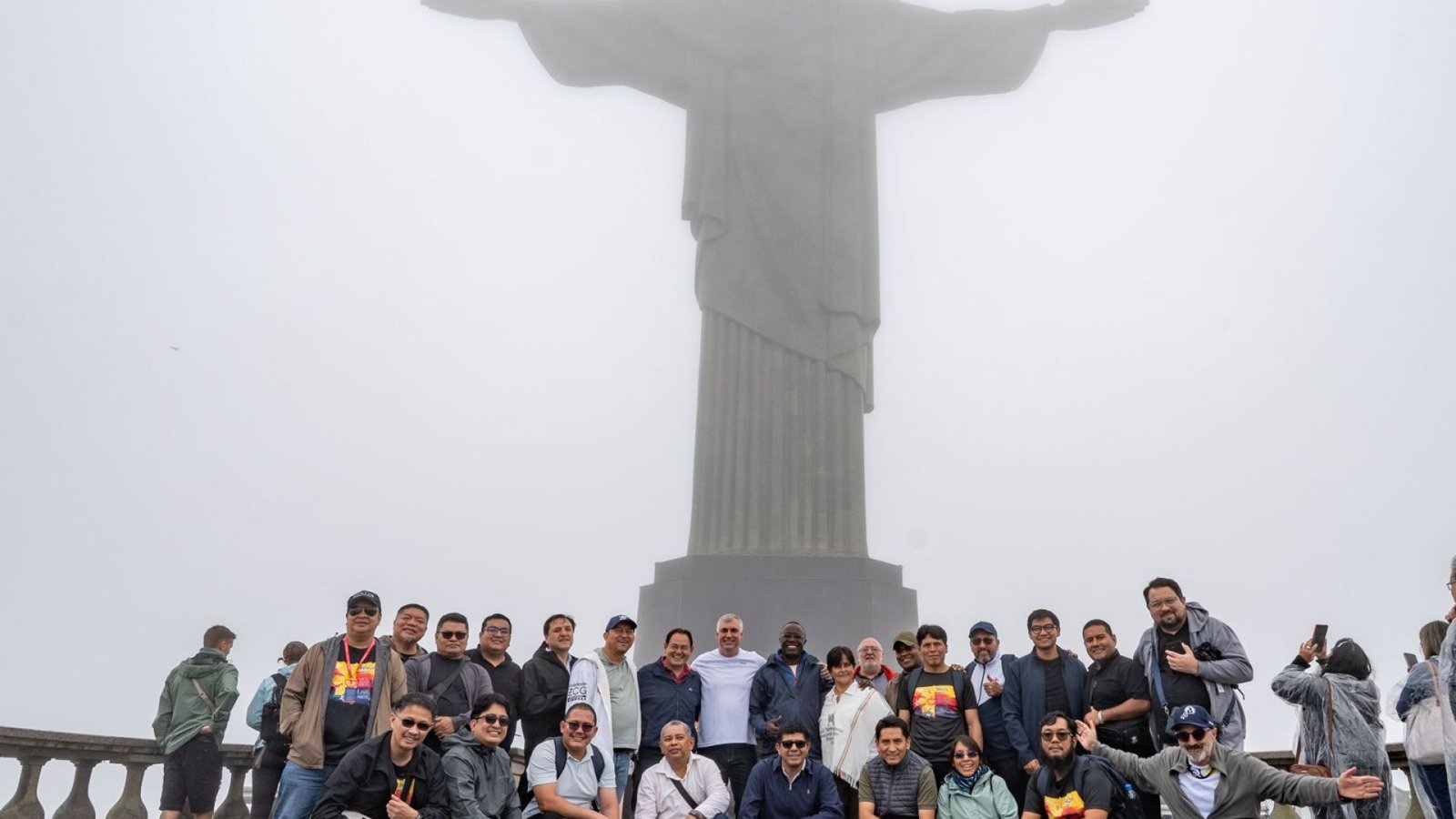
The Augustinian Recollect Missionary Synod has concluded in Rio de Janeiro. For one week, 34 synod participants prayed, listened, discerned, and shared the life and challenges of the mission. From recoletos.org, we endeavored to report on it daily. Now the bags are being packed again, but one question remains: what will we do with the fire we have received?
During these days, we spoke much of fire. Even before it began, Friar Ismael Xuruc warned us that “mission begins in the heart”. Afterwards, the Prior General, Friar Miguel Ángel Hernández, proposed eight “incendiary strategies” to place mission back at the heart of the Order. And the Synod concluded around the same image: a bonfire from which each person would take away an ember.
As I listened to the Prior General, I thought that for the Augustinian Recollects, fire could have yet another meaning, or perhaps that fire has always been present.
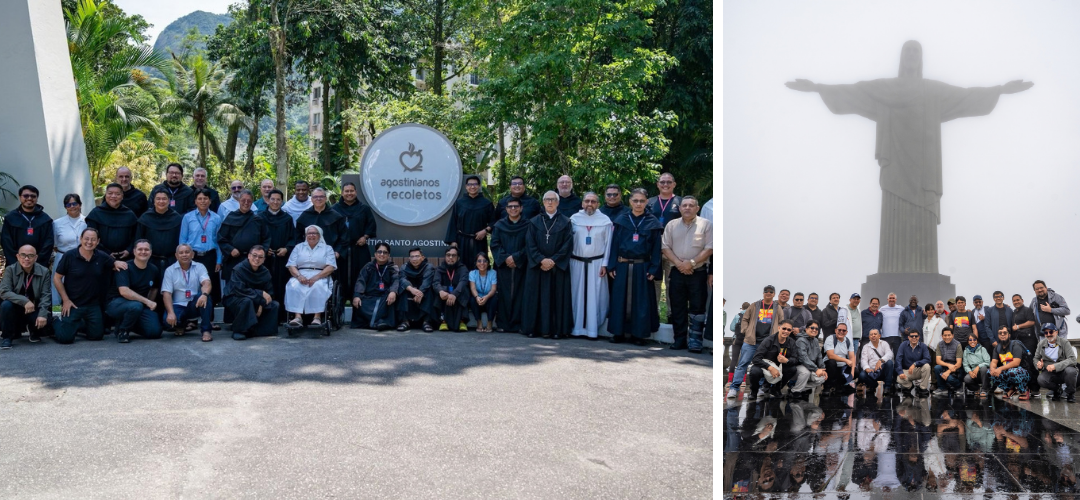
From the very iron
Friar Luis de León, the religious who drafted our Way of Life, adopted as his emblem “Ab ipso ferro”, “from the very iron”. The expression was accompanied by the image of a tree wounded by an axe from which new branches sprouted again. What had pruned it did not have the last word: life re-emerged with greater vigor.
Perhaps this Synod has also been a fire capable of heating our own iron, cold, old, but still iron. Not to transform us into something different from what we are, but to restore our temper, renew what needs to be renewed, and remind us of an identity that we sometimes forget: we are missionaries.
The journey began by asking ourselves before the Blessed Sacrament what water jars we needed to leave behind. Bishop Alejandro Castaño reminded us that “we cannot live on the longings of the past”, though neither can we forget where we come from. That is why we traversed the path from Saint Ezekiel to the digital continent and heard that new territories of evangelization coexist with those places where our brothers continue to give their lives.
Friar Russell Cordero reminded us that the missionary does not arrive as a messiah, because God was always there before. René González Regorigo invited us to recognize ourselves as “sent, not settled” and to understand that mission can no longer be lived without the laity. And, as we advanced, we learned what it truly means to walk together. This is how we experienced it, and this is how we tried to tell you about it.

Holiness has the color of mission
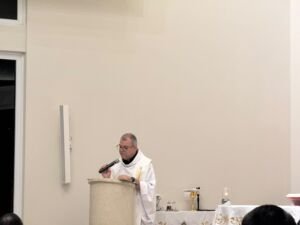
In the closing homily, Friar Miguel Ángel Hernández gave new depth to all that had been experienced. He recalled that we had dedicated these days to something for which we almost never find time: to pause and listen.
“It was not time stolen from the mission. It was mission at its very root,” he affirmed.
It was the feast of the Holy Guardian Angels, and the Prior General connected two words: angel means “sent,” and missionary comes from the Latin missus, which also means “sent.” But he warned that we should not turn our missionaries into heroes. “The greatness of the angel is not in what it does, but in what it beholds.”
That gaze has two directions: towards God and towards the little one. Interiority and mission. The Prior General defined it as a profoundly Recollect synthesis and gave it a name: holiness. “Mission is the best place to be holy,” he affirmed.
Our history seems to prove him right. Saint Magdalena of Nagasaki and Saint Ezekiel Moreno, our two saints, were sanctified in the missions. There, the martyrs of Japan also gave their lives; in China, the Venerable Friar Jenaro Fernández Gazpio spent his; in Lábrea, the Venerable Cleusa and the Servant of God Bishop Ignacio Martínez gave theirs.
That is why the Prior General could affirm that “almost all the faces of holiness in our family bear the color of mission”.
May the fire of these days heat our iron until it helps us forcefully recover that identity. May we once again be a missionary Order, not because we all have to cross oceans, but because mission once again becomes the apple of our eye, is present in our communities and formation houses, and ignites the hearts of those who one day will have to continue our history.
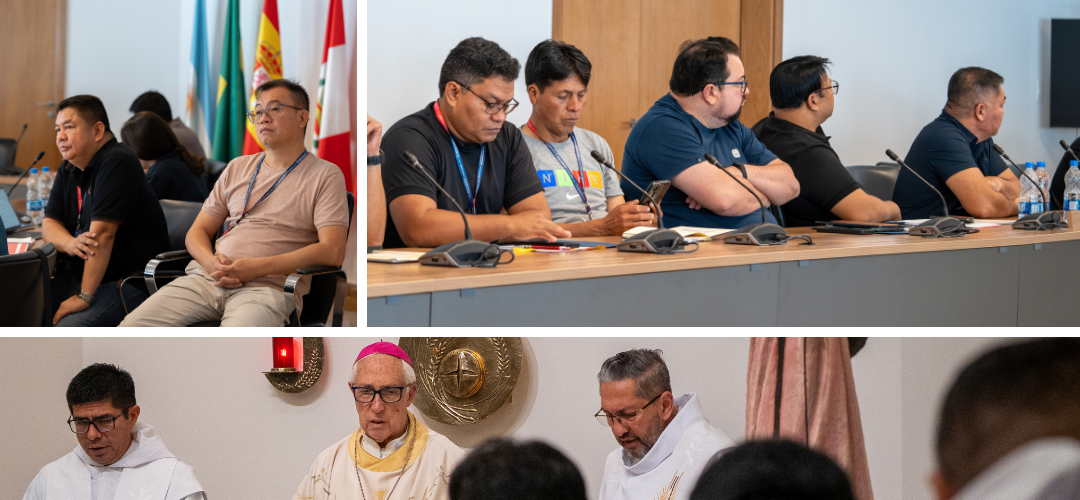
Now it is our turn to carry the embers
One of the fears expressed during the Synod was returning home and living exactly as before. The Prior General acknowledged that he shared that fear. However, he said he had seen that something had ignited in the eyes, tears, and truth with which the brothers spoke. The fire, he recalled, was not lit by us: “But carrying it is indeed our task.”
That is why he asked: “What do we do now with this bonfire?” We cannot remain contemplating it. A bonfire warms and gathers, but if no one takes an ember, the next day only ashes remain. “Be those embers yourselves,” he asked the synod participants, because “a bonfire is not measured by how high it is, but by the fires that were lit from it.”
I do not know if this Synod will change our lives. Nor do I know if it will change our Order. We cannot know that today. We will discover it when we see what happens with the fire upon returning to daily life.
I do know, however, what these days reaffirm in me and in the mission of the Order’s Communication Office: we want to be witnesses and guardians of these perspectives and share them with the whole world. Communicating our life is not just about publishing what we do. It also means recognizing what God is doing among us, preserving His memory, and ensuring that the stories of this family reach those who could not be there.
That is why the Synod ends in Rio de Janeiro, but it does not yet end on recoletos.org. Starting next week, we will begin The Echoes of the Synod. We will revisit stories we barely had time to tell, listen to their protagonists, and delve into our missions. The Synod now transforms into an echo, and we want to continue telling its story.
“I do not wish to be saved without you”
I want to conclude in a personal way. There are words of Saint Augustine that have accompanied me for many years. They are those from the famous sermon 340 in which he states: “For you I am a bishop, with you I am a Christian.” Ministry, for Augustine, only makes sense as service: he who presides remains a servant alongside others, because all have one Lord.
Later, he expresses a desire that I made my own on the day of my solemn profession: “I do not wish to be saved without you”. At that time, my life was especially dedicated to study, to university students, and to the parish. Today, I want to reaffirm it from the mission that this religious family has entrusted to me in communication.
I wish to be saved with you and for you, by telling your stories.
I want to tell, and from the Order’s Communication Office, we want to tell, the story of the missionary who crosses a river, of the elder brother who sustains the mission with his prayer, of the religious sister who silently gives her life, of the young person who begins to ask where God needs him, and of the layperson who discovers that this mission is also his own. I also want to tell the story of the weary brother, of the one who needs to return to the well, and of the one who needs someone to remind him that there is still fire.
In a few days, the phones will ring again. We will once again rush after meetings, video calls, emails, appointments, and urgent news. But I wish that something from Rio de Janeiro would remain when all that noise returns.
Ab ipso ferro. From the very iron.
May the fire of the Spirit warm our iron, renew our temper, and remind us who we are. And may we not forget those words of Augustine that I make my own again today: “For what do I live, but with the sole purpose that we may live together with Christ?”
That is also my way of understanding communication: to tell your stories so that the fire does not die out.
I do not like to sign my articles on the website, but today I borrow Friar Ismael Xuruc’s way of signing, as a tribute.
In Augustinian spirit, Friar Alfonso.