

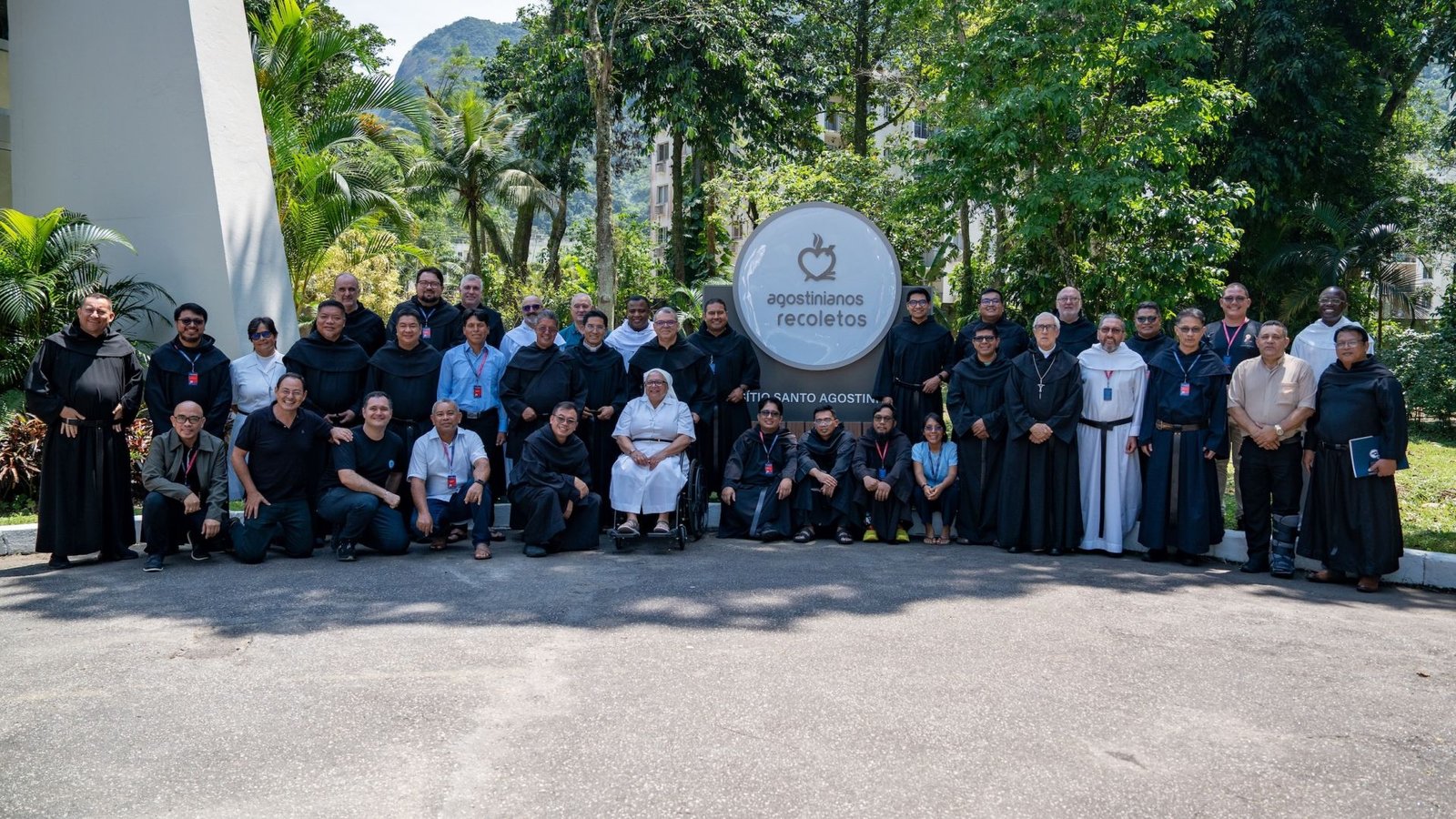
We have reached the midpoint of the Augustinian Recollect Missionary Synod. Only a few days have passed since we began, but I have the feeling that we have been here much longer. We have prayed, listened, celebrated, spoken, kept silence, shared concerns, and opened up questions that will probably not have an immediate answer.
I could begin by taking a look at everything we have experienced leading up to this midpoint. But perhaps, before telling what has happened, we must go back to the beginning and ask a much simpler question: what is a synod, really?
Learning to walk together
The word “synod” comes from the Greek synodos. Traditionally it has been explained from syn, “together,” and hodos, “way” or “path.” Hence one of the expressions we have heard most during recent years in the Church: “walking together.”
I must admit that I have read a lot about synodality in recent years. I have worked with this methodology in youth ministry and have even tried to adapt tools like LEGO® Serious Play® to encourage conversations in the Spirit. But I had never experienced a synodal assembly from the inside. And living it is different.
Because a synod does not simply consist of sitting around a table and talking. Nor is it a succession of lectures, or a congress where some present and others take notes. It is an exercise in listening that forces a change of pace: listening to the other, listening to what is happening within oneself, and trying to discover, in the midst of it all, what the Spirit might be saying.
The word is not new to the Church either. Since the first centuries of Christianity, it was used to designate the meetings in which those responsible for the communities met to discern matters of doctrine, discipline, or governance. In 1965, Saint Paul VI instituted the Synod of Bishops and, especially during the pontificate of Pope Francis, the word “synodality” acquired a renewed presence to express a way of being Church based on listening, discernment, and participation.
Curiously, the motto of the last General Chapter of the Augustinian Recollects was precisely one word: Together.
It seemed almost a dream when Pope Francis invited us to live this way. Together as brothers, yes, but not only us. Together with the laity, sharing mission, responsibilities, questions, and dreams.
Three years later, contemplating how far we have come is a gift. And for me, it is a privilege to be able to tell the story from Rio de Janeiro.
A house that began to fill up
It all started even before arriving.
We were still in Rome when I said to Brother Ismael Xuruc: “We are going to make a video to tell the story of what we are going to experience.” That night we left for Rio de Janeiro. Almost twelve hours of flight awaited us and a question difficult to answer: what are we going to find?
Little by little, the 34 synod members began to arrive. The house, initially silent, began to fill with suitcases, greetings, laughter, songs, and conversations. Religious arrived from very different places and with very different missionary experiences. The house began to be inhabited.
And perhaps that is where the Synod really began. The first night we prayed Vespers together, the Salve, and the Ioseph. The Prior General, Brother Miguel Ángel Hernández, then expressed what we were going to try to live during these days: “We are here to listen to each other and, above all, to listen to what the Spirit has to say to the Order through the missionaries.” Listen. That word would begin to be repeated constantly.
El Sínodo Misionero comienza para reavivar el fuego misionero
Asking the Spirit to walk with us
On Sunday, the synodal work had not yet properly begun. First, we had to pray.
Bishop Alejandro Castaño took us back to the missionary origins of our history and left us a warning that resonated strongly: “We cannot live on the yearnings of the past.”
We are heirs to an extraordinary history, but memory cannot become a refuge. Our elders went out, took risks, crossed seas, learned languages, and started over countless times. We also needed to ask ourselves what it means to be missionaries today.
Mons. Alejandro Castaño: “No podemos vivir de las añoranzas del pasado”
In the afternoon, before the Blessed Sacrament, the image of the Samaritan woman appeared. The question was uncomfortable: what jars do we have to leave behind?
Securities, customs, positions, weariness, fears, structures, or that dangerous phrase that so often paralyzes any possibility of change: “It has always been done this way.”
I have always liked to pray with my brothers. That afternoon had a different meaning. We prayed together for what we were about to begin, asking that the Spirit would not simply be a word pronounced during the Synod, but its true protagonist.
An image I hope not to forget
That night we experienced one of those moments that I hope to keep for a long time. The church of Santo Agostinho de Novo Leblon was full. More than a thousand people participated in the opening Eucharist presided over by the Prior General.
The names of our missions began to appear: Lábrea, Marajó, Casanare, the Peruvian Andes, Cuba, Sierra Leone, Indonesia, the Philippines…
Geographies separated by thousands of kilometers that night seemed to meet at the same altar. The music, the liturgy, the words, the care with which every detail had been prepared… Everything helped to understand that something important was beginning.
But there was one especially significant moment. At the end of the celebration, the people extended their hands to bless the missionaries.
Normally we are the ones who bless. That night we let the people give us the blessing.
And then came the photograph. First with the entire parish community and then the synod members before the altarpiece. A powerful image that, for me, summarizes those first days: we came from many places, but we were beginning to walk together.
“The problem is not geography; the problem is the fire”
On Monday, the work began. The Prior General launched a challenge with a question taken from the Gospel: “Were not our hearts burning within us?”
His concern was clear: we can maintain missionary structures and yet gradually lose the spirit that gave them birth. That is why he insisted that mission is not simply a place to which we are sent. It is identity.
“The problem is not geography; the problem is the fire.”
He invited us to set a fire. Not outside, first, but inside. To let ourselves be inflamed so that mission once again occupies its rightful place in our lives.
While listening to him, I remembered one of my favorite quotes, from M. Raymond in Three Rebel Monks:
“But do not be a straw fire. Burn with vigor, as vigorously as the stars and as the sun. Keep burning until you burn out! […] If you are willing to give yourself to God, give yourself entirely or give Him nothing. Be a saint.”
Perhaps that is what it is all about.
El Prior General pide al Sínodo “incendiar” la Orden con la misión
God was there before us
That first day ended with the Eucharist presided over by Brother Russell Cordero, a missionary of the Province of Saint Ezekiel Moreno in Indonesia. Brother Russell has been one of the discoveries of these days for me.
He spoke from his experience in Sierra Leone and Indonesia and recalled something essential for anyone who wants to be a missionary: we do not arrive anywhere as messiahs. God was there before us.
Mission requires humility to enter into the life, culture, and history of another people, knowing that one steps on ground where God is already acting.
La Eucaristía cierra el primer día de trabajo del Sínodo Misionero
That Eucharist also had a specific name. That same day we learned of the passing of Sister Marfiza Pessoa, an Augustinian Recollect missionary. We prayed for her and her life became, in a way, another word spoken within the Synod.
We live from a tradition
On Tuesday we looked back at our history again. Bishop Alejandro Castaño went through some names that are part of our missionary tradition: Saint Thomas of Villanova, Saint Alonso de Orozco, Saint John of Sahagún and, especially, Saint Ezekiel Moreno.
“I feel that the Lord is calling me there.”
A phrase that spans the centuries. We are new, but we live from a tradition. And we should not forget it.
However, looking back does not mean staying behind. At the end of that morning, two messages arrived that opened the horizon. The youth of the ARY expressed their availability for the mission and Bishop Lucio Ruiz recalled that there is also a huge “digital continent” waiting for the announcement of the Gospel.
From Saint Ezekiel to TikTok, it may seem that there is an insurmountable distance. Perhaps it is not so great.
The paths change, the languages change, and the maps change. What remains is the question: who will go?
Turning our gaze toward heaven
That night Bishop Castaño left us another image.
“We must turn our gaze toward heaven.”
After talking so much about strategies, structures, missions, difficulties, and possibilities, we needed to remember where we are walking toward.
There are religious who are tired. There are communities that are aging. There are places where strength seems insufficient. There are ministries that weigh heavy. The Synod does not intend to ignore any of that.
But we also cannot forget that our hope does not depend solely on our capabilities. Jesus Christ “is not only a God who loves, but a God who redeems.”
Mons. Alejandro Castaño: “Tenemos que volver nuestra mirada hacia el cielo”
Sent, not settled
And we reached Wednesday. This morning René González Regorigo opened his heart before the synod members.
René was an Augustinian Recollect religious. Today he is a family man and works for the Order through ARCORES Brazil. His personal story and missionary experience allowed him to speak from a very particular place: as someone who still deeply loves this family and continues to put his professional life at the service of its mission.
He spoke to us of “three faces, one question, and a well”: an elderly woman in London, Ebola in Sierra Leone, and a child in the Amazon. And he left a question that deserves to be taken to prayer:
“What do I hold onto because I have been sent, and what do I hold onto because I do not dare to let go of it?”
Then came listening in the Spirit again. And something is changing.
As the days go by, the interventions cease to be just ideas. Stories, wounds, concerns, dreams, and personal experiences appear. The room is becoming closer. The Prior General thanked the synod members this morning for precisely that: their openness and the good that, by sharing their lives, they are doing for the Order.
https://recoletos.org/enviados-no-instalados-una-mision-que-se-comparte/
Perhaps the challenge is to be saints together
About a year ago I gave a LEGO® Serious Play® workshop to some cloistered Augustinian Recollect nuns.
There was something that impressed me deeply. When we talked about their dreams, a desire appeared with extraordinary naturalness: they wanted to be saints.
They did not simply want to do things better. They did not only dream of more efficient communities, better-organized structures, or more successful projects.
They wanted to be saints.
And thinking about it now, halfway through this Synod, perhaps an important part of the answer lies there.
The missionaries who crossed oceans wanted to give their lives. Saint Ezekiel wanted to respond to a call. So many religious and laity who sustain our missions today continue trying to respond to theirs. We still have half of the Synod left.
New insights will come, new conversations, silences, questions, and surely some discomforts. The Synod members will still have to talk a lot and, above all, listen a lot.
But I am beginning to understand something that I had not fully understood reading documents on synodality. Walking together does not simply mean everyone moving in the same direction.
It means learning to listen to the other’s step, accepting that sometimes we will have to modify our own rhythm, and discovering that the Spirit can speak to us through the brother in front of us.
Perhaps the challenge is much simpler to formulate and much more difficult to live.
To become saints. Together.


