
The Augustinian Recollect Missionary Synod concludes its work in Rio de Janeiro with the approval of the final document and a message addressed to the entire Augustinian Recollect Family: “Mission is not a geography. It is our identity.”
At 5:00 PM in Rio de Janeiro, the Assembly of the Augustinian Recollect Missionary Synod voted on the final points of the document. Thus ended several days of listening, dialogue in the Spirit, testimonies, and shared discernment on the present and future of mission in the Order.
The document approved by the synod members will be released shortly to the entire Augustinian Recollect Family. In the meantime, the Assembly wished to share an initial message, titled “A fire received, a fire to be fanned into flame”, which gathers some of the fundamental convictions that emerged during these days.
The text was drafted by Friar Joseph Sonibari, Sr. Sandra Maldonado, MAR, and Friar Alessandro Moreira, based on the experience and discernment of the Missionary Synodal Assembly.
It is not merely a farewell. The message poses a question that the Synod now carries from Rio de Janeiro to every community of the Augustinian Recollect Family: “What is going to change in our lives, in our communities, and in our Order after this Synod?”
Mission begins in a restless heart
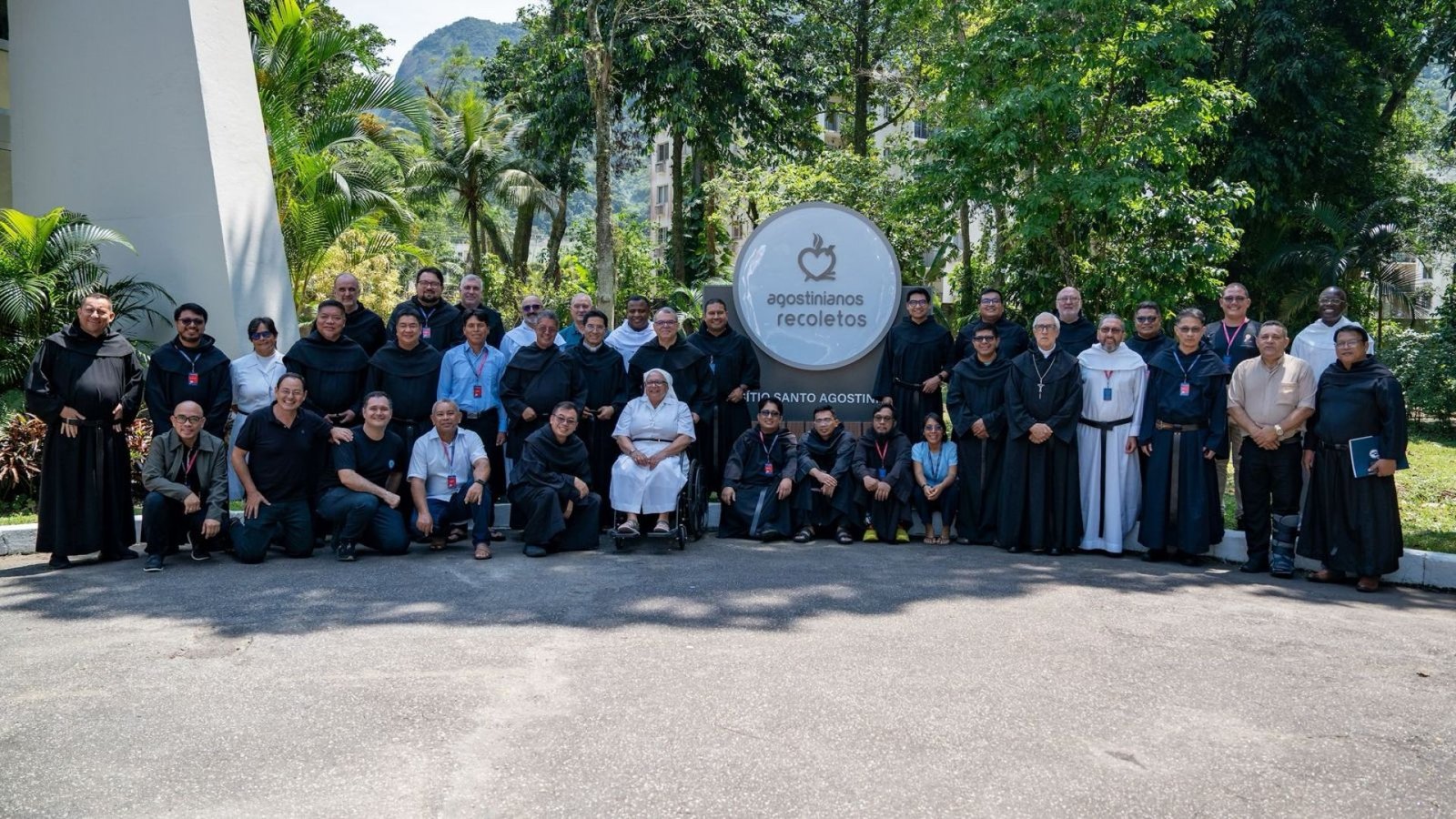
The message begins by recalling the origin of the encounter. Summoned by the Prior General and the General Secretariat for Missionary and Ministerial Apostolate, and in compliance with Decision D.9 of the 56th General Chapter of 2022, 36 religious men, religious women, and laity from seven mission countries and representing 16 missionary communities arrived at Sítio Santo Agostinho.
But the text goes beyond figures and returns to the roots of the Recollection itself. The synod members recall that the initial restlessness to live with “greater austerity, depth, and authenticity” ended up opening itself to peoples, borders, and evangelization.
Therefore, one of the central statements of the message is that mission cannot be understood as just another activity within the life of the Order:
“Mission did not simply begin when someone crossed an ocean. It began much earlier: when a heart allowed itself to be made restless by God and by the needs of others.”
Saint Thomas of Villanova, Saint Alonso de Orozco, Saint John of Sahagún, and Saint Ezekiel Moreno appear in the text as witnesses to a history in which mission and charism cannot be separated.
This perspective also leads to recognizing the vulnerability of those who evangelize. The message speaks fearlessly of exhaustion, mistakes, fragilities, and the need to learn how to ask for help. “We are fragile. We get tired, we make mistakes, we break down,” the synod members acknowledge, before recalling that it is precisely in this reality that God can manifest His greatness.
From this also arises a call to care for community life: knowing how to rely on one’s brother, asking for relief when strength fails, and building communities capable of listening and sustaining. For the synod members, this fraternal life can only be sustained through “interior life and in the encounter with the Lord.”
“Mission must give us life, not take it away”
Among the convictions left by the Synod, there is one that is especially significant:
“Mission must give us life, not take it away.” Message_of_the_Missionary_Synod_EN
The message connects this statement with the need to care for all those who participate in the mission and devotes particular attention to the laity. They are not understood as secondary help for apostolic works, but from the perspective of co-responsibility:
“They are not simply collaborators or pastoral labor. They are brothers and sisters and co-responsible for the mission.”
The synod members find an image of this vulnerable mission in Jesus’ encounter with the Samaritan woman. Jesus arrives tired at the well, without a strategy or even a bucket to draw water, and yet, from there, He transforms a life. “Mission is not born of our strength. Many times it is born precisely where our strength ends,” the message states.
“We are all missionaries”
The final message also expands the meaning of the word missionary. Mission does not belong exclusively to those who have been sent to geographically distant places.
The Assembly remembers those who live on the frontiers, but also those who remain in their communities; those who can move and those who can no longer do so; those who announce, accompany, and serve; and those who silently sustain the mission through their prayer. In a special way, the text mentions the elderly and sick brothers.
The conclusion is expressed in a simple phrase:
“We are all missionaries when we place our lives at God’s disposal.”
Therefore, one of the challenges left by the Synod is to ensure that the experience of the missions does not remain hidden. The synod members ask that it enter “into our conversations, into our communities, into our formation, and into the hearts of our new generations.”
They also call to tell missionary stories. Not to build idealized figures, but so that young people can discover that giving one’s life for the Gospel continues to make sense:
“We need to tell our missionary stories. Not to manufacture unreachable heroes, but so that our young people can discover that giving one’s life, going out of oneself, and venturing for the Gospel remains something beautiful, valuable, and possible.”
The discernment carried out during these days is finally condensed into a statement intended to extend beyond Rio de Janeiro:
“Mission is not a geography. It is our identity.”
A word of thanks before the closing
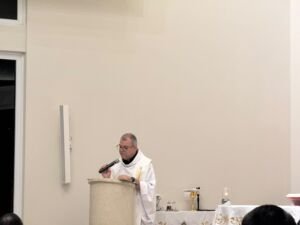
After the vote on the final document, Friar Ismael Xuruc took the floor to thank the work of those who participated and made the Synod possible.
Firstly, he thanked the Prior General, Friar Miguel Ángel Hernández, for his presence and constant involvement in the synodal process, as well as the service performed as moderator during the sessions.
He also expressed his gratitude to the missionaries, who traveled to Rio de Janeiro from different places to place their experiences, difficulties, hopes, and testimonies at the service of common discernment.
Friar Ismael likewise thanked Bishop Alejandro Castaño for his presence and accompaniment during the encounter; Friar René González, for handling the logistics; and Friar Jesús Emmanuel Mendoza, for assuming the responsibility of the Synod Secretariat.
The gratitude extended to Friar Alfonso Dávila, Director of Communication of the Order, for the logistical and communicative support of the encounter, and to Vanessa Pagiola, for her collaboration in communication and in the Portuguese translation of the documents used during the Synod.
Friar Ismael ended his words by returning again to the missionaries and thanking them for their daily dedication to the service of the Church and the peoples in which the Augustinian Recollect Family is present.
With the vote, the work of the Assembly has ended, but the final act of the encounter still remains. In the coming hours, the Prior General will preside over the closing Eucharist, which will formally conclude the Augustinian Recollect Missionary Synod.
The message sent to the entire Augustinian Recollect Family ends by placing this path under the intercession of the Mother of Consolation, patroness of the Order and “first missionary,” and asking her to help everyone to “fan into flame the fire received.”