
The first morning of work at the Augustinian Recollect Missionary Synod focused on a decisive question: “Does our missionary heart still burn?”. Fray Miguel Ángel Hernández invited the synod participants to seek concrete paths so that the mission may once again become a concern of the entire Order.
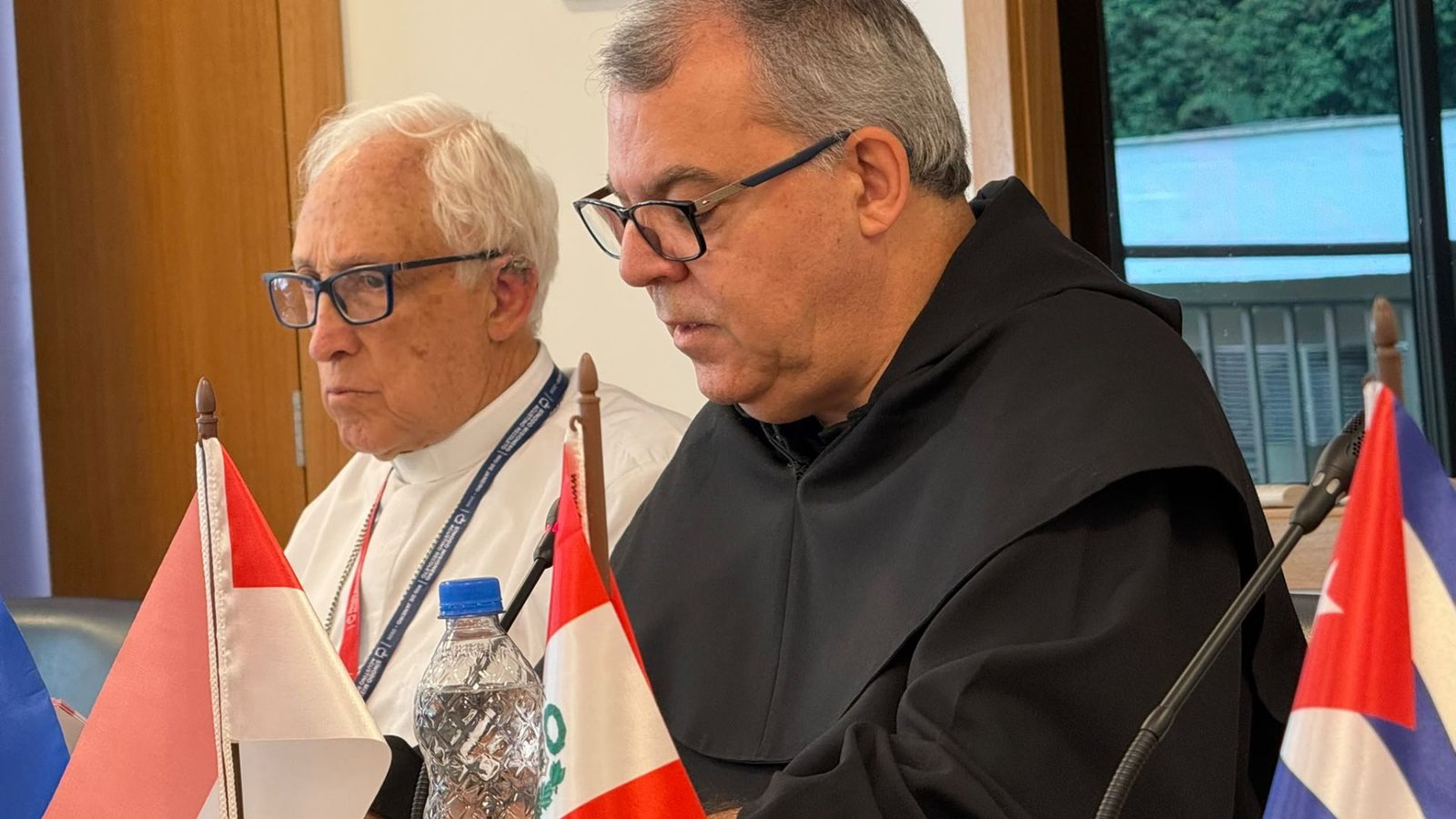
The first morning of work of the Augustinian Recollect Missionary Synod, being held in Rio de Janeiro, began on September 28 with an address by the Prior General, Fray Miguel Ángel Hernández, who set before the synod participants one of the great challenges that prompted the convocation: how to rekindle the missionary spirit and ensure that the mission is once again felt as a shared responsibility of the entire Order.
Under the title “Were our hearts not burning?”, the Prior General began from a fact: there is concern about the weakening of the missionary spirit, understood not only in terms of the number of religious sent, but in terms of “availability for the mission, the desire to be sent, that ancient restlessness for the frontiers where the Church needs us most.”
However, Fray Miguel Ángel wanted to make clear from the outset that his address was not intended to reproach anything in those taking part in the Synod, many of whom have extensive missionary experience. “This talk is not looking for culprits. It is looking for paths and collaborators,” he explained. The goal, he noted, is to find together “incendiary strategies” capable of returning the mission to everyone’s heart.
From having missionaries to being a missionary Order
One of the central ideas of the address was that “the mission is not first a destination. The mission is an identity”. For the Prior General, the danger lies not only in having fewer religious available for certain territories, but in the mission ending up becoming the specialty of a few while the rest of the Order looks on from a distance.
For this reason, he distinguished between admiring missionaries and allowing oneself to be challenged by their witness. Not all religious will be able to cross a geographical border, he recalled, but all are called to share the same missionary identity. Even being assigned to a mission territory does not guarantee preserving that spirit:
“The opposite of the missionary spirit is not not having gone on mission. It is indifference. The problem is not geography; the problem is the fire.”
From there, Fray Miguel Ángel posed a question that will accompany much of the synodal work: “What are we doing to make the mission exciting?”. In his view, perhaps the Order does not need only better speeches about the mission, but experiences capable of making it desirable again and of showing that giving one’s life is still worth it.
Eight “incendiary strategies” to rekindle the mission
The Prior General made his reflection concrete in a series of proposals that he provocatively called “incendiary strategies”. Although you spoke of seven points, Alfonso, in the final text there are eight numbered strategies; for that reason I include them here, respecting the document:
1. Let the missionaries also set the Order ablaze. Their experience should not remain hidden in the places where they serve. The Prior General proposed encouraging testimonies, meetings with communities and those in formation, visits to formation houses, and personal accounts that make it possible to discover not only what missionaries do, but what God is doing in their lives. “A well-told missionary story can do more for a young person’s vocation than ten speeches about the importance of the missions.”
2. Bring the mission into communities and involve them. The mission needs to be part of the ordinary conversations of communities. Knowing a story, a need, or the reality of a territory can help what happens on the missionary frontiers no longer feel distant.
3. Let formation “smell of mission”. Availability to be sent cannot appear only at the end of the formation process. From its earliest stages, formation should help develop a heart open to the mission: “We are not forming religious to fill missionary posts. We are forming religious with a heart available to be sent.”
4. Create experiences that spread. Faced with a mission known only through speeches, the Prior General proposed concrete experiences that allow encounters with missionaries and communities and an understanding of realities of poverty, the peripheries, or exclusion. The goal, he warned, “is not to form mission tourists,” but to broaden the horizons of one’s own vocation.
5. Let the older members keep adding fuel. Religious who can no longer travel retain an important missionary responsibility: to pray, accompany, write, encourage and, especially, pass on to new generations the stories of a life given.
6. The sick can also be missionaries. From their frailty they can sustain the mission through prayer, the offering of their suffering, closeness to missionaries, and interest in communities. If the mission is identity, the Prior General recalled, it does not disappear when physical capacity diminishes.
7. Celebrate the mission. The Order needs to make publicly visible the beauty of missionary self-giving, not to present the missionary as an unattainable hero, but to show that giving one’s life on the frontiers continues to be “something beautiful, valuable, and desirable.”
8. Recover the missionary fire of the 19th, in memory of Saint Ezequiel. Fray Miguel Ángel proposed recovering more explicitly the missionary dimension of this day, ensuring that each month one mission of the Order can enter communities, parishes, schools, and formation houses through testimonies, stories, faces, and prayer intentions. October, traditionally a missionary month, could intensify this dynamic so that the whole Order may “breathe mission.”
The challenge, the Prior General insisted, will be to see what truly changes after the gathering. The fruit of the Synod will not be measured only by its documents or proposals, but by its ability to bring about a transformation in the way religious, communities, young people, and apostolic works experience the mission. “Not all of us are called to go on mission, but all of us are called to live the mission as our own.”
The address ended by returning participants to the image of fire: “The mission is not imposed; it spreads. Fire is not manufactured; it is passed on.”. And it left a question to carry from Rio de Janeiro to the whole Order: “Lord, where do you need us?”.
From fire to the well: the conversation in the Spirit begins
After the Prior General’s address, Fray Ismael Xuruc led the first illumination that prepared the synod participants for the conversation in the Spirit. Under the title “Charismatic identity and missionary spirituality,” the reflection took as its starting point Jesus’ encounter with the Samaritan woman and a conviction: “Being before doing: interiority as the root of the mission”.
The image of the well made it possible to deepen the relationship between interiority, community, and mission. “Before being missionaries who give, we are thirsty people who receive. Before carrying the water, one must have it,” the illumination recalled. Interiority was presented as the hidden water; the community, as the wellhead that protects it; and the mission, as the bucket that carries that water to those who are thirsty.
The reflection finally led to the image of the jar that the Samaritan woman leaves beside the well after encountering Christ. From it, participants were invited to ask what they need to leave behind in order to proclaim the Gospel with greater freedom, and to discern about activism, community life, the participation of the laity in the charism, and the interior root of the mission.
With these questions, the work of the groups began through the conversation in the Spirit. Thus, the first morning of the Synod brought together two images that will accompany the discernment of these days: a fire that needs to be passed on and a well to which it is necessary to return in order to have water to offer.