
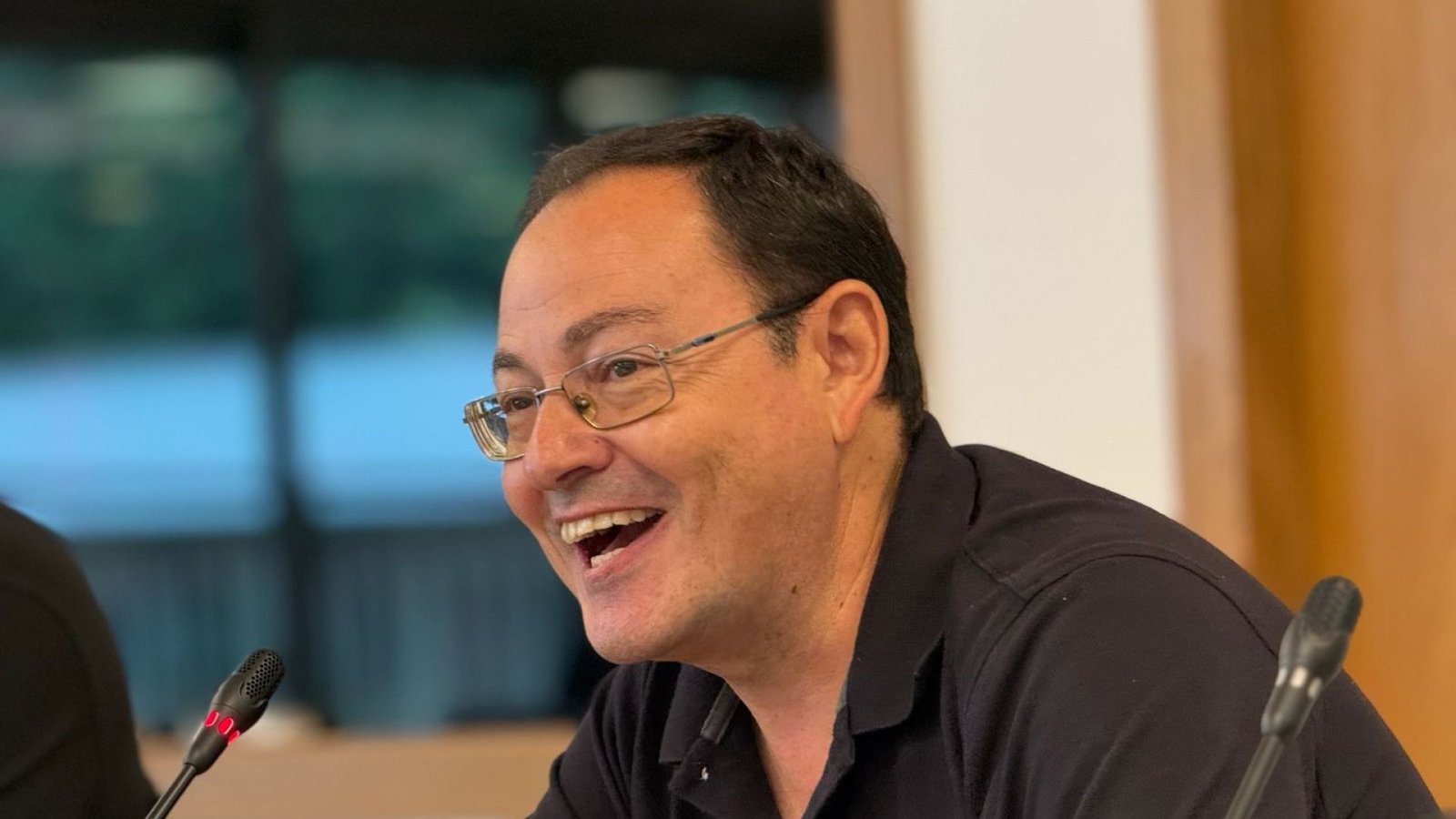
The testimony of René González Regorigo, a former Augustinian Recollect religious and now a collaborator with ARCORES Brazil, offered a particularly personal reflection on the third working morning of the Augustinian Recollect Missionary Synod. His experience served as a reminder that the mission can change its form without ceasing to be a sending.
The working morning of the Augustinian Recollect Missionary Synod had one of its most intimate moments with the insights provided by René González Regorigo, from ARCORES Brazil. His presentation, titled “Sent, Not Settled,” accompanied the synod participants’ reflection on presences, priorities, and shared mission.
His words were also spoken from a personal history deeply connected to the Augustinian Recollects. René was an Augustinian Recollect religious, lived the missionary experience for years, and is now a family man. His life took another path, but neither his affection for the Order nor his commitment to its mission disappeared. He currently works in the ARCORES Brazil office, from where he continues to help sustain projects in service of communities and missionaries.
Therefore, more than a theoretical exposition, his words took on the tone of someone sharing something that is part of their own life. And he did so with a grateful gaze towards a religious family he continues to feel close to.
Three Faces to Speak of Mission
René began by making it clear that he did not intend to offer a reconfiguration plan or decide which presences should be maintained or closed. “I bring three faces, a question, and a well”, he explained to the synod participants. The three faces came from his own experience.
He first recalled an elderly woman from a poor neighborhood in London, where he discovered that one of the greatest poverties was simply not having anyone to listen.
He then took the synod participants to Sierra Leone, where he had worked in education, agriculture, and evangelization. The arrival of Ebola radically changed the mission:
“I learned there that there is a moment when the mission is not about giving anything, but about not leaving.”
The third face was that of an eight or nine-year-old boy by an Amazonian river. The long hours of navigation to reach the riverside communities taught him that “arriving is already mission” and that the time spent reaching people also expresses how much they matter.
London, Sierra Leone, and the Amazon eventually converged in a question René left in the middle of the room:
What do I sustain because I have been sent, and what do I sustain because I dare not let go?
Drawing from Jesus’ encounter with the Samaritan woman, René invited them to understand that mission arises from presence, listening, and the capacity to become vulnerable to the other.
“Mission, before being words, is a presence that makes itself vulnerable in the other’s territory,” he affirmed. And he reminded them that no one owns the harvest: “We are all sent to a field that others began.”
A Mission Also Shared with the Laity
His current situation allowed the reflection on shared mission to acquire special depth. From his work at ARCORES, René explained that in an emergency, those who respond first are often not structures, but “people with names,” including numerous laymen and laywomen.
For René, shared mission does not simply mean finding collaborators or distributing tasks. It means sharing “the joy and responsibility of being sent” and recognizing that religious and laity are called to discern together. “It is a communion of vocations, not a division of functions,” he pointed out.
His words inevitably had an autobiographical element. Someone who once lived the mission as an Augustinian Recollect religious continues to serve it today from another vocation and from a different family and professional reality. His presence before the synod participants was also a concrete expression of this shared mission that the Synod is reflecting upon.
At the end, René returned to the image of the well and left five questions for silent reflection. Among them, one particularly related to the morning’s discussion:
Do I recognize the layman and laywoman as brothers and sisters with whom to pray, discern, and decide, or only as collaborators who execute?
When the Synod Begins to Share Life
After the insights, it was again time for listening in the Spirit. But, as the days progress, these spaces are taking on a different tone. The closeness among the synod participants is growing, and with it, also the freedom to share not only ideas about the mission, but their own lives.
Personal experiences, pains, concerns, and hopes emerged in the groups. Discernment thus began to touch the concrete history of those participating in the Synod.
The Prior General, Fray Miguel Ángel Hernández, expressly thanked the synod participants for this openness and the good they are doing for the Order through their sincerity and willingness to listen to one another.
The morning concluded with a sign of communion received from contemplative life. The Augustinian Recollect Nuns of the Monastery of Our Lady of Guadalupe, in Guaraciaba do Norte (Brazil), sent a message to the Synod participants, reminding them through prayer that the missionary discernment of these days does not belong solely to those gathered in Rio de Janeiro, but is accompanied by the entire Augustinian Recollect Family.