

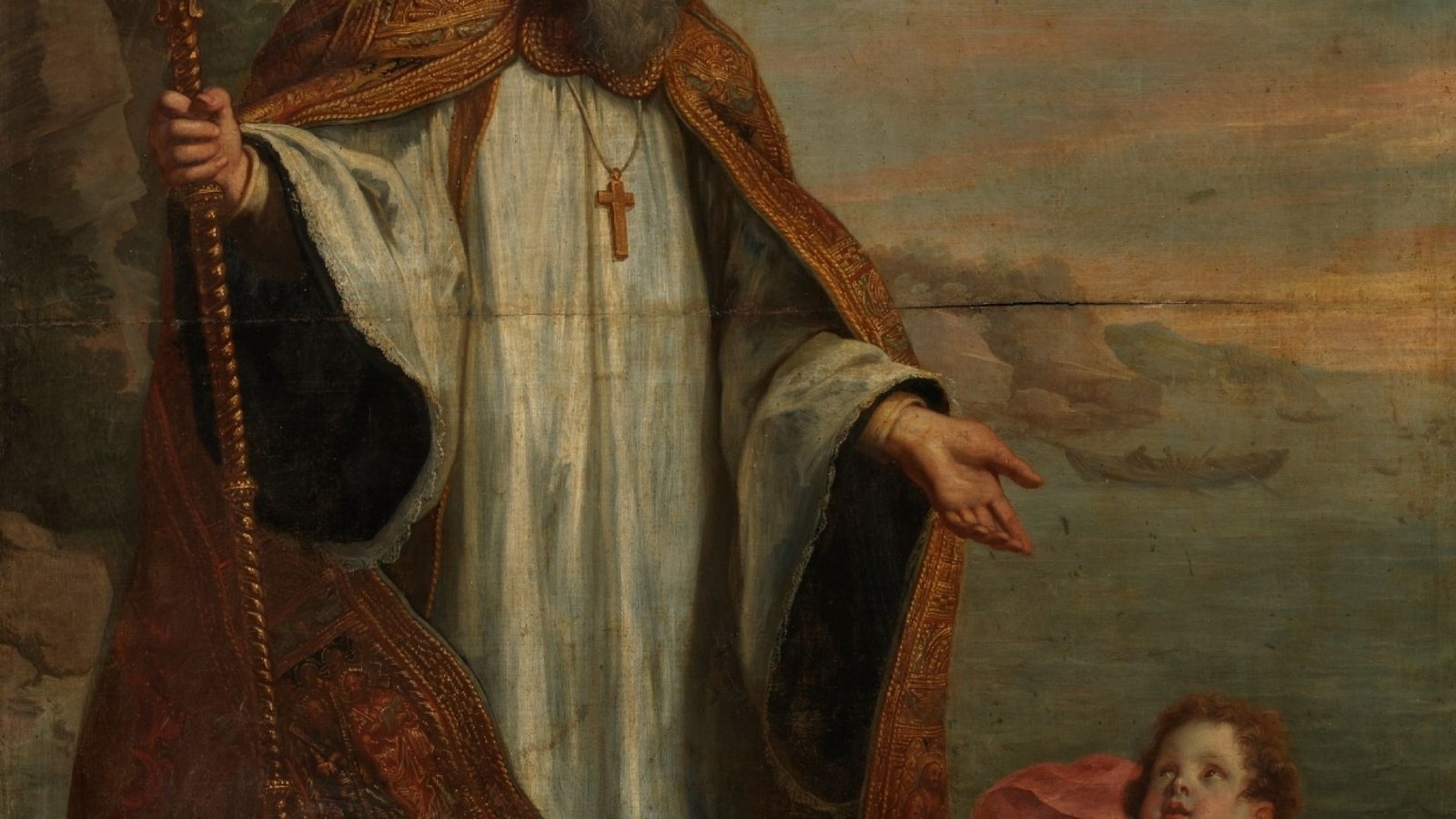
There are questions that accompany a person throughout their entire life. For Augustine, one of them was this: how can God be only one and, at the same time, Father, Son, and Holy Spirit? The concern for Trinitarian doctrine appears very early in his career as a Christian theologian and would never entirely leave him: De Trinitate is the result of that long maturation, a work in fifteen books written, for the most part, in dialogue and in controversy with those who denied the full equality between the Father and the Son.
To help young people delve deeper into this work during the month of August, the Augustinian Recollect Youth (JAR) have prepared a series of infographics on their website that accompany the reading of this great classic of Christian thought in a simple and visual way.
A Real Controversy, Not Just Academic
It is best not to imagine this work as an exercise in abstract speculation detached from life. Everything indicates that, in Augustine’s time, the presence in Milan—at the time of his own baptism—of eloquent representatives of Homoian Arianism (one of the currents we today generally call “Arian”) gave these discussions a very concrete relevance. Years later, as a bishop, Augustine would continue to discuss these same issues face-to-face, for example, in his meeting with the Arian bishop Maximinus.
Words to Avoid Remaining Silent
The underlying theological challenge was enormous: how to speak of three—Father, Son, and Spirit—without saying there are three gods, and how to speak of one without denying the real distinction between them? Augustine resorts to a technical vocabulary: “substance,” “essence,” “person,” knowing that such language does not exhaust the mystery. He himself acknowledges it honestly: these terms are used not because they fully explain what occurs in God, but, in his own words, to say something and not simply remain silent.
Seeking a Reflection of God in the Human Being
The most famous and original part of the work occurs when Augustine, convinced that the human being is made in the image of God, decides to search within the human mind for some reflection of that Trinity he confesses by faith. He begins with a simple intuition: a mind that knows and loves itself already reveals a certain triple structure. But he advances and refines it until reaching its best-known formulation: the human mind, in its unity, contains memory, understanding, and will: three faculties that are truly distinct, yet inseparable, from one and the same mind. They are not three minds, but a single life, a single substance, lived in three ways at once.
Augustine is careful: this analogy does not explain God, nor does it allow us to deduce from it what the divine life is like in itself. What it does is help us, through self-examination, to draw closer—in a still very imperfect way—to a mystery that remains, after all the reflection, deeper, not less so.
The Holy Spirit as the Love That Unites
Another of the intuitions that runs through the work is that of the Holy Spirit understood as the gift and mutual love shared eternally by the Father and the Son. The communion between them, Augustine insists, is not a passing fact or something added from the outside: it is, in itself, a substantial reality. God does not love as one who has an accidental feeling; God is, in His deepest intimacy, that relationship of love.
A Work That Ends in Prayer
Perhaps the most revealing aspect of De Trinitate is how he decides to end it. After fifteen books of rigorous theological argumentation, Augustine does not close with a triumphal formula, but with a plea: he asks God to help him understand Him, to keep Him present, to love Him, and to give him the strength to continue seeking Him, until being completely remade in the fullness to which God Himself calls him. That mixture of demanding reasoning and humble prayer is, probably, the most characteristic element of this work: for Augustine, theology never ceases to be also a form of conversion.