
Aurora Campos introduces us to the compelling story of Saint Magdalene of Nagasaki, an Augustinian Recollect tertiary and one of the great martyrs of Japanese Christianity. Through a narrative filled with strength and sensitivity, we discover the life of a young woman formed by the Augustinian Recollects who chose to surrender her life rather than renounce her faith in Christ, becoming an enduring testimony of fidelity and hope.
A Childhood Forged in Faith and Persecution
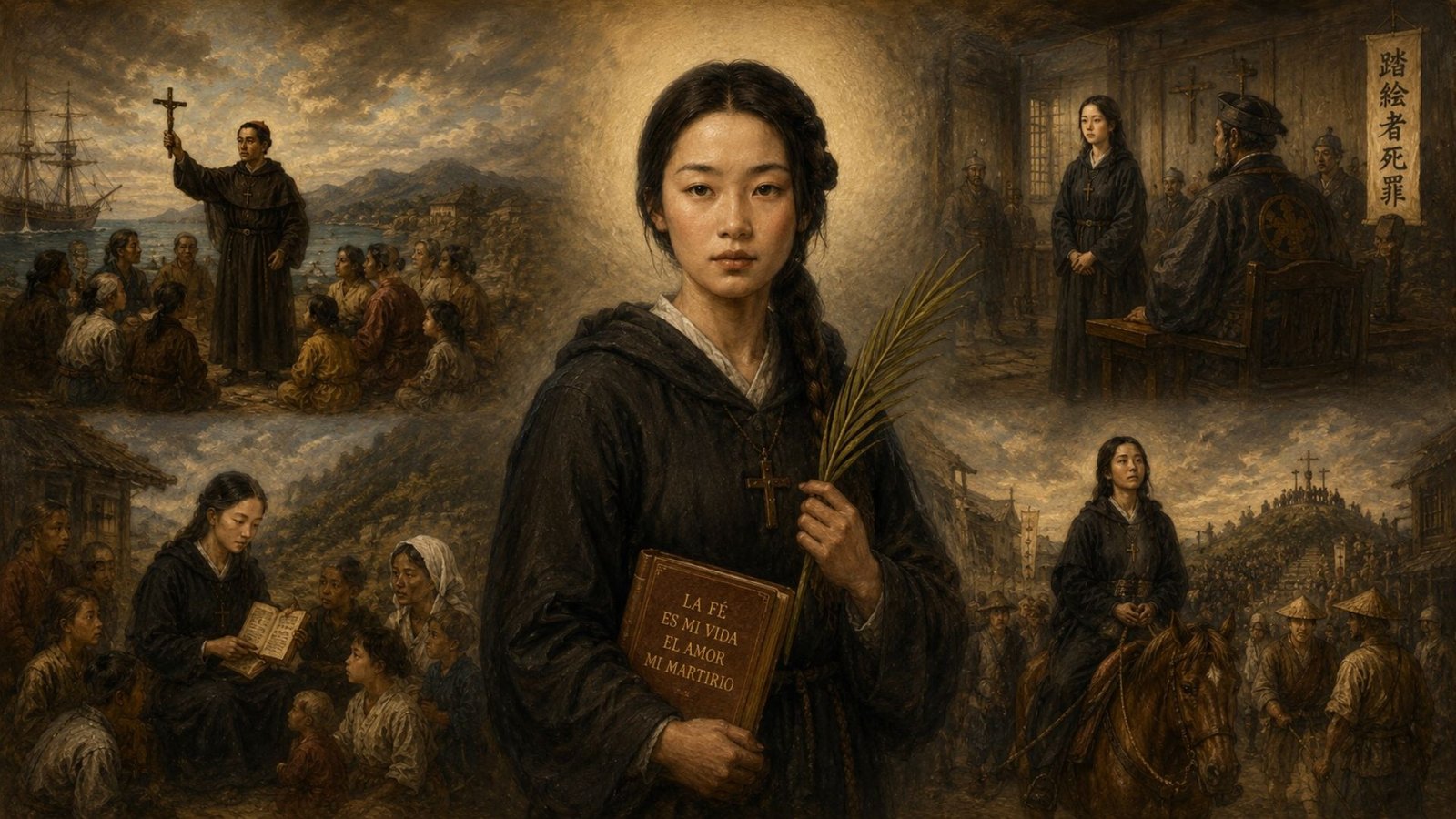
The October sun fell upon the cobblestone streets of Nagasaki while a dull lament spread through the crowd. With her hands tied behind her neck and her shoulders stiff from the tension of the ropes, Saint Magdalene advanced on horseback toward her execution. Around her, ten other Christians walked through the dust.
Despite the swaying of the mount and the pain that pierced her bones, no complaints issued from her lips, but rather a constant murmur of prayers and praises. The contrast was striking: she wore the heavy black wool habit of the Augustinian Recollects, worn by years of mission in the mountains, its rough friction against her skin serving as a reminder of the seriousness of her consecration. From atop the horse, with a burning gaze, Magdalene did not cease to speak. Her voice, clear and firm, broke the tense air to exhort the pagans to embrace the faith of the true God and the fearful Catholics to resist firmly under the scourge of persecution.
Magdalene knew human fragility well. She had seen many falter, suffocated by fear, abandoning the cross to save their lives. For this reason, a month earlier, in the humid September of 1634, she decided to step forward. Without waiting to be betrayed in the shadows of a hiding place, she walked resolutely to the governor’s palace. She presented herself dressed in her tertiary habit, defiant and serene, surrendering voluntarily. She did not seek death out of fanaticism, but to ignite a spark of fervor in lukewarm hearts, demonstrating that faith was not a theory, but an absolute gift for which it was worth shedding even the last drop of blood.
That courage had not sprung from nowhere; she carried it engraved in her soul and in the memory of her home. Born around 1610 in a small village near Nagasaki, where the air smelled of sea and pine, Magdalene grew up learning that being a Christian in Japan was equivalent to a death sentence. Faith was lived in the silence of the nights, under the flicker of hidden candles. In the islands, the shogun’s edict pursued Catholicism with implacable fury: churches were reduced to ashes, the smoke from the fires clouded the sky, and the faithful were subjected to torments designed to break the soul before the body.
Her education was a double school of martyrdom. She received the first lesson from her own blood: between 1614 and 1624, she saw her parents and siblings depart, one by one, toward death for defending the cross. The second lesson was sculpted into her spirit by the Augustinian Recollect friars. She was barely fourteen years old when she met Blessed Francis of Jesus in the steep mountains of Nagasaki, where moss seals the rocks and mist hides everything. Fascinated by the missionary’s dedication, the young woman became his shadow. She walked barefoot along the rugged paths carrying catechisms, helping to instruct children, and comforting families in improvised shelters that smelled of damp earth and fear.
Under the guidance of Francis, she donned the belt and the habit of an Augustinian Recollect tertiary, becoming a “cinturada.” When the executioners captured Blessed Francis of Jesus and Blessed Vincent of Saint Anthony in 1629, the world seemed to darken, but Magdalene multiplied her strength. She evaded the guards’ vigilance, carried messages to the dark and pestilential prisons, and drew nourishment from the courage of her spiritual fathers. Seeing them march toward the pyre, the crackling of the fire and the smell of sacred smoke were forever engraved in her heart, secretly preparing her for her own hour.
Formed by the Augustinian Recollects, Strengthened by Martyrdom
As the horse advanced painfully toward the place of torment, memories refreshed the young woman’s soul. She remembered how Providence, after the execution of her beloved pastors, sent a balm to Nagasaki: Blessed Melchior of Saint Augustine and Blessed Martin of Saint Nicholas. With them, the aroma of hope once again permeated the hidden communities. However, the consolation was ephemeral. Two months after setting foot on Japanese soil, the cold steel of chains ensnared them, and they were martyred on December 11, 1632, under a gray, wintry sky.
At barely twenty-two years old, alone and in a Japan where no friars of her Order remained, Magdalene refused to be cowed. Her youth and her small body harbored a will of iron. She then joined her steps with those of the Dominican Jordan of Saint Stephen. Although he proposed that she wear the habit of Saint Dominic to integrate into his work, she preferred to maintain the ties with her first teachers. For this reason, when surrendering to the governor and now, when marching toward the scaffold, she proudly wore the sackcloth of the Recollects, a banner of gratitude toward those who taught her the way to heaven.
Upon seeing her arrive at the tribunal, young, with fresh skin and a serene beauty, the governor attempted to break her through seduction. He offered her riches, fine silks, and a life of privilege far from the prisons in exchange for a single word of apostasy.
Faced with Magdalene’s firm rejection, the machinery of terror was set in motion.
First, they subjected her to the water torture: they forced her to ingest immense quantities of liquid until her belly swelled, only to strike her violently in the stomach, forcing her to expel it mixed with gastric juices and blood. Seeing that her soaked face remained firm, the executioners moved on to a more refined cruelty. They drove sharp bamboo splinters under her fingernails, tearing the living flesh, and forced her to dig in the earth with her bloodied hands. The crunching of the bamboo and the screams of pain from other prisoners filled the room, but Magdalene, with her eyes fixed on the invisible crucifix of her memory, resisted the torment.
Defeated by her fortitude, the governor handed down the final sentence: the torment of “the gallows and the pit.” It was a method so terrifying that merely naming it was enough to make many apostatize out of horror. It consisted of tying the victims by their feet and suspending them upside down inside a deep pit filled with filth. The waist was imprisoned by airtight planks that prevented the entry of light and air, causing blood to rush violently to the brain and eyes.
Upon arriving at the site of the ordeal, the stench of the pit and the crudeness of the timbers did not take away her peace. Magdalene was lowered into the pit. In the absolute darkness of the earth, the congestion began to take its toll, but her resistance defied the science of death: she survived thirteen and a half days in that vertical agony. Death did not come to her by the design of her executioners, but by an intense storm that broke over Nagasaki. Rainwater ran through the earth, seeped into the pit, freezing her body, and slowly drowned her in the mud.
A Testimony That Continues to Enlighten the Church
To erase her memory, the soldiers burned her exhausted body along with the remains of her companions, scattering the grayish ashes in the waters of the sea. They tried to make her disappear, but the wind carried her testimony across the oceans. Her joyful simplicity and the firmness of her faith transcended the centuries.
Today, under the sky of Nagasaki and very close to the ground that absorbed her blood, a beautiful statue in her honor stands against the horizon. With her habit sculpted in stone fluttering in the wind, Saint Magdalene remains standing: an eternal symbol of thousands of laypeople who, with no weapons other than love, preferred the pit rather than betray their faith.