
Cristina de la Fuente brings us closer to the figure of Saint Ezequiel Moreno, an Augustinian Recollect missionary and bishop, through a deeply human narrative. Far from presenting only his great apostolic works, this account reveals the secret that sustained him throughout his life: an unconditional love for Christ that enabled him to face mission, suffering, and illness with extraordinary serenity. A story that invites us to discover the true strength of the saints.
A life sown by the love of Christ
The morning was grey over Madrid. In the corridors of the Clínica del Rosario hung that sharp smell of ether, alcohol, and medicines that seems to cling to hospital walls. The silence was barely broken by the hurried murmur of footsteps and the faint clinking of surgical instruments prepared for the operation.
The doctors worked with focused concentration. The operation was delicate. The cancer advanced without respite, devouring the throat and palate of that bishop who had crossed oceans and mountain ranges to proclaim the Gospel. At first they thought the anaesthetic had taken effect. However, suddenly, one of the surgeons noticed something that made him shudder: a slight grimace of pain crossed the patient’s face.
Saint Ezequiel was suffering. The anaesthetic had not worked.
For a few moments, only two thoughts filled the minds of those doctors. The first was to find words of encouragement for a man fully aware of what was happening. The second was to admire the extraordinary fortitude of that patient, who endured, in raw flesh, the terrible pain of the operation without a complaint, without a gesture of rebellion, without a word of despair.
What those doctors did not know was that suffering was no stranger to Ezequiel Moreno.
For years he had lived with pain. But they also did not know that this man, whose serenity seemed carved in stone, possessed an extraordinarily tender heart. Those who knew him never remembered him as a distant or severe saint. On the contrary, they recalled his discreet smile, his kind manner, his ability to listen, and that fatherly closeness that made everyone feel welcomed.
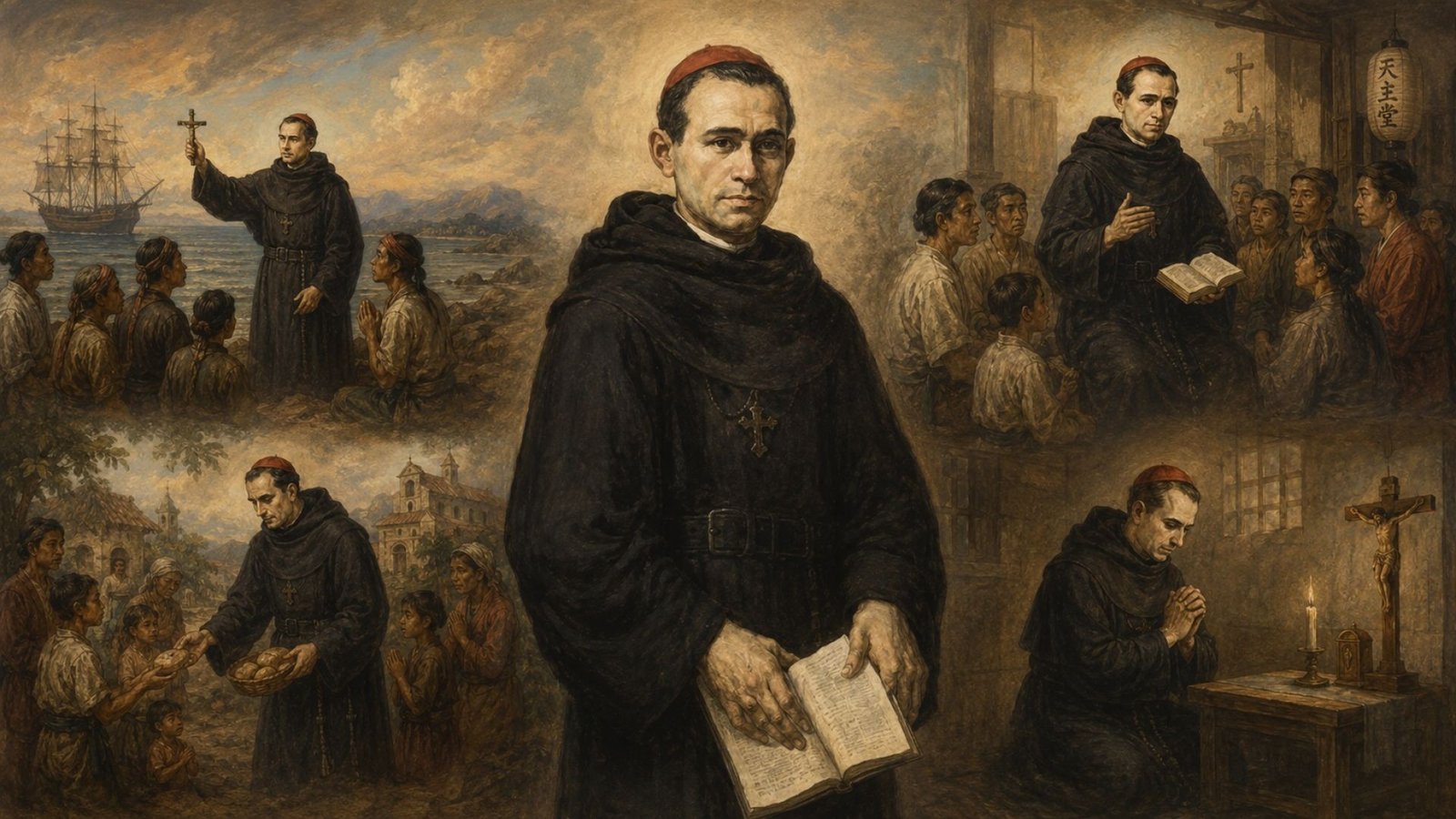
Many years earlier, under the scorching sun of the Philippines, he had travelled paths covered in lush vegetation, crossed rushing rivers, and visited remote villages where the scent of damp earth mingled with the ocean’s salty breeze. In Palawan, in Mindoro and, later, in Luzon, the faithful discovered in him a devoted shepherd.
An elderly sacristan in Las Piñas still remembered, decades later, that parish priest who seemed to live for God and for his people. He affectionately called him “the holy man”. He would see him moved during First Communions, attentive to every detail of the liturgy, and watching the children approach the altar with a joy that lit up his whole face.
For, although his appearance might seem austere, within him burned an inextinguishable fire: the love of God.
That love began very early. When he was barely a boy in Alfaro, a Dominican sister asked him what he wanted to be when he grew up.
—I am going to be a friar —he replied without hesitation.
The nun, amused by the child’s certainty, replied:
—A friar? But you are so small and such a “calandrajo”, why would the friars want you?
Ezequiel, without losing his composure, replied with a smile:
—Then I will put on a top hat to look taller.
The sister laughed heartily. But she did not imagine that this seemingly insignificant boy would become one of the great missionaries of his time.
His true greatness was not in his height, but in the depth of his love for Christ.
Prayer, the source of boundless charity
That love led him to leave Spain to evangelise the Philippines. It later led him to return to Monteagudo, where the poor, the sick, and the hungry always found the convent doors open. During the years of hardship in the Queiles region, long lines of men and women waited at the monastery gates. No one left empty-handed.
At times, when resources were scarce, Saint Ezequiel did not hesitate to part even with valuable possessions to help those most in need. For him, the face of the poor was the very face of Christ.
But those who lived with him knew the secret of that inexhaustible charity.
As evening fell, when the convent returned to silence, he would go to the choir or to the tabernacle. There he remained for long hours in prayer. The friars observed his recollection. They saw him motionless, absorbed, like someone speaking with an intimate friend.
From that encounter all his strength was born.
That is why he chose as his episcopal motto those words of the psalmist: Refugium meum et fortitudo mea es tu. “You are my refuge and my strength.”
That certainty sustained his entire existence. It sustained him when he crossed the ocean again to restore the Province of La Candelaria in Colombia. It sustained him when the churches once again filled with faithful drawn by his preaching. It sustained him during the long hours in the confessional, where countless people found forgiveness, guidance, and hope.
It also sustained him when he was appointed Apostolic Vicar of Casanare and, later, Bishop of Pasto.
And it sustained him, above all, when illness, slander, and pain arrived. For the cancer advanced slowly. First the throat. Then the tongue. Finally, the palate.
Every word he spoke became a sacrifice. Every bite of food, a trial. Every day, an offering. Yet he never lost his peace.
When he understood that the illness was irreversible, he did not ask for privileges or extraordinary treatments. He expressed only one desire: to return to Monteagudo and die beside Our Lady of the Way, in that convent where he had professed and where he had learned to love Christ.
And there, surrounded by his brothers, he serenely awaited the Lord’s coming.
The strength of Saint Ezequiel Moreno sprang from love
The morning of 19 August 1906 dawned calm. The golden light of the Navarrese summer gently streamed through the window of his room. Against all logic, he insisted on making his bed himself. His nurse tried to stop him, fearing the effort would exhaust him.
But Saint Ezequiel smiled. He wanted to leave everything in order.
Perhaps he sensed that that day he would receive the most longed-for visit of his life. Hours later, the Lord came to take him.
Thus ended the pilgrimage of the missionary, the shepherd, the friend of the poor, the one in love with Christ.
Today, whoever visits Monteagudo can still contemplate that silent room where his last days passed. Very nearby rests his incorrupt body, a visible testimony to a life given completely to God.
And as pilgrims draw near to pray before him, it is inevitable to think again of those Madrid doctors who operated on him that morning in 1906.
They admired his fortitude. But they never came to fully know the secret that made it possible. Saint Ezequiel’s strength did not spring from an exceptional character or an iron will. It sprang from love. From an immense love for Christ, who had conquered his heart forever.