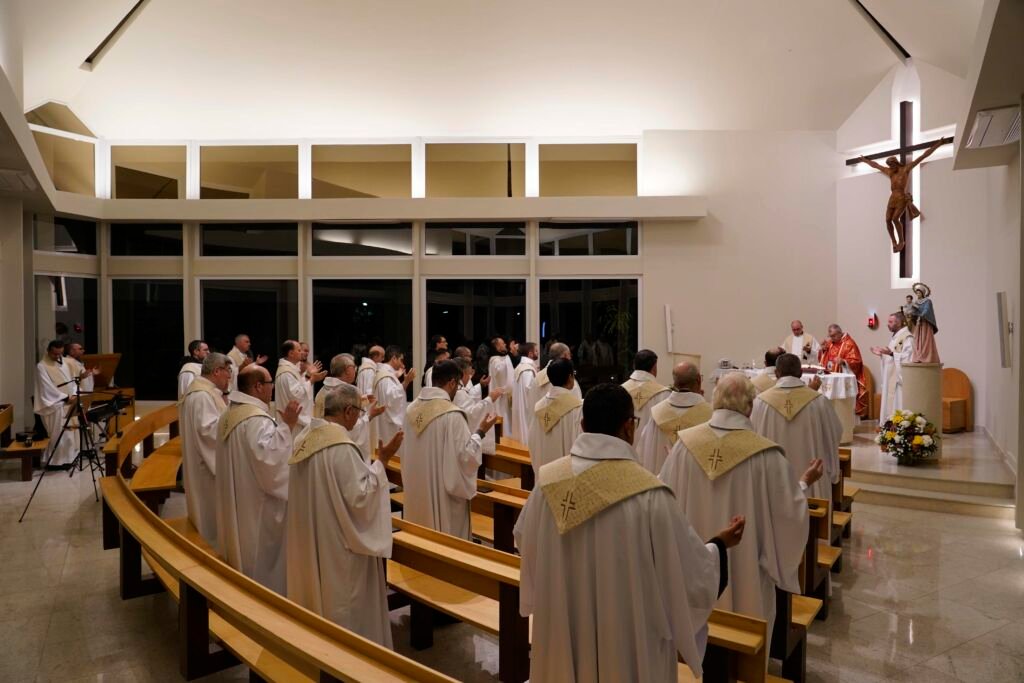

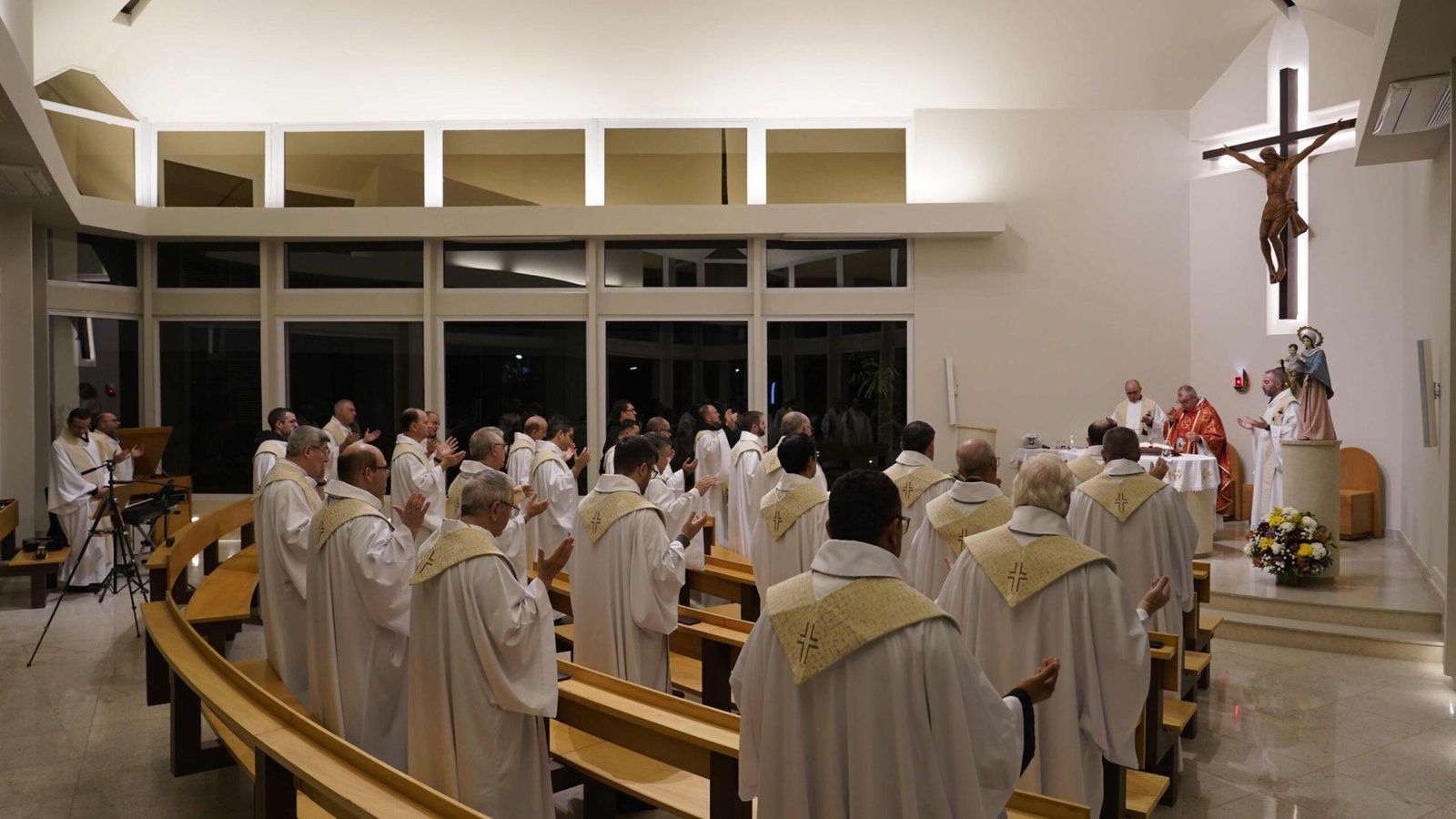
The Eucharist, presided over by the Prior General, Fray Miguel Ángel Hernández, officially opened the chapter proceedings with an invitation to live communal discernment through listening, prayer, and charity.
The Province of Saint Thomas of Villanueva of the Order of Augustinian Recollects began its 38th provincial chapter on July 13 with the celebration of the Eucharist of the Holy Spirit at the Sitio Santo Agostinho, in Rio de Janeiro (Brazil). The celebration was presided over by the Prior General, Fray Miguel Ángel Hernández, who invited the chapter members to understand this time as an authentic spiritual experience of discernment and not merely as a governmental process.
From the beginning of the homily, the Prior General outlined the profound meaning of the chapter:
“Today we are not simply beginning a provincial chapter. We are entering a time of grace, a time when the Lord gathers us as a community to listen to His voice and together discern the paths of the future.”
A chapter to seek God’s will together
Referring to the Council of Jerusalem narrated in the Acts of the Apostles, Fray Miguel Ángel recalled that the Church faced challenges from its earliest years that could only be resolved through communal discernment.
The Prior General highlighted the famous expression used by the apostles: “It seemed good to the Holy Spirit and to us,” emphasizing that the order of these words is not accidental.
“It does not say: ‘It seemed good to us, and we hope it seems good to the Holy Spirit.’ It first says that the Spirit goes first, and the community follows, discerning where it blows,” he explained.
Based on this biblical scene, he defined what the identity of every provincial chapter should be: “That is the program of every authentic chapter. This must be the heart of our chapter. It is not just about organizing, analyzing, and voting. It is about seeking God’s will together ”.
In this regard, he recalled that a chapter cannot be reduced to a parliamentary dynamic.
“A chapter is not a parliament. We do not come to defend interests, nor to impose majorities, nor to guarantee quotas. We come to listen,” he affirmed.
He even went further in describing the spiritual nature of this assembly: “The chapter, at its deepest root, is a prolonged liturgical act. It is an act of adoration expressed in the joint search for God’s will for our province at this moment in history.”
Listening to God also through our brothers
Inspired by Saint Augustine, the Prior General recalled that discernment is only possible through communion.
“Saint Augustine reminds us that God also speaks through our brothers. He knew that no one possesses the whole truth and that communion is not born when we all think alike, but when we all listen together to the one Teacher,” he pointed out.
Therefore, he encouraged the chapter members to cultivate humble and sincere listening throughout the chapter process.
“When a community listens with humility, dialogues with sincerity, and places Christ at the center, the Spirit finds space to act,” he assured.
Fray Miguel Ángel also expressed his wish that the conclusions of the chapter would not be solely the fruit of human effort, but of God’s action: “It will not simply be the fruit of our deliberations, but of the silent action of the Spirit in a community that allows itself to be led by Him.”
A house built by God
Meditating on the responsorial psalm, the Prior General recalled that all authentic renewal begins by placing God at the center.
“Unless the Lord builds the house, the builders labor in vain. We can work a lot, discuss a lot, plan a lot; but if the Lord is not at the center, everything becomes empty,” he affirmed.
Therefore, he invited them to live the chapter with a profound attitude of humility.
“We have to work, yes, but knowing that the work belongs to Another. We have to contribute, yes, but not pretend to control. We have to discern, yes, but not impose,” he pointed out.
And he added one of the central ideas of the entire homily: “Perhaps the best service we can offer these days is not so much the brilliance of our ideas, but the docility with which we let God build the Province.”
Abide in love to bear fruit
The reflection concluded with the Gospel of Jesus’ farewell discourse during the Last Supper.
The Prior General recalled that the ultimate foundation of any chapter decision is not structures or strategies, but love.
“It is not about doctrine, it is not about structures, it is not about regulations. It is about love. Abiding in the love of Christ is the condition for the possibility of everything else: apostolate, governance, renewal, and discernment,” he explained.
With the same force, he warned:
“A chapter that does not spring from love becomes a management meeting. A chapter born of love can change the course of a province.”
That love, he added, is the concrete love of Christ: “A love that washes feet; a love that goes out to meet those who err; a love that gives life; a love that goes beyond natural affinities, beyond generations, and beyond the different visions for the future of the Order and the Province.”
Three images for living the chapter
Before concluding the homily, Fray Miguel Ángel Hernández left the chapter members with three images to guide them during the working days.
The first was that of the apostles gathered in Jerusalem: “Men who disagreed, but who found the Spirit in the midst of their honest and fraternal discussions. The Spirit does not flee from conflict; when well managed, it inhabits and fertilizes it.”
The second was that of the house that only God can build: “A province, a community, an Order, a chapter, is always a work in progress. And here is the decisive point: we are not the main architects.”
Finally, he recalled the words of Jesus: “You did not choose me, but I chose you and appointed you so that you might go and bear fruit,” affirming that “the chapter does not create the vocation; it recognizes it and places it at the service of all.”
As a wish for the future, he expressed: “May when we have left Rio de Janeiro, we remember this chapter not for the documents we approved, but because here we learned once again to listen to the Spirit of the Lord.”
The homily concluded with a reference to the Rule of Saint Augustine and a prayer for the chapter proceedings: “May everything you do be done with love, in caritate, and may the love that unites us be more beautiful at the end of the chapter than at the beginning.”