


Each year, the Educational Innovation Awards become in Spain a major meeting point for educators, administrators, and professionals committed to the future of teaching. The final gala is the culmination of a series of projects that, through talent and effort, have developed disruptive methodologies already in use in classrooms and which, in this space, connect with other professionals and schools.
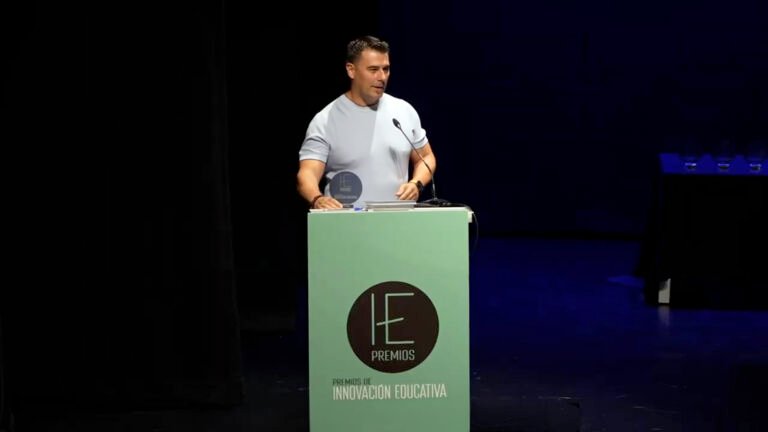
Málaga hosted the 8th edition of these awards, in which the “Pedagogical Use of Artificial Intelligence” category featured the Saint Augustine High School of the Augustinian Recollects in Valladolid. According to the jury, the school has been a pioneer “in integrating Artificial Intelligence in an ethical, brilliant, and truly useful way for learning.”
This competition, organized by the Trébol Educación Foundation, has recognized Saint Augustine High School for a model that transforms learning and places students within the so-called Nexus Ecosystem, a comprehensive platform conceived and promoted by the school’s ICT coordinator and teacher, Ibán de la Horra. Nexus, designed specifically for daily school life, connects two complementary environments: the student body (Nexus Student) and the teaching staff (Nexus Teacher).
One of the most common experiences in the daily lives of new generations is interactive and cooperative gaming. This context is leveraged and used to give students access to virtual laboratories, challenges, and simulators for the disciplines of Science, Technology, Engineering, Mathematics, and Arts&Design.
Teachers have access to an analytics panel that monitors the group’s competency progress in real time, helps detect doubts early, and provides much more personalized final attention.
The aspect most valued by the jury was the pedagogical and ethical approach to Artificial Intelligence. It ceases to be a shortcut for obtaining automatic answers and acts as a learning co-pilot: it offers gradual hints, poses reflective questions, and helps the student identify where they have gone wrong, turning the error into an opportunity for reasoning.
Each student neither memorizes nor delegates their efforts: they investigate, experiment, and consolidate their own critical thinking. The impact is palpable every day in the classroom: increased motivation, respect for individual learning paces, education in digital citizenship, and students use AI responsibly, consciously, and constructively.
At Saint Augustine High School, AI doesn’t provide ready-made answers, but rather formulates the right questions to encourage students to think for themselves, as Ibán de la Horra summarizes: “What we have presented is a mathematical ecosystem for secondary school. Through gamification and the feedback provided by AI, we are able to develop an individualized methodology for each student.”