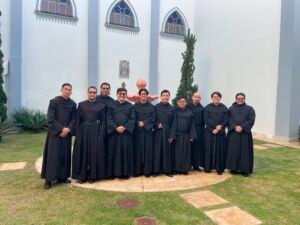

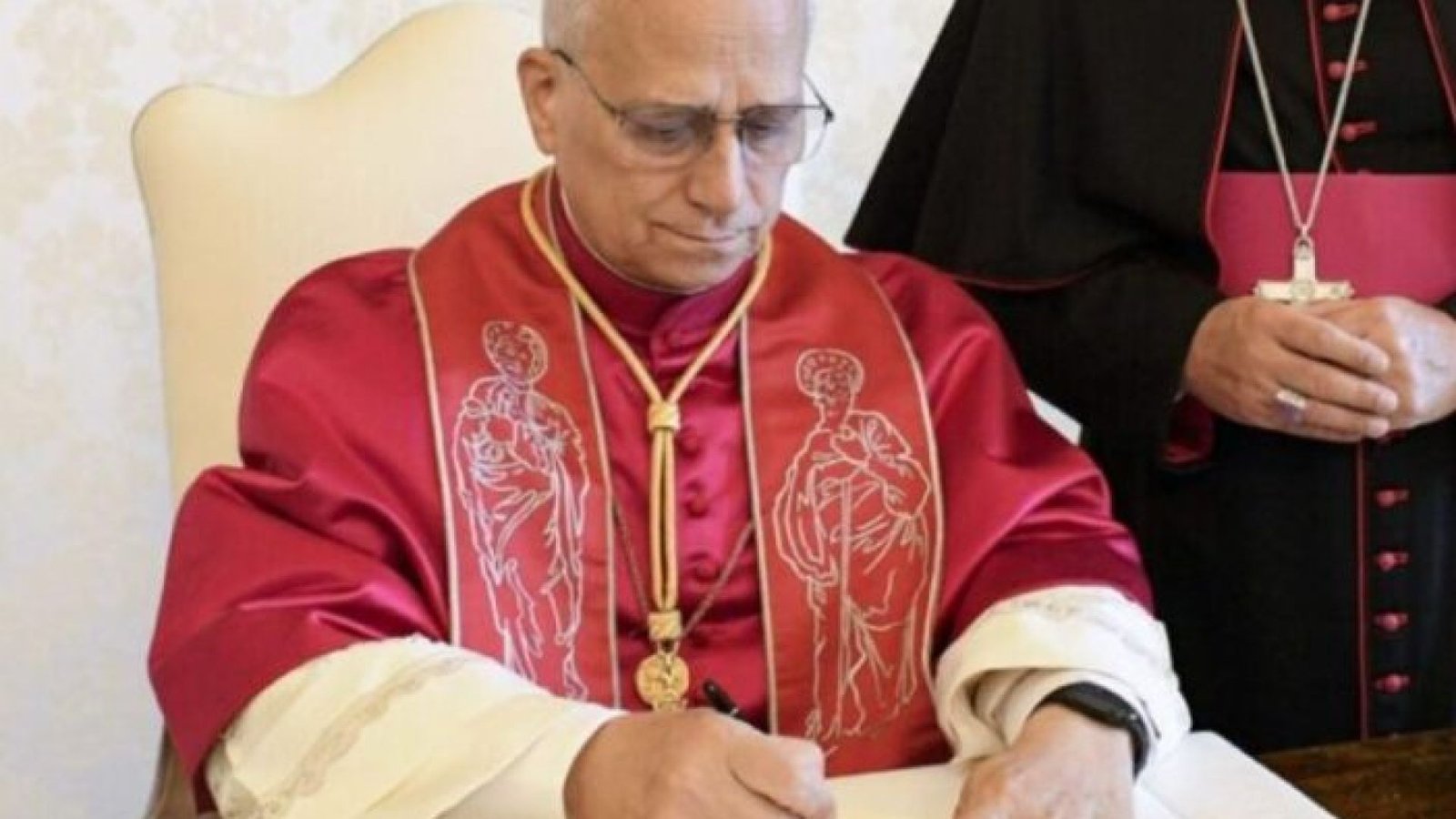
Msgr. Mario Alberto Molina, OAR , Archbishop Emeritus of Los Altos (Quetzaltenango), offers a critical reading of Pope Leo XIV’s encyclical Magnifica humanitas. In this analysis, he reflects on its contribution to the development of the Church’s social doctrine, especially in relation to artificial intelligence, and raises the need for the proclamation of Jesus Christ and eternal life to always remain at the center of the Church’s evangelizing mission.
Leo XIV and the Continuity of the Church’s Social Doctrine
The encyclical fulfills a desire expressed by Pope Leo XIV since his election in May 2025. When he explained the choice of his name, he stated that he wanted to link his papal ministry to that of Leo XIII, his predecessor more than one hundred twenty years earlier. That pontiff, with his encyclical Rerum novarum (On New Matters), had initiated reflection on the social transformations underway; with the collaboration of subsequent pontiffs, those reflections would give substance to what is known today as the Church’s social doctrine.
Leo XIV wished to respond, through his ministry, to the new situations created by the development of information technology. Months later, comments began to circulate according to which the Pope was indeed preparing a social encyclical to address the anthropological and ethical challenges posed by the development of artificial intelligence. The encyclical was signed on May 15, 2026, on the one hundred thirty-fifth anniversary of the publication of Rerum novarum. It was received with very favorable comments, although it also received criticism. After having read it, I write these lines to express my opinion to those who have requested it and to those interested in knowing it.
The encyclical consists of an introduction, five chapters, and a conclusion. In the introduction, Pope Leo XIV clearly explains his desire to link himself to Leo XIII’s initiative and also contribute to reflecting on ‘the new matters‘ of our time, just as that pope opened reflection on “the new matters” of his era.
That is, Leo XIV considers reflection on social questions—such as the impact of artificial intelligence on humanity and society—a task of the first order and the central reason for his pontificate. However, it is my conviction that many believers expect from the Pope, bishops, and priests the proclamation of the central themes of the Gospel: Jesus Christ, his death and resurrection, which open horizons of transcendence capable of giving meaning and consistency to human life. These are the themes that many believers demand to hear from their pastors.
Reflection on ethical problems in the social and cultural sphere is part of the Gospel, but it is subordinate to the main theme of the Church’s mission. Moreover, those central themes are not absent from Pope Leo XIV’s speeches.
In the introduction, the Pope uses two images that serve as inspiration for his reflection. The Tower of Babel, narrated in Genesis 11:1-9, symbolizes the human pretension to establish itself in self-sufficiency and pride. The other image is the reconstruction of Jerusalem’s walls after the exile, recounted in Nehemiah 2–6, which represents the effort to build a city in which all collaborate, not from individual pride, but from awareness of one’s own limitations and the need for cooperation and coordination under Nehemiah’s leadership.
In the choice of these images by a Pope of Augustinian identity, one intuits the famous two cities proposed by St. Augustine in The City of God. In fact, the Pope cites St. Augustine in number 130, at the end of chapter III. The earthly city is built by love of self to the point of contempt for God; the city of God, by love of God to the point of contempt for self.
In St. Augustine, the construction of the city of God is animated by a vision of transcendence, by awareness of the transience of this world, and by aspiration to eternity. That perspective is completely absent in Pope Leo XIV’s explanation of Nehemiah’s effort to rebuild Jerusalem and also in the social approach he proposes regarding the society that must be built.
In fact, when in the conclusion he explains what the purpose of human social effort should be, he says, citing an earlier pronouncement of his:
The hope we proclaim […] comes from heaven, but to generate a new history here below; precisely for this reason, whoever believes commits himself so that, instead of inequalities, there may be more justice and so that, instead of the industry of war, the craft of peace may be affirmed (n. 240).
Those words of St. Paul spontaneously come to my mind:
“If our hope in Christ is limited only to this life, we are the most pitiable people of all” (1 Cor 15:19).
The word ‘heaven’ appears nine times in the text, but never as the definitive destination of human life, except when the builders of Babel pretended to reach it.
Curiously, in number 232 of the conclusion, when wanting to give a Christological foundation to the commitment to resolve temporal problems, the text cites Pierre de Bérulle and alludes to Christ’s life as a model for human action, but omits all reference to the resurrection:
We have, as our faith teaches us and we elucidate in our mysteries, a God who is born in the cradle, a God who lives and travels through Judea, a God who dies on the cross, and a God dead and buried.
Is the resurrection not pertinent? Does it have no value? Is it not real?
There is a paragraph in which the Pope speaks of transcendence. In number 127 he clearly affirms that it is Christian doctrine that “the human being is not enclosed within the limits of his own nature, but is called to transcend himself, not to flee from reality or despise the limit, but to fulfill himself in love. Faith knows a ‘beyond’ that is born from God’s gift. This transformation is the work of the Holy Spirit.”
However, that transcendence is not presented as a definitive destination or as the ultimate vocation of the human being, but only as an aid to walk within the limits of this world. We return, therefore, to remaining within the horizon of temporality.
An Anthropology Centered on Artificial Intelligence
The author of the encyclical is aware that his approach is secondary to the primary end of the Church and evangelization. In number 33 he alludes to the introduction of the encyclical Mater et magistra (nn. 2-3) by St. John XXIII and summarizes it by affirming that “although the Church has as its principal mission sanctification and the proclamation of eternal goods, it does not for that reason neglect the concrete needs of people’s daily life.”
In the current historical juncture, it seems essential to me that the Church affirm and develop precisely that principal mission, for it is what the faithful seek in it. Concerns for temporal needs are important, but they do not fully respond to the deepest demands of those who seek meaning for their lives in faith in Jesus Christ. Therefore, the text of the encyclical remains, to a large extent, within the horizon of immanence.
The five chapters develop with great programmatic clarity. The first traces the history of the Church’s social doctrine to situate Leo XIV’s magisterium within the development of the social encyclicals of the twentieth century. The guiding thread has always been the defense of human dignity against the threats that have endangered it: industrialization, wars, totalitarian regimes, and, today, artificial intelligence.
The second chapter is, in a certain sense, a summary of chapter four of the Compendium of the Social Doctrine of the Church. Pope Leo XIV reviews and proposes anew the principles that articulate and ground this doctrine.
First, the human person and his non-negotiable dignity constitute the foundation of the entire social discourse of the Church. In number 53 he offers an acceptable interpretation of what Pope Francis called the ‘infinite dignity’ of the human person. The infinite character of that dignity is not an inherent quality of man, who remains a finite creature; it comes to him because God has loved him with an infinite love and because that dignity can never be revoked or suppressed.
However, the vocation to eternal life, to which every human being is called according to Christian anthropology, is never mentioned as a constitutive element of that dignity. Moreover, the expression ‘eternal life’ appears only once in the entire encyclical, in number 3, when recalling Leo XIII’s response to those who objected to the publication of Rerum novarum, arguing that the Church should concern itself solely with communicating the message of eternal life.
According to Pope Leo XIV, his predecessor responded that the Church must also concern itself with the daily life of men. The problem is that the men and women of our time expect with ever greater intensity that the Church speak to them precisely about eternal life and propose to them the path to attain it. The human being needs horizons of eternity to live his temporal existence with meaning.
The Pope then develops the meaning of the other principles of the Church’s social doctrine: the common good, the universal destination of goods, subsidiarity, solidarity, and social justice.
When he addresses integral human development, in numbers 82 to 85, one expects to find at least a reference to the fact that this development reaches its fullness in God, in eternal life. But this does not happen. Integral development remains anchored in temporality. That, in my judgment, is not a fully Christian anthropology, nor properly Augustinian.
The Great Achievements of Magnifica humanitas
The third chapter contains the encyclical’s principal contribution. It is a defense of the dignity of the human person against the threats posed by the development of artificial intelligence.
Although the approach continues to move within the horizon of immanence, the thought is lucid in its discernment, intuitive in identifying the dangers that artificial intelligence represents for humanity, profound in understanding the logic that governs these technologies, and truly novel as a development of the Church’s social doctrine. It is, probably, a chapter hardly surpassable within its genre and the limits it imposes on itself.
Pope Leo XIV begins this chapter by formulating a question inspired by the images of Babel and Jerusalem:
What are we building by developing artificial intelligence? A Tower of Babel, fruit of human pride, destined for failure and the dispersion of humanity, or the walls of Jerusalem, fruit of everyone’s collaboration to build a habitable city?
And he adds:
If technological development advances without adequate ethical and social maturation, it may happen that means increase without humanity growing to the same extent (n. 94).
Based on the fundamental principles of the Church’s social doctrine, the Pope conducts a moral discernment of the development and use of artificial intelligence to guarantee the primacy of the human person,
so that it may always be human intelligence, with its conscience and freedom, that guides technical innovations and responsibly establishes their use and limits (n. 97).
Number 99 is particularly brilliant. It warns of the error of comparing human intelligence with artificial intelligence. The latter can imitate certain intellectual functions, but remains limited to data processing. Its knowledge does not arise from experience, it lacks feelings, and it does not possess moral conscience.
The Pope equally alerts to the danger of leaving in the hands of algorithms decisions that require freedom and conscience, as well as the real risk that the human being may end up subjected to the instrument he himself has created.
We cannot consider AI as morally neutral. […] If a system is conceived or employed treating some lives as less worthy, or excludes them without possibility of appeal, it is not a simple instrument that “must be used correctly”; it already introduces a criterion that contradicts the inalienable dignity of the person (n. 104).
Nevertheless, the Pope manifests both in this chapter and in the following ones a perhaps excessive confidence in the State, in national political institutions, and in international organizations as bodies capable of ethically regulating the development of artificial intelligence.
However, the State is formed by sinful men—a reality of which the encyclical never speaks—often capable of directing the use of artificial intelligence toward illicit ends rather than truly putting it at the service of the common good.
Evangelization and Eternal Realities, the Great Challenge
The fourth and fifth chapters are more debatable. In them, the practical consequences of the use of artificial intelligence in different spheres of social life are analyzed.
The fourth chapter addresses truth, communication, and artificial intelligence’s capacity to manipulate information. It also reflects on its influence on education and on the way it can compromise the school’s proper mission. It equally analyzes the threats it poses to the world of work and its consequences for employment, going so far as to speak of the “paradox of material progress and anthropological regression” (n. 154). Alongside work, it studies the national and global economy, increasingly conditioned by algorithmic decisions. The chapter concludes with a reflection on the safeguarding of freedom.
The fifth chapter prolongs this same dynamic, transferring the analysis to other spheres such as the management of political power and decisions related to war. It is written with true passion for humanity and extensively develops the consequences that artificial intelligence can have, especially in the military sphere. It even goes so far as to predict the end of wars and conflicts, although without proposing an evangelization to sustain that hope.
Frequently, both in the fourth and fifth chapters, the Pope descends to proposing concrete decisions and lines of action that, in my opinion, do not correspond to the ministry of a pontiff or, in general, to that of a cleric. These are prudential decisions that could legitimately be resolved in diverse ways.
The Pope seems to assume that those who act in those social spheres are Christians with a conscience formed by the Gospel. However, he barely seems to consider that the majority of those actors are not even believers and, even less, that their moral logic is configured by Christian faith.
At no point does he clearly propose what constitutes the Church’s proper mission: the conversion to the Gospel of those who exercise political, economic, technological, or cultural responsibilities. The word ‘conversion’ appears only five times in the entire encyclical and always in generic expressions such as ‘paths of conversion’, without an explicit reference to Jesus Christ.
Only in the conclusion, from number 229 onward, does a timid allusion to the evangelizing task appear, although it seems more like a final addition than a true pastoral proposal.
Undoubtedly, the encyclical incorporates a significant contribution to the development of the Church’s social doctrine. Particularly, the third chapter manifests analytical, perceptive, articulated, and propositional thought of great quality.
However, I expected that the first encyclical of Pope Leo XIV, in the current situation of the Church, would have developed more extensively the proclamation of eternal realities: God’s love, his compassion for humanity, the sending of his Son Jesus Christ, dead and risen for the forgiveness of sins, the opening of the path to eternal life, and man’s vocation to live with God now and forever through the action of the Holy Spirit.
Pope Leo XIV is still relatively young. I do not lose hope that the encyclical many of us await will arrive in the near future. May it be that, just as Leo XIII was a pioneer in incorporating ‘new matters’ into papal magisterium, Leo XIV may also become a pioneer in powerfully recovering for the universal Church its mission and its most proper discourse: to proclaim eternal realities and offer humanity—troubled by the vagaries of freedom and the threat of death—the meaning of life that springs from the redemptive work of Jesus Christ, who opened the path to the Father so that the hope of eternal life may illuminate and give consistency to our temporal existence.