
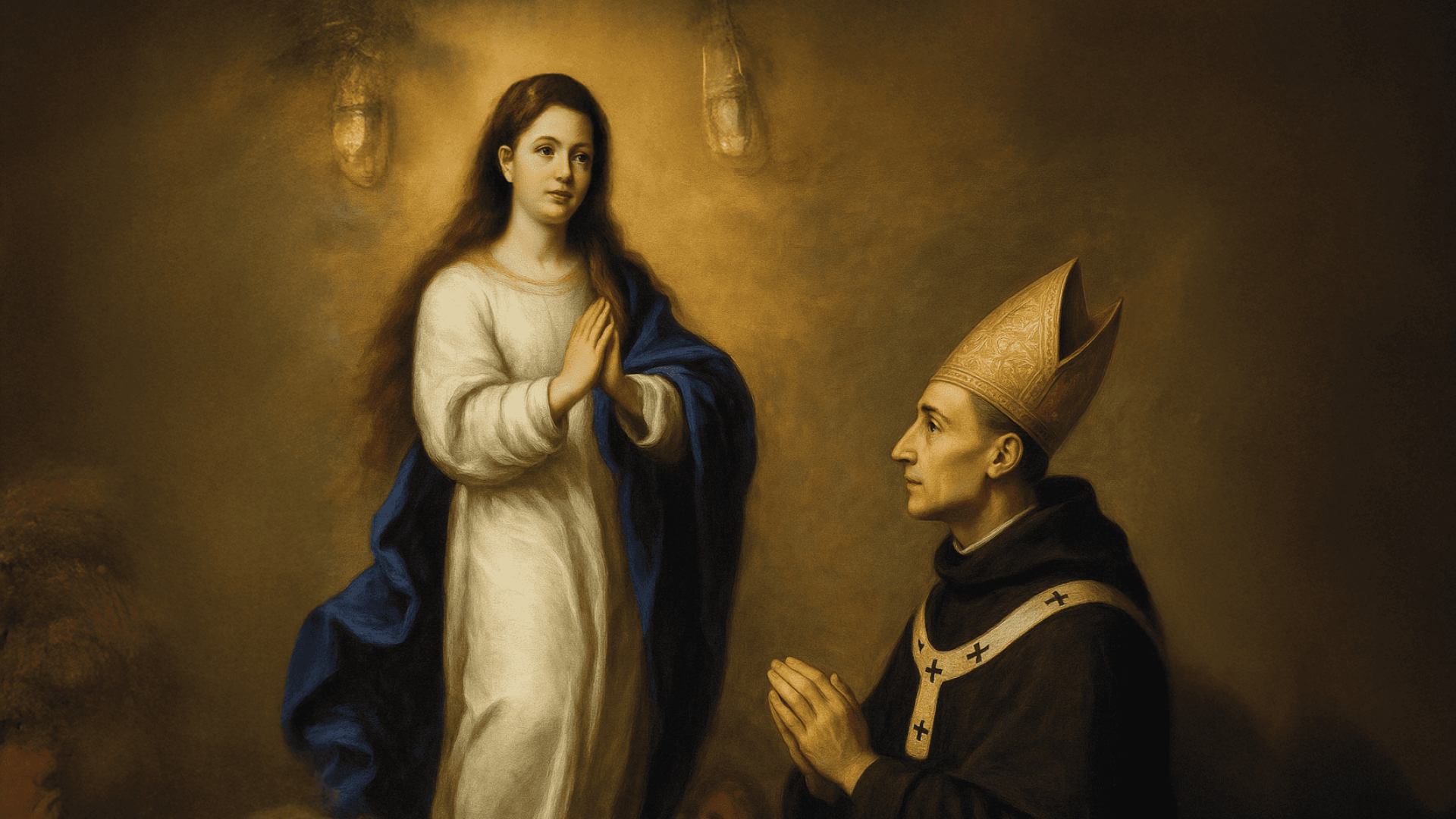
Today the Church celebrates the Solemnity of the Immaculate Conception of Mary. For this reason, Friar Alfonso shares some lines on how Saint Thomas of Villanova—three centuries before the dogma—preached about the sinless conception of the Virgin.
When one feels that he is late
Many times I feel that I am late for things. It is a feeling that constantly accompanies me in my life as a consecrated person, as a Christian, as a son, and as a brother. But today I find a little consolation: there are saints who are late to dogmas… and saints who, without knowing it, arrive earlier.
Saint Thomas of Villanova clearly belongs to the second group. He died in 1555, three centuries before Pius IX proclaimed the dogma of the Immaculate Conception in Ineffabilis Deus (1854). But it is enough to delve into his Marian sermons to discover that, although he did not know the dogmatic definition, he did know—and proclaim—the truth that that definition would seal forever.
A surprising clarity for his time
What is admirable is not only that he defended the unique holiness of Mary, but the theological precision with which he speaks of her sinless conception. In an era in which the question was still being debated, Thomas preached with the naturalness of someone who contemplates something obvious.
Already in Sermon I, he affirms that Mary “was conceived without sin; because, if she had not been exempt from guilt, neither would she have been from punishment” . It is not a rhetorical detour: it is a clear, direct, and forceful affirmation.
In Sermon III, he explains it more clearly and poetically: “Oh Mary!, you appeared immaculate in your conception” . That a preacher from the 16th century uses exactly that expression should surprise us. Later, he insists in the same line: Mary is “similar for the lack of sin, similar in the conception without stain” . It is difficult to find a more precise formulation of the core of the dogma.
Absolute purity: neither original nor venial
Saint Thomas not only excludes original sin: he even excludes all shadow of venial sin. He affirms of the Virgin “not to see her body stained with the most subtle venial sin”.And he supports his conviction in Saint Ambrose: “This is the rod that did not have the knot of original sin nor the bark of venial sin” .
He also introduces an idea that clearly anticipates the notion of preservation: Mary “always kept intact the grace that she received from the beginning, without throwing it away through sin.” In case there is any doubt, he adds: Mary “could not even think of sin” .
A dogma that recognizes, not invents
All this shows that the definition of 1854 did not invent anything: it solemnly and definitively recognized a theological intuition alive in the Church for centuries.
Saint Thomas of Villanova—like so many other saints—contemplated before what the Church would formulate later. For him, the Immaculate was not a matter of dispute, but a spiritual evidence: Mary is full of grace because she was never empty of it.
The teaching we need today
In a time when many reduce faith to consensus or calculations, the voice of a saint from the 16th century reminds us that: dogmas are born from prayer, not from bureaucracy; from contemplation, not from calculation; from the experience of God in the saints, not from abstract theories.
The Immaculate is not a concept. She is a woman. And saints like Thomas of Villanova saw her as she is:
without any shadow that extinguishes the brightness of God in her life.