


Biographical Note: A Life Between Memory and Fidelity
In rural post-war Spain, in the small town of Brullés in Burgos,
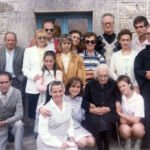
Family testimonies allow us to glimpse that first face of Father Ángel, prior to the historian. His sister Guadalupe remembers him as a child who was “affectionate, cheerful, humble, generous, and very hardworking,” without lacking the mischief typical of his age. His brother Luis completes the picture: “extroverted, a friend to his friends… with a great heart,” to the point that when others proposed going to pick fruit from other people’s orchards, he would respond naturally: “let’s go to mine, it’s closer.” It was not merely a childish remark: it was already a way of understanding life as a gift.
Carmen, another of his sisters, provides specific memories that reveal that human foundation. She recalls how, as a young boy, he shared with her a cheese that his mother had saved, keeping nothing for himself. Or how he responsibly assumed household and school tasks, showing an inclination toward work that everyone recognized. These are simple scenes, but in them the foundation of his life already appears: generosity, closeness, sense of duty.
Early Vocation, Defined Path
That family environment soon found continuity in religious life. While his older brother entered the minor seminary of the Augustinian Recollects in Lodosa (Navarre, Spain), Ángel would begin his own path years later in those same seminaries, first in Lodosa and then in Fuenterrabía (Guipúzcoa, Spain), between 1949 and 1956.
There he not only acquired academic formation, but also an interior discipline that would mark his life. His family members recall that even then he stood out for his pleasant conversation, his capacity for relationships, and his good academic results. He was a young man who made himself loved, without ever losing his simplicity.
In 1956 he entered the novitiate in Monteagudo (Navarre, Spain), where he professed the following year. Theology in Marcilla (Navarre, Spain) completed his formation until his priestly ordination in 1961. Everything seemed to direct him toward an ordinary pastoral life, perhaps in mission. But his itinerary would soon take an unexpected turn.
From the Philippines to Rome: A Decisive Call
After his ordination, he spent a brief period in Manila (Philippines), dedicated to the study of English and sociology. That experience, which could have marked his definitive destiny, was interrupted by a call that would change his life.
In 1962 he received the order to move to Rome (Italy) to specialize in Ecclesiastical History. It was not a sought decision, but one accepted. This fact is not minor: it defines a constant trait in his biography, availability. From then on, Rome would become his permanent home and the space where his vocation would acquire its definitive form.
At the Pontifical Gregorian University he obtained his licentiate (1964) and doctorate (1972), with a thesis on the socio-religious history of the island of Negros (Philippines), distinguished with the gold medal of the University. It was the beginning of a trajectory marked by rigor, patience, and constant dedication to sources.
Historian of the Order, Servant of Memory
Since his arrival in Rome, Father Ángel’s life became inseparably united with the history of the Order of Augustinian Recollects. For more than forty years he cared for the General Archive, and for three decades (1973-2004) he directed the Historical Institute. In 1978 he founded the journal Recollectio, which remains an indispensable reference today.
His output is extensive and decisive: biographies such as that of Saint Ezekiel Moreno (The Path of Duty, 1975) or Father Jenaro Fernández; the editing of the saint’s correspondence; his collaboration in the Dizionario degli Istituti di Perfezione; and, especially, the monumental History of the Augustinian Recollects, a work built over decades.
But beyond the titles, there is a fundamental key: his way of understanding history. Not as an accumulation of data, but as a search for meaning. Not as a cold exercise, but as service to the identity of a community.
The Man: Between Approachability and Rigor
Those who have lived with him agree in emphasizing a trait that runs through his entire life: coherence. His brother Luis describes him as “a very simple and humble person, who treats everyone equally, never showing off his knowledge.” That discretion has been a constant: an intellectual without ostentation, a scholar without distance.
That closeness also appears in his way of communicating. From a young age—his family recalls—he made conversation a living space, capable of turning any account into a shared experience. It is no coincidence that, on family trips, he was the one who explained the history of the places they passed through, making the journey a lesson.
The testimony of his fellow student, Francisco Javier Legarra, confirms that impression: a man of privileged memory, analytical spirit, and great capacity for synthesis, profoundly rooted in his Augustinian Recollect identity. A historian who is not a “dilettante,” but someone whose work is born from love for what he studies.
From Word to Silence
With the passing of years, his personality has evolved toward greater interiority. His sisters perceive a significant change from his dedication to the figure of Saint Ezequiel Moreno: more recollected, more focused, more silent. As if contact with sanctity had refined his gaze.
It is not a loss, but a maturation. The historian who began narrating with vivacity has learned to listen. The researcher has made space for the contemplative. And in that process, his life has gained in depth.
A Life That Challenges
Who, then, is Father Ángel Martínez Cuesta?
He is, without doubt, a rigorous historian, a faithful priest, a religious profoundly identified with his way of living, an Augustinian Recollect who has lived, lives, and will continue to live his charism with passion. But, above all, he is a man who has made his life a bridge between memory and the future.
He belongs to a generation that has seen the Church and the world transform. He has passed from the rural Castilian environment to the Rome of the Second Vatican Council and globalization. And yet, he has maintained a constant: the search for truth from fidelity.
His life cannot be understood without the Order, but the Order cannot be understood today without his contribution. Because in a time marked by fragmentation and forgetfulness, his work has been—and continues to be—an act of resistance: safeguarding memory to sustain identity.
And perhaps therein lies the key to this entire journey. Before the travels, before the archives, before the books, there is a story that explains everything: that of a village boy who learned to share the little he had… and ended up dedicating his life to offering others the treasure of memory.