
In February 1626, an Augustinian Recollect friar arrived in Rome after one of the most extraordinary journeys of the 17th century. Friar Rodrigo de San Miguel brought with him a letter signed by Christian princes of Chaldea that would change the course of a mission and deeply impress Pope Urban VIII.
A Dawn in Rome and a Decisive Audience
Rome dawned enveloped in a golden haze that February 28, 1626. Winter still held its breath, but among the roofs of Trastevere and the domes that stood like marble islands, the sun began to appear, warm and lazy. In the Apostolic Palace, the Swiss Guards moved with ritual precision, and the servants polished the marble floors as the aroma of nocturnal incense slowly dissipated.
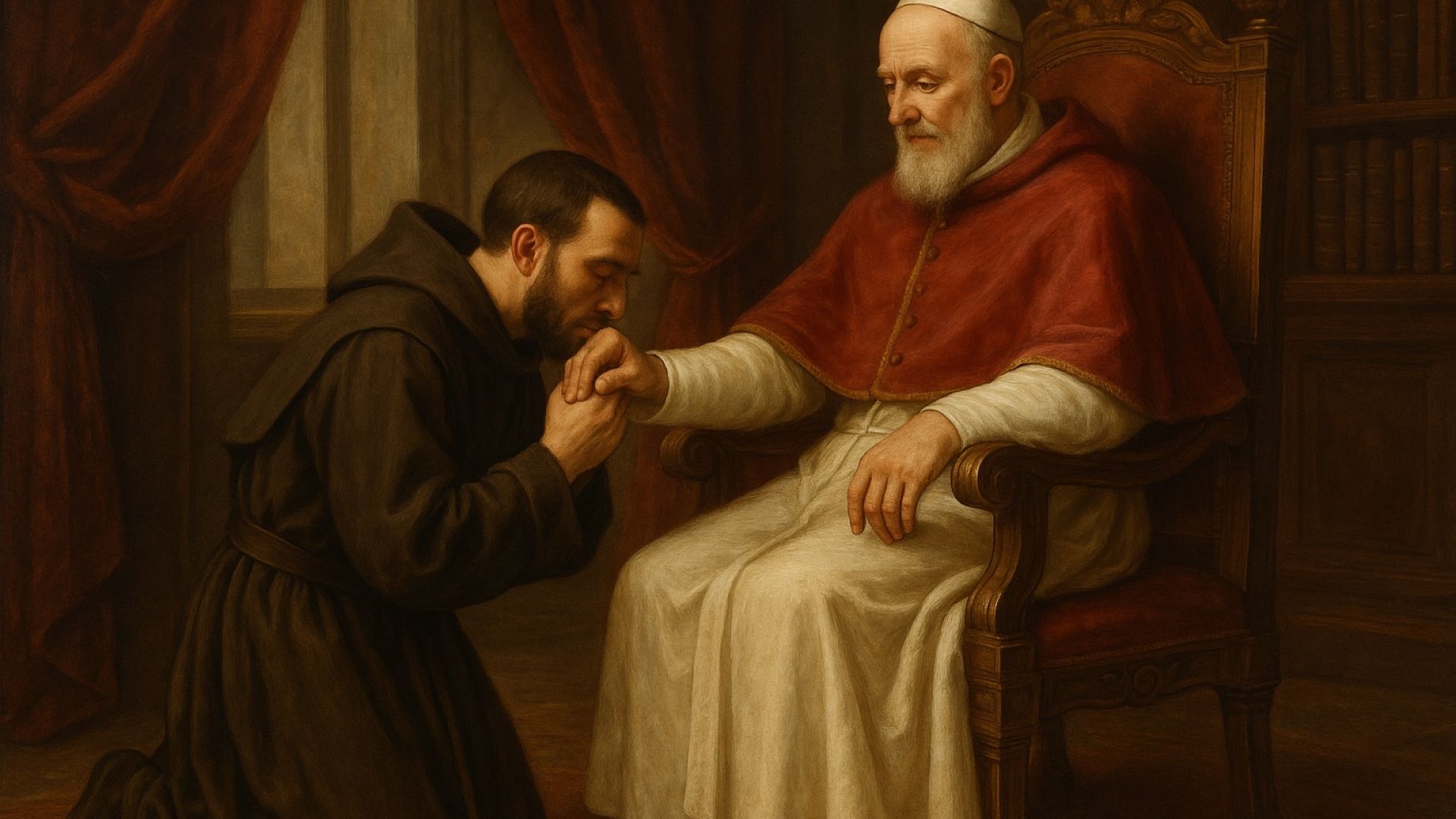
In the anteroom of the pontifical audience waited the Duke of Pastrana, with the patience of one accustomed to the solemn rhythms of the Roman Court. His cape, of a muted red tone, seemed to drink the light that entered through the high windows. Behind him advanced a friar with a weathered face and long beard, whose dark, lively, and attentive eyes seemed to encompass the entire room with a mixture of humility and determination. Beside him, a man of oriental features, coppery skin, and serene gaze, walked with measured steps, as if each one were a reverence.
The chamber prefect announced their entrance. The enormous doors opened with a deep sound, and the group advanced towards the presence of Pope Urban VIII.
The Sealed Letter: Twenty-Five Princes of Chaldea Return to Rome
The Pope, seated on his throne, looked up. That morning he had already received bishops, ambassadors, and prelates, but the figure of the friar immediately caught his attention. It was not his attire nor the beard that seemed to mix road dust and monastic discipline; it was the intensity fixed in his eyes, a flame that betrayed something that only travelers of impossible routes carry with them.
The oriental man knelt immediately, bowing his head until it almost touched the ground. The silence became thicker, as if the air had decided to listen.
The Duke stepped forward:
—Holy Father, I present to you Friar Rodrigo de San Miguel, of the Congregation of the Augustinian Recollects. He brings with him a message of great importance for the Church.
The friar bowed his head and, when speaking, his voice filled the room with an unexpectedly elegant cadence:
—Most Holy Father, I have come from the ends of the East to deliver a letter to you…, a letter that could well have cost me my life.
When the Pope broke the seal and unfolded the parchment, the rustling echoed in the room like a whisper of centuries. There were twenty-five signatures: twenty-five Christian princes of Basra, in Chaldea—today Iraq—, who declared their renunciation of the Nestorian rite and doctrines and proclaimed their adherence to the Catholic Church and their obedience to the successor of Peter.
An Impossible Journey: From Manila to the Eternal City
—I left Manila on December 24, 1622 —began Friar Rodrigo—. I did not take the usual route to return to Spain; prudence advised against it. I headed towards the Moluccas Islands, skirted the coasts of Borneo, continued through Sumatra, and then arrived in Ceylon. Afterwards, I reached India…
As he spoke, the room seemed to vanish. Rome was left behind, replaced by spice markets where cinnamon mingled with cardamom; by humid jungles where insects sang as if in a hurry; by burning coasts where ships groaned under the weight of the tides.
Rescues, Persecutions, and Dialogue with Nestorian Christians
—In India I found several Filipinos sold as slaves by Moro Joloano pirates —he continued—. Their faces were marked by hopelessness…, but I was able to pay their ransom, and they returned to their homeland.
From Goa he crossed the Strait of Hormuz. There the wind smelled of salt and scorching sand. He arrived in Persia and, later, in Chaldea. There he found the Nestorian Christians. He spoke with them for a long time. And, moved by the truth of the Gospel, twenty-five princes decided to join the Catholic Church and asked him to take the letter to Rome.
The Astonishment of Urban VIII and a Trusted Mission
The Pope looked up. In his eyes there was an almost childlike astonishment.
—This is the work of God —he said with a broken voice.
Moved by the account, Urban VIII proposed to Friar Rodrigo the episcopate and the patriarchate of those kingdoms. The friar bowed deeply:
—Your Holiness must forgive me, but I cannot accept that honor. If it is your wish, I will return to those lands to lead the mission, provided that my superiors allow it.
Chronicles, Memory, and Projects for the East
The following weeks were a tapestry of encounters, words, and confidences. The Pope asked Friar Rodrigo to return a second time. He listened to him speak of the Philippines, of towns founded between mangroves and mountains, of churches erected between machetes and rains.
Urban VIII was so captivated that he entrusted his private chamberlain, Monsignor Sanccio, to go every day to the house of the Recollects on the Via Sistina. At night, the Pontiff listened to the stories with the same delight with which a child listens to an exotic tale.
Friar Rodrigo wrote a detailed chronicle of his journey, which the Pope kept in the Barberini Library, and ordered the organization of a mission to Persia and Chaldea with him at the head.
The Last Journey and Death in Elorrio
Having concluded his mission in Rome, Friar Rodrigo began his return to Spain accompanied by his Filipino secretary Miguel Calimpas, one of the first natives baptized by him in Zambales. Ill in Genoa, he continued the journey driven by a desire that consumed him: to launch the mission dreamed of by the Pope.
Upon arriving in Spain, he visited his uncle, Bishop Juan Moriz de Salazar, in Huesca. Afterwards, he departed for Elorrio, where his family lived. There he died on December 26, 1626, at barely 42 years old.
Missionary Legacy of a Universal Augustinian Recollect
His works, his travels, his rescues, his dialogues, and his writings born between storms and sleepless nights remained. Friar Rodrigo de San Miguel was, in the fullest sense, an Augustinian Recollect of universal horizons.