


August 19, 2006, marked the 100th anniversary of the death of Saint Ezekiel Moreno (1848-1906), the only Augustinian Recollect saint. A missionary, mentor of missionaries, and bishop, he evangelized on three continents (in Spain, the Philippines, and Colombia) and is today the patron saint and companion of cancer patients and their families.
That day, the celebration was presided over by the then Prior General of the Augustinian Recollects, Javier Guerra, and the location could be none other than the convent of Monteagudo (Navarre, Spain). It was here, in fact, that the saint had begun his religious life and concluded his earthly life. His remains rest here, and most of his belongings are preserved here.
Immediately after his death in 1906, his superiors ordered that his personal belongings and the places associated with his final days be preserved, and they have been safeguarded intact for a century. But, after so much time and with Ezekiel now canonized, it seemed necessary to present his figure, his spirituality, his work, and his possessions to the public. And, with this aim, a permanent exhibition was prepared and inaugurated on the centenary of his death.
This exhibition space has since welcomed numerous devotees and visitors, who have come into contact with the saint through personal objects that bring visitors closer to his real and tangible life. Over time, the exhibition has grown in popularity as the number of visitors, many of them foreigners, and especially Filipinos, has increased.
In the first half of 2021, a remarkable change took place. The Province of Saint Nicholas of Tolentine of the Augustinian Recollects donated to the University of Navarra the collection of taxidermied animals from the Philippines, as well as the equipment from the former Physics Laboratory, which had been used to train future missionaries since 1877.
These objects occupied two entire display cases in the Saint Ezekiel museum, which were now empty. Therefore, the first two sections of the exhibition have just been specially reorganized.
In the section dedicated to Monteagudo, as a center for the training of missionaries (and of Saint Ezekiel himself), the portraits of eminent Recollects of the time – Gabino Sánchez, Manuel María Martínez, Juan Gascón and Leandro Arrué – have been replaced by those of Ezekiel himself and two other bishops of his time, Nicolás Casas and Andrés Ferrero.
The previous paintings were the work of a renowned artist, José María Romero, while the current ones primarily aim to showcase the exemplary nature of the figure, as reflected in the biographical inscription at their base. These three paintings mark the zenith of Monteagudo’s history as an educational institution and its influence on the formation of many generations of young people who passed through its halls, especially those from Navarre, La Rioja, Aragon, the Basque Country, and Castile.
The section formerly dedicated to Saint Ezekiel’s first destination, the Philippines, was the most affected by the bequest to the University of Navarra. To bolster this section, portraits of Ezekiel by Filipino Recollect artists are now on display, specifically those by Pastor Paloma, René Paglinawan, and Jaazeal. Jakosalem. And, in addition, there is a simple display of modern craftsmanship that unfolds a range of typical scenes carved in wood.
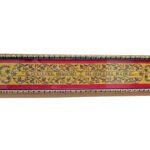
The central section of the exhibition, as such, has remained unchanged. However, some modifications have been made. The museum’s collection has been enriched with two important pieces, previously exhibited temporarily, which have now been permanently loaned to the Monteagudo Museum.
The first is the ordination ribbon of Saint Ezekiel Moreno, which until now was treasured by the Sanjuán Sobejano family of Marcilla. The other is the veil or cloak kept by the Augustinian Recollect nuns of the Monastery of Jesus and Mary of Orón (Miranda de Ebro, Burgos).
Other innovations include a rosary recently given by the Discalced Carmelites of Borja (Saragossa) and another gift from the Augustinian Recollect historian Ángel Martínez Cuesta, which he had received, in turn, from the Colombian Augustinian Recollect José Abel Salazar.
Together with two other rosaries that were previously included in other sections of the exhibition, they now form a new section recalling the full name of the religious saint: Ezequiel Moreno “of the Rosary”. They thus demonstrate the centrality of this devotion in his life, as well as his custom of giving rosaries as gifts.
A recent and significant addition to the exhibition has been the inclusion of cloaks and other garments that were previously displayed in a glass case near the cell where he died, outside the main exhibition area. This location was not easily accessible, and now they are visible to all visitors.
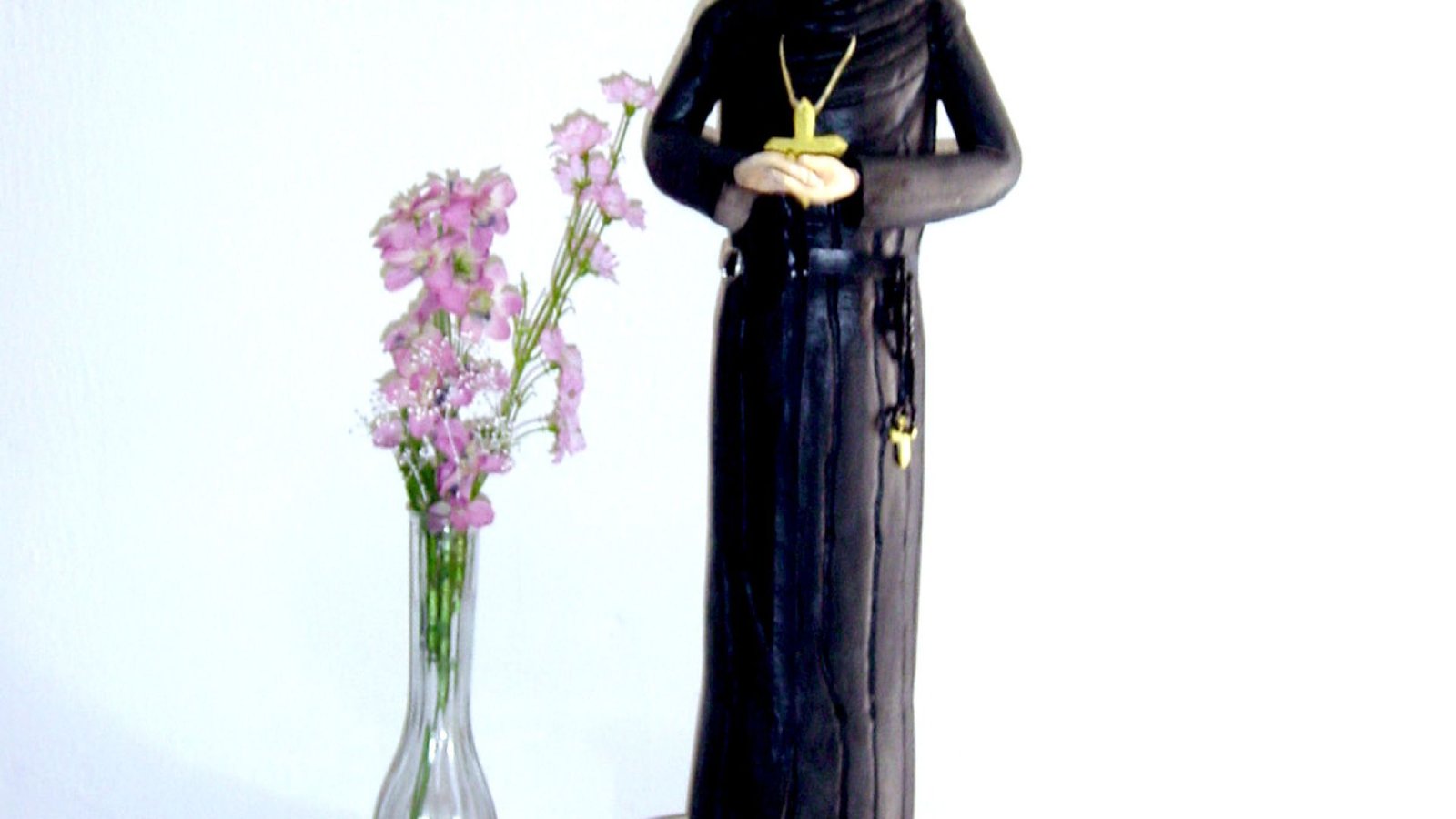
And finally, interesting for its picturesque character, is the statue of the saint in the Santero style, carved from a single piece of mesquite wood, which in the southern United States is called mesquite. It is the work of Ray Lee, an inmate at the New Mexico prison, made at the request of the Augustinian Recollect Ricardo Hinojal, who later donated it in 2007 for the Monteagudo exhibition.
The voice that calls us out of death