


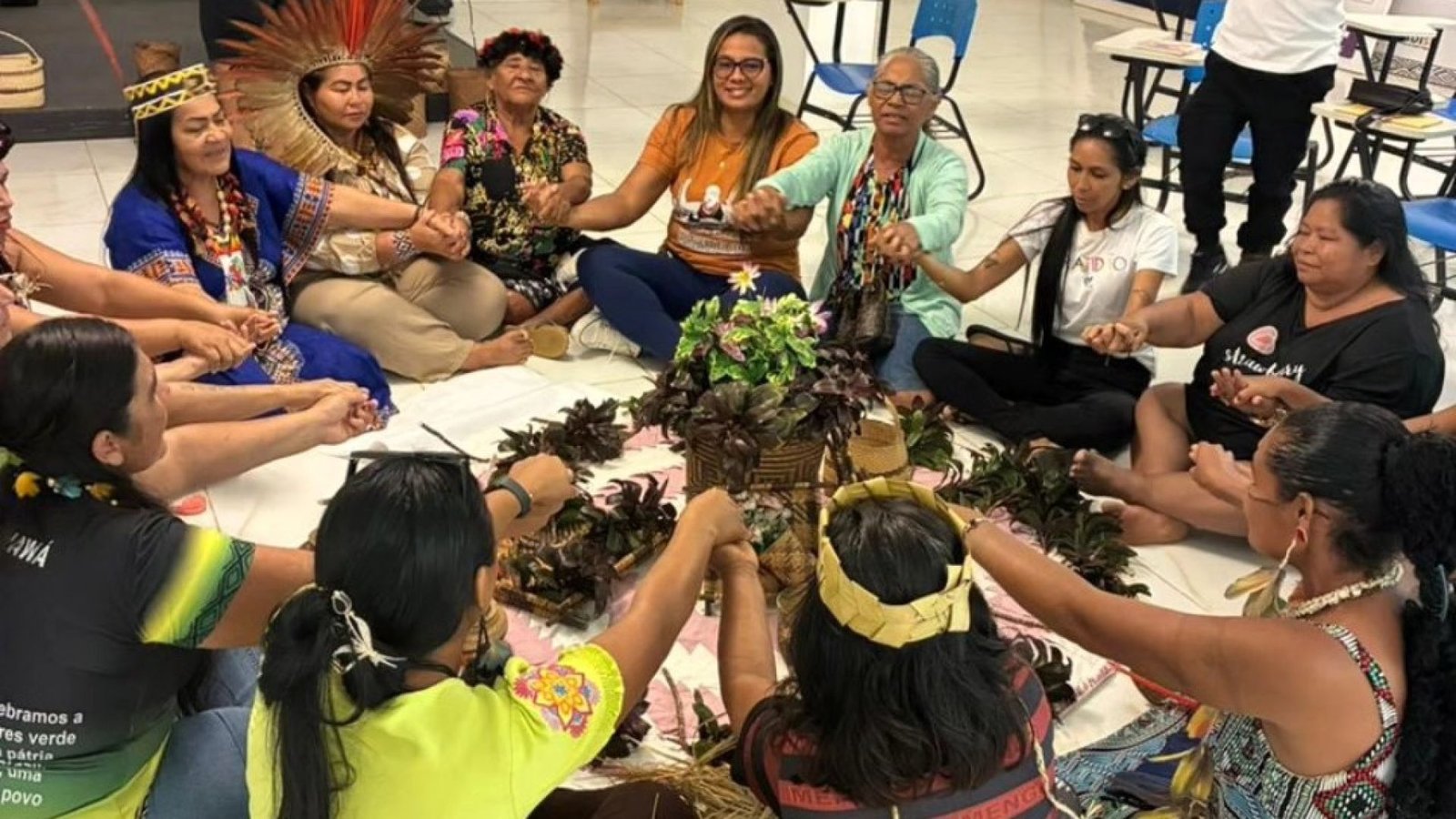
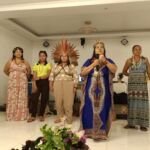
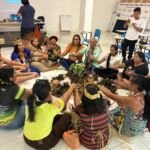
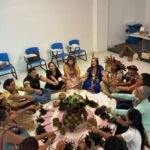
A group of Indigenous women from various villages in the municipality of Labrea (Amazonas, Brazil) have decided to join forces to reactivate the Association of Indigenous Women of the Middle Purus. Their goal is to strengthen their way of life and culture and to give visibility to female leadership in this region of the Middle Purus, a tributary of the Amazon River and the backbone of the Prelature of Labrea, where the Augustinian Recollects have been working for 100 years.
The women came from different demarcated indigenous lands. Uniting their efforts means not only defending their rights as women, but also strengthening their own indigenous culture, of which they are the primary transmitters.
The Association will explore ways to foster women’s economic autonomy through crafts and agriculture. Furthermore, it will help overcome some of the challenges women face in their communities and in Brazilian society at large, such as violence against women, territorial insecurity in Indigenous communities, and their still insufficient participation in public, political, and decision-making spaces.
In the Purus region live various ethnic groups, such as the Apurinã, Jamamadi or Paumari, some of whom have contact with non-indigenous society, and others in a situation of semi-contact or no contact, but who make up and complete the indigenous cultural mosaic of the region.
The resilience of Indigenous women is rooted in the daily life of their villages, in caring for the land, and in transmitting their language and culture. By uniting, they can find more effective ways to defend women and Indigenous identity.
The Association is assessing its next steps, which will be its legal regularization, the definition of the new coordination and the development of an action plan to respond to the most immediate needs, such as political training, income generation and coordination with other institutional partners.
The idea is to go far beyond simply exercising an associational right administratively. For these women, it is also a collective gesture of courage and hope. There are constant threats to Indigenous peoples and their way of life, their culture, and their territories; but these women are reaffirming their central role in building a dignified future and in defending a way of life that is environmentally friendly and an example of coexistence and holistic ecology among human beings, fauna and flora, water, and climate change.


From Blindness to Light: The Path of Faith in the Gospel of the Man Born Blind