
The life of the Augustinian Recollect Mariano Gazpio is a testament to silent fidelity, lived between the mission in China, persevering prayer, and humble service. In this article, Aurora Campos traces his life’s journey marked by the motto “to pray and to preach”, a spirituality embodied in the small things, sustained in trials, and fruitful even in times of persecution and dispossession.
The smallness of the beginning
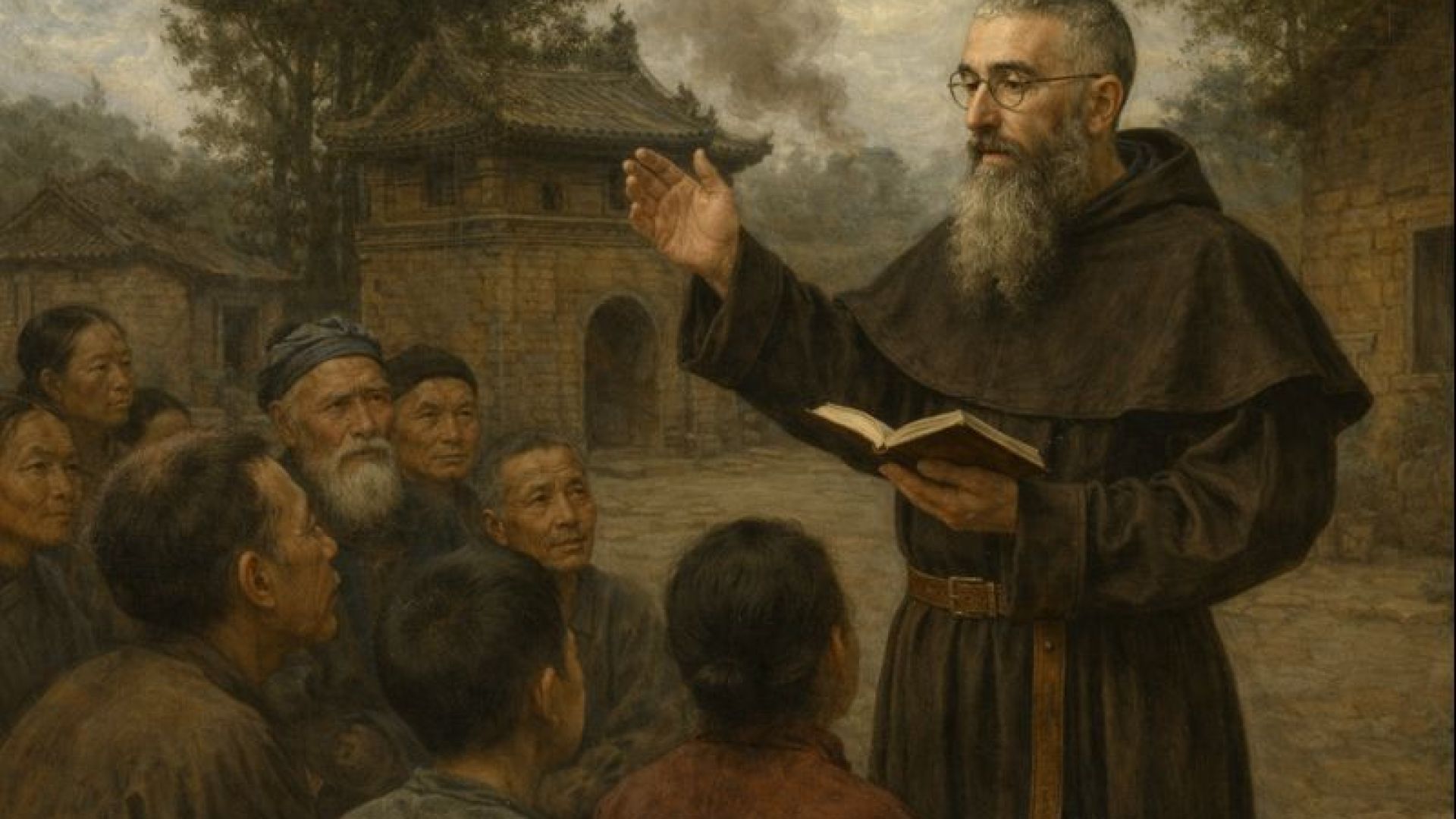
When Father Mariano arrived in 1928 in Yucheng, his second missionary destination in China, the first thing revealed to him was the bareness of the mission. Ten thousand inhabitants and only one Christian. An eighty-year-old man, almost completely deaf. That figure, so brief, had the weight of a call: to start from nothing, or rather, from the small. The air of the town, dense and laden with wood smoke, seemed to underline that initial poverty; the streets of packed earth, traversed by animals and carts, spoke of a simple and hard life.
He was not discouraged. He had already spent four years in China, since that April 4, 1924, when he had first set foot on Asian soil. He had learned to listen before speaking, to observe before judging, to let himself be taught by an ancient culture. The smell of the damp fields after the rain, the murmur of the markets, the slow rhythm of the days had been shaping his patience. The first experiences in Chengliku, when he barely mastered the language and announced the Gospel with clumsiness and perseverance, had been a true school of humility. Now, in Yucheng, he understood more clearly that the mission is not based on numbers, but on silent fidelity.
«To pray and to preach»: a rule of life
In Yucheng, Father Mariano adopted a motto that was not a simple pastoral program, but a constant inner attitude: «to pray and to preach». In it, an entire spirituality was condensed. He knew that the mission is not sustained by human efficacy, but by docility to God. Before the word, prayer; before action, prolonged listening before the Lord, often in poor chapels, with the smell of wax and aged wood.
The fruits began to appear slowly, as the work of God usually does. First almost imperceptibly, then with greater clarity. A month after his arrival, the leaders of the town of Wen Tsuan Lou appeared before him with news that exceeded all expectations: the entire town had decided to receive baptism. They also offered him a brick pagoda, with a tiled roof, solid, firm, for Christian worship. In a context where churches used to be fragile constructions of mud and straw, that building, with its smell of baked clay and its interior coolness, was received as a discreet sign of providence: God was building on solid ground.
The silent passage of grace
In Yucheng, there were also several healings that deeply marked the community: that of Magdalena, that of Mrs. Li, and others. They were not experienced as a spectacle, but as silent signs of a presence that healed and attracted. As a result, many asked for baptism, moved more by the perceived peace than by the emotion of the moment.
But Father Mariano knew that grace does not exempt one from the path. It was necessary to continue going out, walking, visiting nearby towns. His life became itinerant, marked by the dust of the roads, the smell of the hot earth, the tiredness of the body at the end of long and uneven days. He preached with simple words and with a presence that transmitted peace. In that constant coming and going, in the humble repetition of daily gestures, his interior was being shaped, becoming more and more centered, more unified, more free.
A vocation born in silence
That missionary life was the culmination of an old desire. Mariano was born in Puente la Reina, Navarra, on December 18, 1899. In his childhood, he was an altar boy and a student of the Augustinian Recollects. In the chapel of Our Lady of Solitude —with its smell of incense, cold stone, and worn benches— he heard, as a child, the stories of the missions in the Philippines narrated by friars who had given their lives there. Those words, spoken without solemnity, remained engraved like a seed.
The vocation was not born from a spectacular moment, but from a slow inner maturation. At the age of ten, he entered the preceptory of San Millán de la Cogolla; later he passed through the novitiate of Monteagudo, the studies in Marcilla, and the formation in the Philippines. Each place left its mark: silent cloisters, austere cells, chapels where time seemed to stand still. His priestly ordination, on December 23, 1922, was not a point of arrival, but a threshold from which he would continue his mission.
Changing mission without losing the center
After the intense years of Yucheng, in 1934 he was assigned to Chutsi. The mission changed its face. It was no longer so much about traveling through towns as about training catechists and taking care of worship. His life became more secluded, more interior. In a letter, he expressed it simply: before he had attended to numerous communities; now his life was reduced to the chapel, the classroom, and the cell. Three spaces marked by silence, study, and prayer.
He did not experience it as a loss, but as another form of fruitfulness. The mission became internalized. Silence, patient teaching, and persevering prayer sustained a work that was less visible, but deeply structuring. From this time, native vocations sprang forth, a sign of a Church that was beginning to take root.
Light and cross in history
In 1936, he accompanied two young Chinese professed to Rome. In the Eternal City, Father Mariano walked through ancient basilicas, impregnated with the smell of incense and secular stone, prayed before tombs of martyrs, and celebrated the faith in spaces where the Church showed its universality. Later, he visited his family in Spain, in the midst of the civil war. There, the landscape changed abruptly: wounded cities, silences broken by fear, the smell of smoke, ruins, and absence. There, the most intimate pain awaited him: the death of his father and a sister. That wound was assumed without stridency, as a silent offering, sustained by a proven faith.
Returning to China, he encountered the episcopal ordination of Monsignor Javier Ochoa and the war between China and Japan. He lived through the destruction of the missions, the roar of the bombings, the dust of the ruined buildings. He participated in the reconstruction with a serene optimism, born not of naivety, but of a deep trust in God. Years later, in the midst of World War II, he witnessed ten solemn professions of Chinese religious. The seed had borne fruit, even in land shaken by violence.
The night of dispossession
With the arrival of the communist regime, the mission entered a stage of darkness. On December 6, 1950, the central house was occupied by the army. The church, the seminary, and the school came under military control. The atmosphere became dense, guarded, charged with fear. Several missionaries were imprisoned. The siege was closing slowly.
Finally, on January 8, 1952, Father Mariano had to leave China. He left with little luggage, many memories, an intact love for Christ and the mission, and a long beard that became almost a symbol of that generation of expelled missionaries. It was the time of dispossession, lived with inner strength, without bitterness or reproach.
The fidelity of the small
Back in Spain, his mission continued in the houses of formation: Monteagudo and then Marcilla. There, he was master of novices and prior. Nothing spectacular. Faithful punctuality, praying silence, cared for community life. The corridors, the chapels, the orchard formed the new setting for his dedication. His motto remained intact: «to pray and to preach». Now he preached above all with his life.
His last years passed in a luminous simplicity: watering the fig trees in the orchard, with the smell of wet earth; confessing those who asked him; always giving a discreet smile; remaining long hours before the tabernacle, in silence. On September 22, 1989, he was called to the house of the Father.
He was ten years older than that only Christian, almost deaf, whom he had found upon arriving in Yucheng. The story closed in the same key with which it had begun: the smallness inhabited by God and sustained by an unwavering fidelity.