

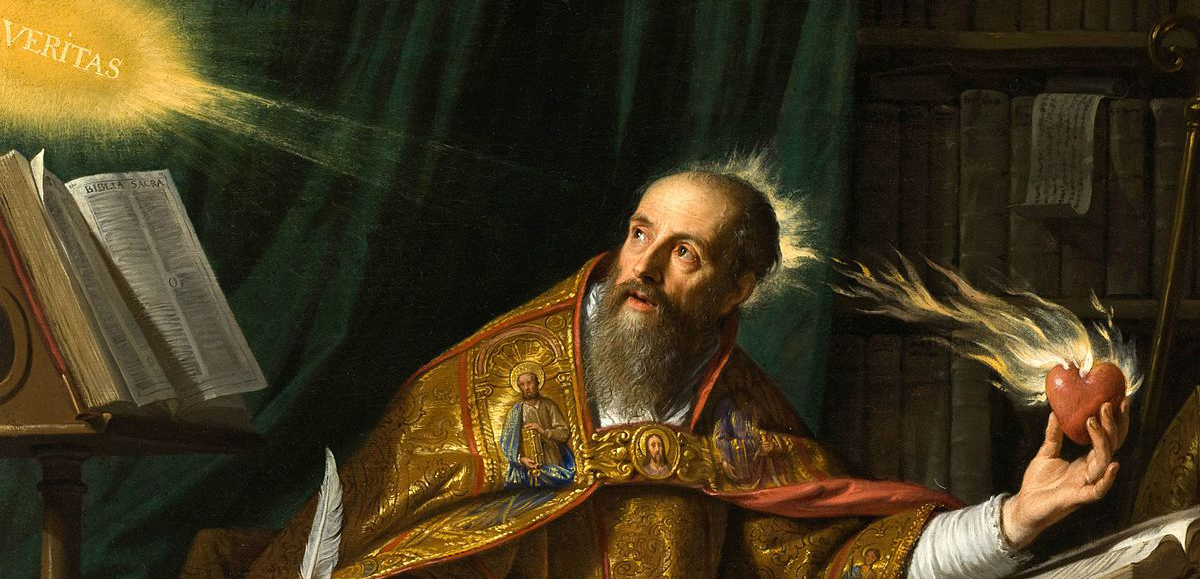
Saint Augustine continues to be one of the most influential authors in both the Christian tradition and Western culture. His reading of the human condition, of history, and of political power maintains a surprising relevance. He does not offer instant formulas, but illuminates the foundations from which we continue to think and believe. His starting point is the interiority of man, that heart that seeks and does not rest until it finds its true end.
From this interiority open to the infinite, the project of De Trinitate is also understood, where Augustine argues that in the depths of the human soul, the dynamism of memory, understanding, and will is reflected, in an imperfect but real way. Through this analogy, he does not intend to resolve the Trinitarian mystery, but to show that man has been created for communion. Interiority is not confinement, but openness; spiritual life does not isolate, but orients towards the relationship with God and with one’s neighbor. This anthropological vision prepares the ground for his conception of history.
 It is in The City of God where Augustine displays the deepest synthesis between faith and history. There he affirms that two forms of love build two distinct cities: an earthly city, originating in the disordered love of oneself to the point of contempt for God, and a city of God, born of the love of God to the point of relativizing oneself (The City of God XIV, 28). These two cities are not two geographical spaces or two perfectly definable institutions, but two orientations of the human heart. Both cross all peoples, all cultures, and all people; both coexist mixed in history, which makes it impossible to draw visible borders. Human history is precisely this conflicting intertwining between the search for God and the search for oneself.
Augustine describes the city of God as a community on the way. In a famous passage he affirms that the heavenly city, while it peregrinates on earth, “calls citizens from all nations and gathers a pilgrim society in all languages, without worrying about what may be diverse in customs, laws and institutions” (The City of God XIX, 17). This is one of the most universalist pages of all ancient Christian thought. The Church, as a historical sign of the city of God, is not defined by ethnic affiliations, nor by concrete human institutions, nor by closed cultural traits. It lives in hope, always oriented towards the ultimate future promised by God, and opens its doors to all peoples without exception.
 The earthly city, for its part, is not an absolute enemy, but a necessary order within historical life. It guarantees a certain level of justice, ensures coexistence, and seeks a possible peace between peoples. However, its peace is always limited and fragile, and can never be identified with the definitive peace of God. That is why Augustine argues that the earthly city can only offer temporary relief, while the fullness of peace belongs only to the Kingdom of God. This clarity dismantles any attempt to sacralize the State, the empire, or any form of political power. Augustine recognizes the value of politics, but also its radical limit.
 From that recognition is born a distinction that has profoundly marked the Christian tradition: the difference between power and authority. Although Augustine does not formulate it in unified technical terms, his entire work presupposes that political power belongs to the order of the temporal and needs to administer the earthly city, while true authority belongs to the spiritual order and orients towards the eternal destiny of man. Power organizes; authority gives meaning. The former establishes laws; the latter recalls the ultimate measure of all human action. This balance allows the Christian to collaborate in public life without absolutizing it, to serve the common good without idolizing any historical structure.
The Christian life, in this vision, is understood as a path. Augustine expresses it in a particularly vivid way when he exhorts the faithful not to stop: “Sing as walkers usually sing; sing, but advance. Relieve your work with song; do not love laziness. Sing and walk” (Sermon 256, 3). In these words, all his historical spirituality is condensed: faith is a song that sustains effort; the path is the charity that moves; vigilance against laziness is responsibility before the mission. The Church is, for Augustine, a community of pilgrims who advance with hope, sustained by grace, called to transform history without confusing it with the final goal.
The relevance of Augustine is perceived precisely in this double tension. The city of God orients, relativizes, and purifies; the earthly city organizes, sustains, and structures. Christian faith does not replace historical action, but frees it from the idolatry of power. Politics does not save, but it is an indispensable area to exercise charity and justice. Living between both cities requires discernment, humility, and hope. That is why Augustine’s work remains a reference for the Church: it reminds us that we are citizens of time and eternity, called to serve the world with our feet on the ground and our hearts in God.