

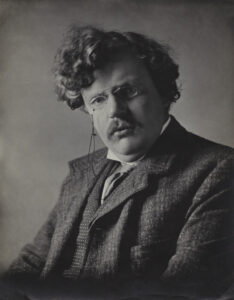
Gilbert Keith Chesterton was born in England in 1874 within the Anglican Church and died in 1936 after joining the Catholic faith in 1922. He is an intuitive thinker and a genius in the deepest sense of the term. He was a novelist, a prolific essayist, a prolific journalist, a poet, a lecturer, a polemicist on a thousand fronts and in many interventions related to politics and the social movements that swarmed between the end of the nineteenth and the first part of the twentieth century. He confronts naturalism, realism, socialism, and the scientific world adverse to the approaches of tradition and classical philosophy. An ideological field very similar to that of our days, precisely because today we are reaping what in that change of century were the seeds.
At present, what is most highlighted about this multifaceted genius is the fact that he converted to Catholicism. Why was he baptized in the Catholic Church? This is the constant question of his friends and also of his adversaries. He answers: “To free myself from my sins.” His Anglican co-religionists reproach him for his passage to the Catholic Church, and he, declaring that he had always been seeking the full truth beyond his Protestant line, affirms: “The key fits the lock; I have crossed the threshold and now I believe I live in the truth.” In Catholic doctrine he has finally found the coherent truth that responds to his intellectual and theological searches “surrendering” -as he writes it-, to the weight of the truth. Masterpieces such as Heretics and Orthodoxy are a display of surprise and paradox, of novel ingenuity and classical strength, all mixed in random doses to give answers that displace the listeners of his debates and continue to surprise the reader of our days.
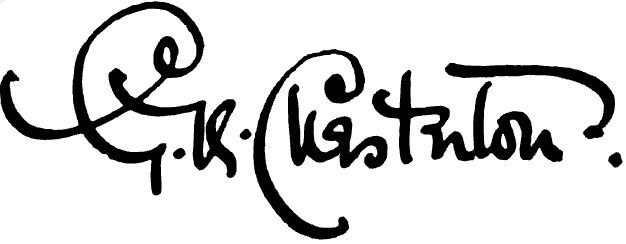
During this year 2025, Cardinal John Henry Newman, an Anglican presbyter who converted to Catholicism in 1845, who was canonized in 2019 and to whom Pope Leo XIV conferred the title of Doctor of the Church in November 2025, has been at the forefront of Catholic news. As following that wake of the convert Newman, Chesterton appears a generation later, a thinker who also comes from Anglicanism and who finds in common sense, in tradition and in the joy of healthy humor, the natural way to arrive at the coherent and simple truth, the Catholic truth. And to take the step and be baptized at the age of 48. Surely it is in the series of detective novels starring Father Brown, where Chesterton most clearly shows the empathy inherent in the Catholic faith, empathy in the simple and profound belief that turns the detective priest, Father Brown, into an acute agent who solves police enigmas with the magnifying glass of faith and human discernment. His investigative ability consists in the vision of faith with which he penetrates the richness and misery of people. And that kind empathy comes to Chesterton from the friendship forged with that parish priest, Father John O’Connor, whose wisdom full of common sense, led Chesterton to his conversion to Catholicism.
 Why will it do us good to read Chesterton in our days? The current push of the woke agenda, leading to the collapse of reason, was already experienced by our author in an active way when he polemicized and wrote forcefully against these disruptive ideas. Our writer is very inspiring to face the challenges of postmodernity when he proposes common sense as a guide, when he affirms the Church as the bearer of healthy and saving tradition, and when he proposes with his sparkling metaphors and paradoxes the sense of humor as an expression of joy and serene conviction in the truth. Postmodern times bring in their flag the culture of emptiness and spectacle, the dissolving nihilism. The Spanish philosopher Iginio Marín affirms: “Woke culture is a mutation of common sense.”
The Christian faith in the Catholic Church is based on the revelation of God, but it rests on a basis of common sense that is a kind of instinct of truth, a practical wisdom, so faith and common sense go hand in hand. Common sense is not a truism but a deep intuition. The ingenuity and naturalness make the apologetic works of this thinker -traditional and, at the same time, dissidents- evoke childhood, lost innocence, the miracle of each thing, astonishment, joy and faith in daily routines, especially in four routines of “homemade” wisdom: love, friendship, family and universal citizenship. The prince of paradox, with surprising metaphors, antitheses and twists in argumentative logic, will tell us, for example, that “the only heresy that is not tolerated today is orthodoxy”; that “the most modern is the traditional”, because all growth of progress needs a sustenance of the roots, that is, it needs the tradition in which to vertebrate the new creations; he says that “the Christian faith represents the greatest adventure that a human can undertake”; he affirms that “tradition is the transmission of fire, not the adoration of ashes”; he writes: “Christianity is the only thing that can free us from being children of our time, because it makes us children of God”; he affirms that “the cross is always out of fashion because it is true”; he proclaims that “orthodoxy is to recover lost innocence.” Common sense, tradition, healthy humor and revaluation of the Catholic truth always form the warp of his ideas.
His pages, in addition to being sown with literary pearls, show that the faith of this man has authenticity of many carats, a thinker who breaks molds and does not let himself be entangled by the truths of fashion. Today, Chesterton continues to appear as an author who faces with originality the forest of the woke ideologies of the twenty-first century that he knew in its embryonic origins and undid with humor and reasoning already in the first thirty years of the twentieth century. Today it seems that Chesterton returns to the stage of controversy, of debates, of dialectics or of computer media to face the cultural battle. From the praise of common sense and Christian doctrine, Chesterton continues to invite us to believe in the truth and to love it simply. To the “moderns” who accused him of having suppressed the use of reason when throwing himself into the bosom of the Catholic faith, he replied: “to enter the Church of truth it is not necessary to cut off the head, only to take off the hat.”
The sense of humor, the sense of common sense and the sense of faith are united as a natural force in this thinker. That is why today this author is more vindicated than ever. We need him in times when the culture of soft thinking appears as a degeneration of man, as a denial of the truth and as a mutation of common sense; we need, I say, a little Chesterton, who comes to show us the conviction and joy that emanate from the principles of Christian humanism. To the contemporaries of the late nineteenth and early twentieth century who professed the sciences of naturalism and socialism in full advance of skeptical scientism, and who shouted that faith was not proper to the educated modern man, our lucid polemicist responded thus: “Take away the supernatural, and you will not find the natural, but the unnatural.”
What does Chesterton bring us in our days? A revulsive to live without timidity or emptiness the life of faith in the Catholic Church. He affirms that an eclectic man has a Catholic compass and that sincerity and common sense guide the conscience of people of good faith. He was convinced that if there is no a priori predisposition, one will arrive at the truth because whoever dives the paths of life will end up embracing the evident light. A little Chesterton will do us a lot of good, because he offers us fresh ideas for the Catholic message, agility of living language, a renewed form of communication, an influential force from a treatment of friendship and empathy with all, a spirit of new apology with charm. In our days of the 21st century, G.K. Chesterton would be a communicator of potent influence, he would be the most impactful ecclesial “influencer.”