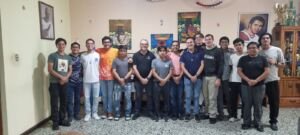


It was not just another consistory. “Your testimony is truly precious,” Pope Leo said to the cardinals, according to Matteo Bruni, emphasizing the communion experienced even with those who could not be present. Days after that meeting, Cardinal José Luis Lacunza Maestrojuán, OAR, Cardinal Emeritus of Panama, visited the General Curia of the Augustinian Recollects and, in a simple and fraternal atmosphere, shared with us his personal experience of a Church that seeks to listen to itself, walk together, and discern its priorities for the coming years.
Cardinal José Luis Lacunza and the experience of walking together
Cardinal Lacunza speaks from a particular place within the College of Cardinals. Now as Cardinal Emeritus, in his words: a decapitated Cardinal, he participates without the pressure of the daily government of a diocese, but with no less responsibility: to contribute memory, pastoral experience, and a serene outlook that helps to discern the common course. His presence in the consistory was not secondary. On the contrary, the voice of the Cardinal Emeriti was heard and valued as a living part of ecclesial discernment, a clear sign that the Church does not disregard accumulated experience, but integrates it into its decision-making processes.
“This is the second time I have participated in an extraordinary consistory,” he recalls. The first was on the occasion of his creation as a cardinal. Today he sits at the table again from another inner disposition, more free, more contemplative. He listens attentively, observes the gestures, perceives the silences. And he especially values that, on this occasion, the Cardinal Emeriti have also been able to contribute their reflections, not to decide, but to illuminate the path of the Pope with the wisdom that time and lived service give.
A Church that learns to listen to itself
The consistory was developed following a clearly synodal methodology. Small groups, shared tables, dialogue without confrontation. “The idea was not to discuss, but to listen,” explains Lacunza. It was not about convincing or imposing points of view, but about welcoming the word of the other and allowing that diversity to find its place in a common discernment.
This way of proceeding generated a serene and fraternal atmosphere. The Church, for a few days, experienced itself as a real community. Not as an abstract structure, but as a body made of relationships. For the Cardinal, this experience is not accidental and connects directly with the style of Pope Leo, a friar and man of community life for many years.
“I think the Pope is looking for this in the College of Cardinals,” suggests Lacunza. Not only work meetings, but spaces where the cardinals can get to know each other better, listen to each other, and recognize each other as brothers. A synodality lived, not only enunciated.
Evangelization and synodality, priorities for the immediate present
When the time came to point out the priorities, the answer was clear. Among the four major themes proposed—Evangelii Gaudium, synodality, Praedicate Evangelium, and the liturgy—the vast majority of the cardinals chose evangelization and synodality as fundamental axes.
This election also marks the horizon of the Church for the next two years. There was no talk of abstract plans or technical reforms, but of concrete priorities. To put evangelization back at the center, to take Evangelii Gaudium seriously, and to help ensure that synodality is not archived, but translated into real practices in local Churches.
“Evangelization is not just another task: it is the raison d’être of the Church,” says Lacunza simply. And he adds a decisive key: there can be no credible proclamation of the Gospel if the Church does not internally live what it proclaims. That is why evangelization and synodality appear inseparably linked.
Priorities that arise from the concrete life of the dioceses
Another relevant aspect of the consistory was the insistence that pastoral priorities take into account the concrete reality of the dioceses. The cardinals shared diverse experiences. Some local Churches have enthusiastically embraced the synodal path. Others still keep it on the sidelines. This unequal reception was recognized with realism, without judgments, as a challenge that must be faced in the coming years.
The contributions of the cardinals—including the emeriti—were collected as direct inputs for the discernment of the Pope. “We help the Pope, but it is he who discerns and decides,” recalls Lacunza. There was no final document or closed conclusions. There were open paths.
A Pope friar, a college called to live as a community
In the words of the Cardinal, the profile of Pope Leo appears clearly. He is not an improvising Pope. He is reflective, methodical, with a style marked by his formation and by his community experience. “He is not going to be a second Francis,” says Lacunza naturally. And he doesn’t need to be.
His way of convening, listening, and proposing medium-term processes reveals a profound intuition: the College of Cardinals cannot be limited to being a functional body. It is called to be a true community at the service of ecclesial discernment. The announcement of a new consistory in June, and the possibility of annual meetings, confirms that this path wants to consolidate.
The Church that is built every day
At the end of the dialogue, the Cardinal returns to his daily life in Panama. To the community of Colegio San Agustín. To daily Mass, the rosary, confessions, catechesis. There, in the simple, everything that has been discussed in the consistory is at stake.
The experience lived in Rome has been intense, but the Church is built every day, walking together, listening to each other, and living as a community. That is, for Cardinal José Luis Lacunza, the key to the present and the immediate future of the Church.