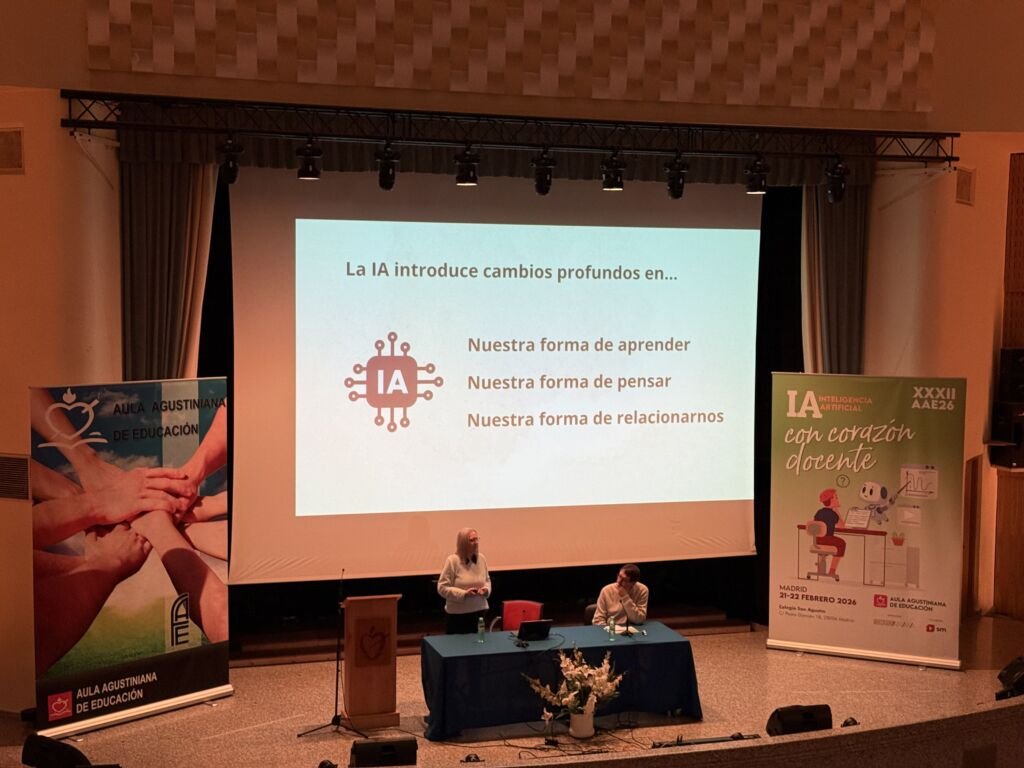

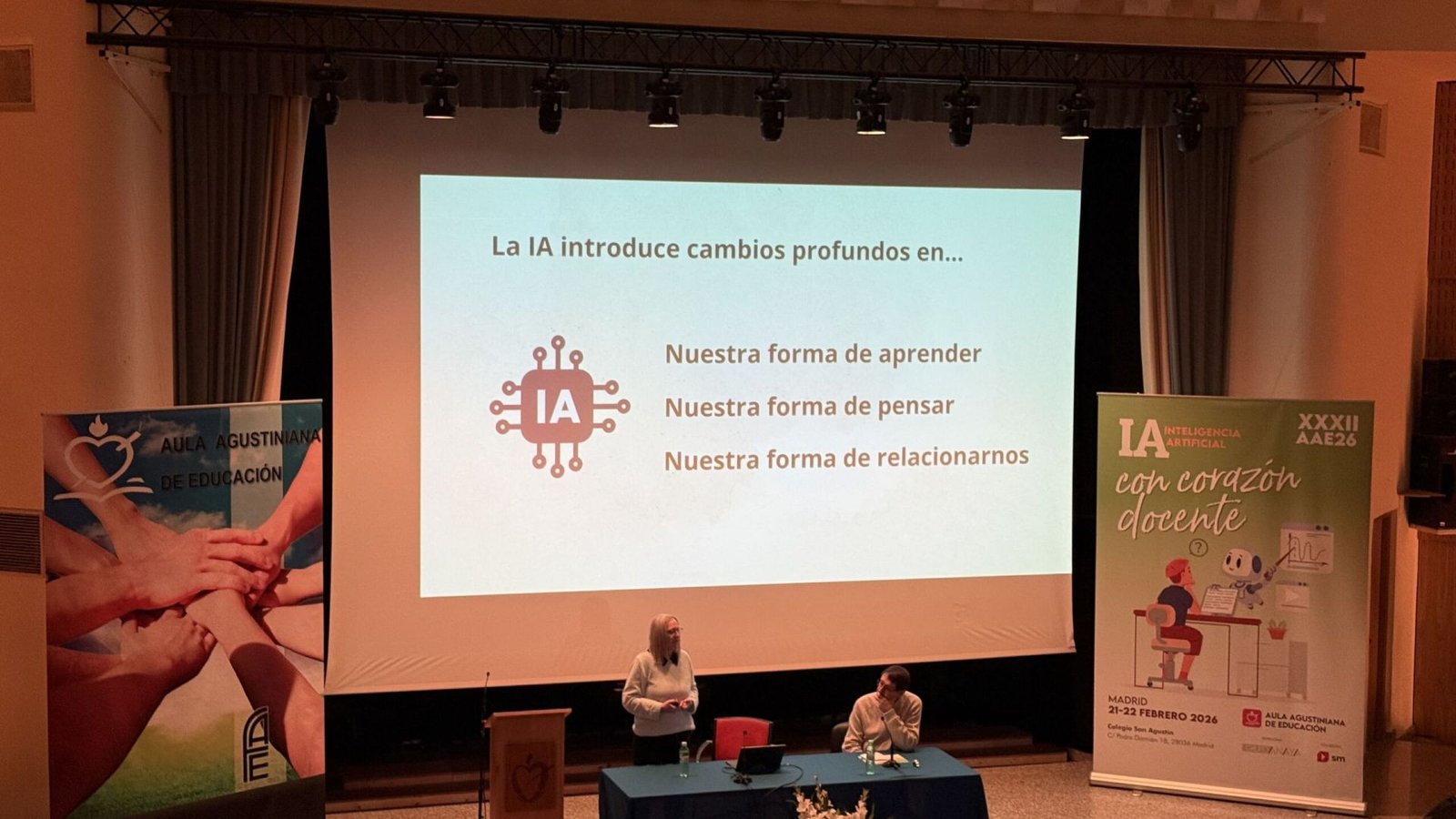
At the Augustinian Classroom 2026, Charo Fernández Aguirre addressed the relationship between artificial intelligence and education from a person-centered perspective, asserting human accompaniment as an essential value for educators.
Educating in the Age of AI: Returning to the Core
Charo Fernández Aguirre’s talk, titled “Artificial Intelligence and a Pastoral Heart: A Possible Dialogue,” did not begin by discussing algorithms or digital tools. It began by discussing the person.
In a context where public conversation about artificial intelligence often focuses on technology—its advancements, risks, and limitations—the speaker deliberately shifted the focus: the core of education is not the tool, but the human being.
AI is here to stay. To deny it would be naive. But accepting it does not mean ceding the leading role of the educational task. On the contrary: it demands a clearer reaffirmation of the irreplaceable value of the educator.
Accompaniment Cannot Be Automated
Charo emphasized that the teacher’s mission remains to accompany, to help discern, to critically literate, and to guide from human intelligence. Technology can assist, organize, and optimize processes. But it cannot replace the understanding gaze, the encouraging word, or the supportive presence.
In this sense, artificial intelligence should not be seen as a threat, but as a tool. When used well, it can enhance educational work: facilitating resources, personalizing learning processes, and better preparing students for the world they already inhabit.
The key is not to choose between people or technology. The key is to teach how to think with technology and, above all, how to think about technology. To form judgment. To educate in ethics. To develop critical thinking.
Transforming Fear into Opportunity
One of the most significant moments was the speaker’s ability to acknowledge the fear present in many educators. Fear of being left behind. Fear of not mastering the tools. Fear of being displaced.
Far from minimizing these concerns, Charo acknowledged them and turned them into a starting point. That fear can be transformed into momentum. It is not about AI replacing our work, or displacing the teaching vocation, but about allowing it to help us perform it better. Technology does not replace the pastoral heart. It challenges it. And, when well integrated, it can strengthen it.
What Was Learned from the Faculty
At the end, the speaker herself shared what she had learned from the encounter: the faculty’s sensitivity to understand the changes affecting education and their constant desire to offer the best to their students.
This attitude—stepping out of one’s comfort zone, overcoming inertia, facing the new with responsibility—reveals something deeper than a technical adaptation. It speaks of vocation.
In teaching teams, especially those with an educational identity inspired by the Augustinian charism, there is a commitment that goes beyond efficiency: an authentic affection for students and a firm will to accompany them in their holistic growth.
A Necessary Dialogue
The integration of artificial intelligence in education cannot be done with naive enthusiasm or fearful rejection. It requires discernment.
The challenge is not technological, but anthropological and pastoral: how to maintain personal accompaniment as the core of education in an increasingly automated environment? What digital literacy frameworks do we need for AI to enhance—and not weaken—critical thinking?
The answer, as the speaker reminded us, always begins with the person. And there, no algorithm can replace the presence of an educator who accompanies with intelligence and heart.