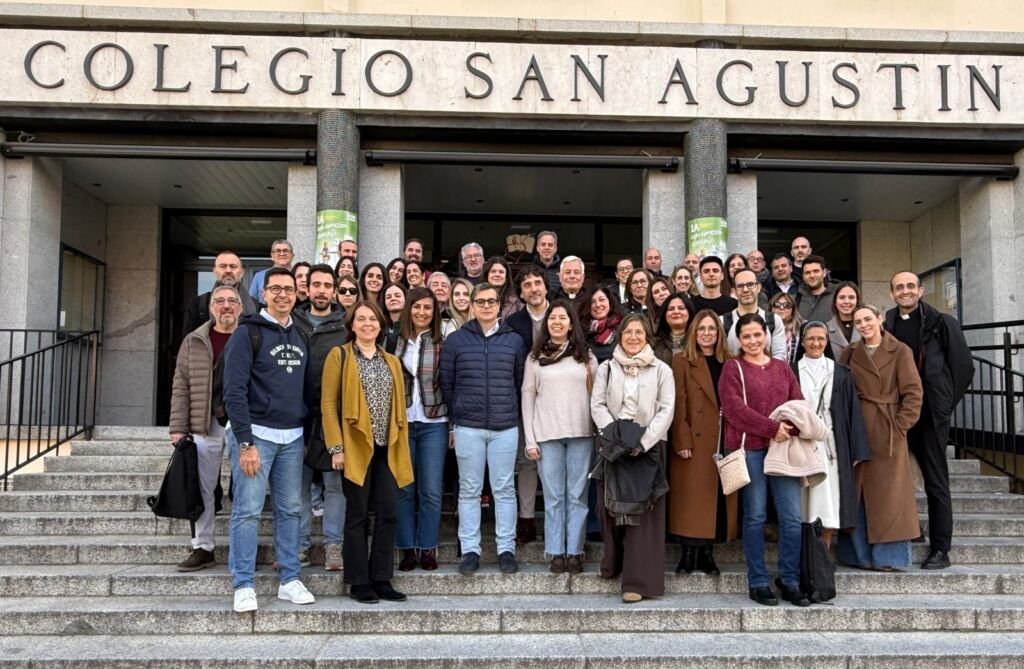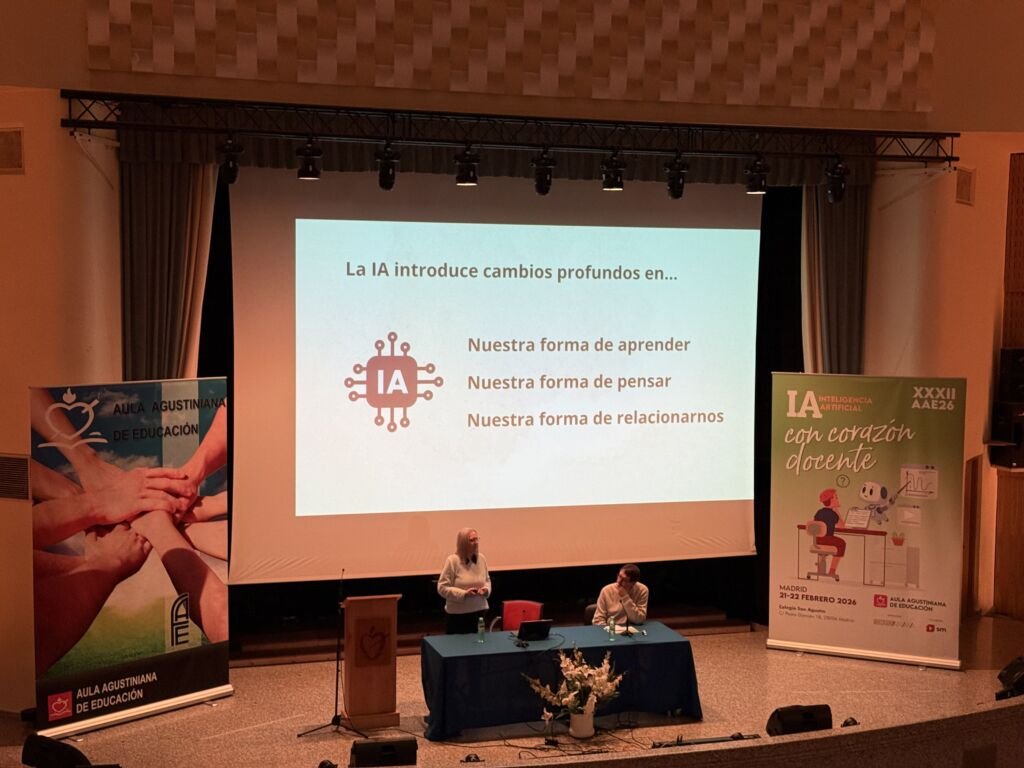

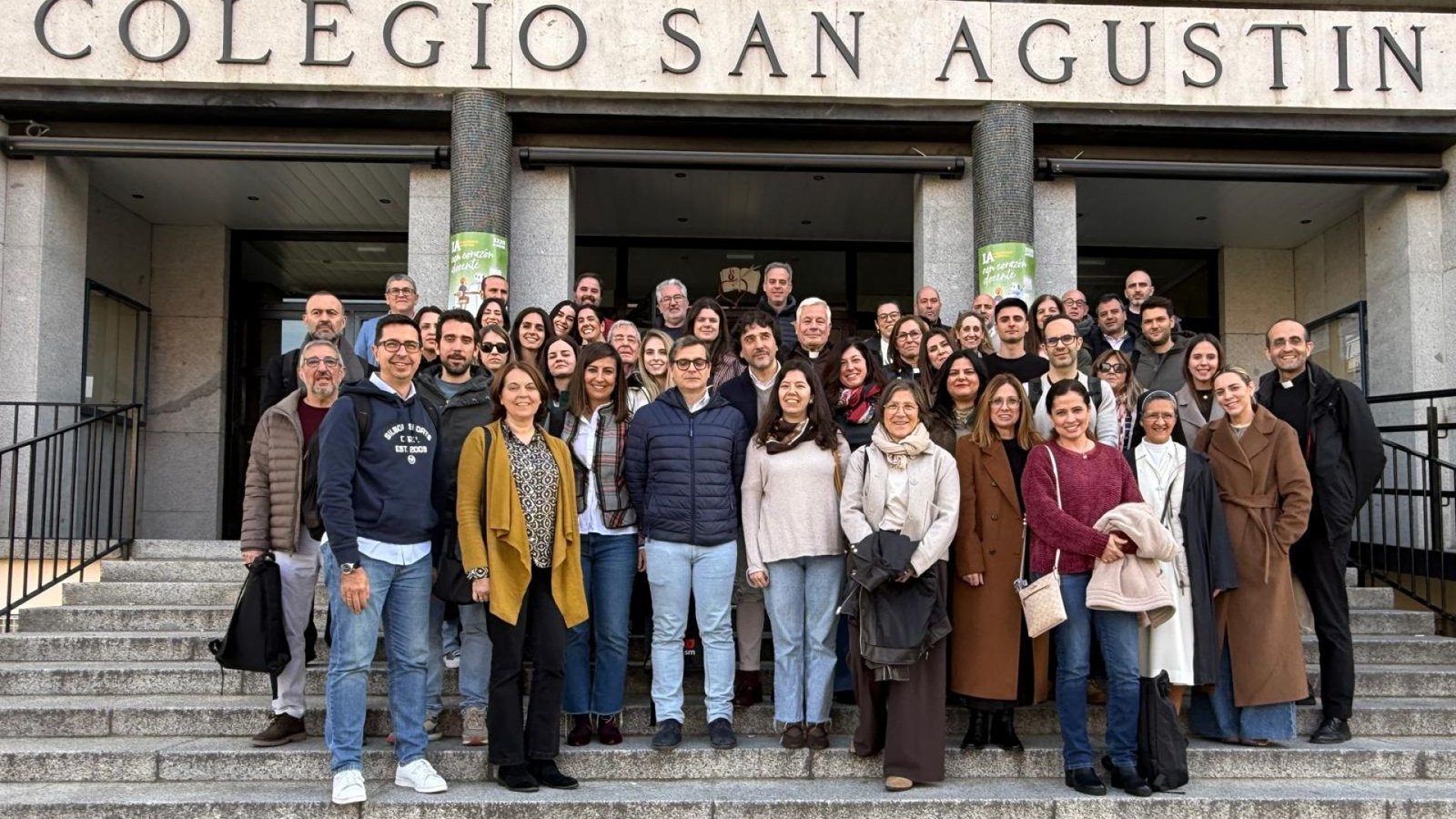
The XXXII Augustinian Education Forum 2026 brought together over 400 educators from Augustinian Family schools in Spain around a common challenge: integrating artificial intelligence into schools without losing the identity, depth, and pastoral heart that characterize the Augustinian educational mission.
First Day: Interiority and Technology with Purpose
The inauguration, on February 21, was marked by the words of Sr. Ana María Guantay, Superior General of the Augustinian Missionaries. In a cultural context profoundly shaped by technological acceleration, she emphasized that this moment represents “a very valuable opportunity” for Augustinian education.
Far from presenting artificial intelligence as a threat, she introduced it as a provocation and a challenge. The key—she affirmed—is not to lose sight of the root: interiority, encounter, and community. In a world marked by hyperconnectivity and constant outward focus, Saint Augustine’s thought offers a solid anchor: returning to the heart to live rooted in this time.
The religious sister insisted on an essential pedagogical dynamic: teachers and students walk together. “We cannot do it alone.” The educational relationship is understood as a mutual learning process, where humility and communion strengthen the Augustinian identity.
Technology with a Roadmap
On the same day, Tirso Maldonado and César Poyatos contributed with complementary reflections from the field of educational innovation.
Maldonado warned against the error of implementing technologies without a real transformation of processes and mindsets. Artificial intelligence cannot be treated as a simple search engine; it requires deep understanding, training in prompt design, and a clear, people-centered strategy.
For his part, Poyatos insisted that “prohibiting does not educate.” Faced with fear, he proposed critical, ethical, and secure digital literacy. He pointed out real risks—disinformation, biases, and inequality—but also the potential of AI to personalize learning, always with the educator as an irreplaceable mediator.
The day concluded with a concert by the Escolanía del Escorial, which provided a moment of beauty and contemplation, reminding us that holistic education also includes the aesthetic and spiritual dimensions.
Second Day: Eucharist, Discernment, and Sending Forth
The second day began at 8:30 PM with the celebration of the Eucharist, presided over by Friar Carlos González Castellanos, OAR, Provincial Prior of the Province of Saint Nicholas of Tolentine, along with about twenty priests.
The celebration was an act of thanksgiving for the gathering, a plea for schools to embrace new technologies, and a grateful remembrance of the educators who have preceded them in the Augustinian mission in Spain.
In his homily, Friar Carlos framed the Forum in a Lenten key: conversion, interiority, and overcoming temptations. He reminded the audience that true progress originates from the heart and that prudence—not display or unnecessary risk—is a safe path when facing challenges. Prayer, fasting, and almsgiving were presented as “wings” that elevate spiritual life and sustain any authentic renewal.
Artificial Intelligence and the Pastoral Heart
The academic reflection continued with a presentation by Charo Fernández Aguirre, who shifted the focus to the anthropological and pastoral dimensions. Artificial intelligence can assist, organize, and optimize processes, but it cannot replace human accompaniment.
To educate is to accompany, discern, and sustain. Technology challenges the educator’s heart, but it does not replace it. The key is not to choose between person or tool, but to develop discernment to think with technology and about technology.
Closing Ceremony: The Person at the Center
The closing ceremony was led by Friar Antonio Carrón de la Torre, OAR, General Counselor and head of the Educar Network. At a historical moment when the Church is actively reflecting on artificial intelligence, he reiterated that the person must always remain at the center.
He proposed three clear lines of action: educating for AI (ethical and critical competence), educating about AI (understanding its functioning), and educating with AI (integrating it pedagogically). Always avoiding the absolutization of the tool and reaffirming that the foundation of the Christian educational mission is Jesus Christ.
Innovating Without Losing Our Soul
The XXXII Augustinian Education Forum 2026 has shown that it is possible to combine innovation and tradition, technique and transcendence, professional competence and a pastoral heart.
Artificial intelligence presents unprecedented challenges. But the answer is not fear or naive fascination, but discernment. In Augustinian classrooms, the future is not built solely with algorithms, but with educators who believe in each student as a unique person, called to truth and goodness.
Humanizing technology from the heart of the charism: this has been the shared vision.