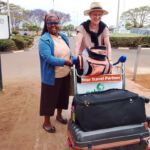

A member of the parish community of Santa Rita of the Augustinian Recollects in Madrid (Spain), Isabel Fraga is a specialist in internal medicine and has practiced her profession in Madrid (San Carlos Clinic and Red Cross), Soria (where she collaborated in the launch of the hospital center), Santiago de Compostela (A Coruña).
After retiring, she channeled her knowledge and energy into volunteering in South Sudan, Malawi, and Madagascar, for which she had previously trained in tropical medicine. She emphasizes the need for humility and patience to dedicate herself to volunteer work and feels above all like a “missionary,” rekindling a childhood dream that she has finally realized.
How did your vocation for volunteering begin?
After retiring as an internist from the San Carlos Clinical Hospital in Madrid and after the life project I had planned for my retirement failed —things happen—, I remembered what my dream had been as a very young girl: to be a doctor and a missionary.
Without giving it much thought, or perhaps thinking about it too late, I started looking for a place to train in tropical medicine, convinced that I was going to work in very different conditions than I had ever known. At the Jiménez Díaz Foundation in Madrid, I found a course almost by a miracle: after the registration period had ended, there were still places available, and I managed to get in.
It was essential to have a minimum prior knowledge: to know about the local culture, the socioeconomic level, the prevalent pathologies and the health situation, personnel and resources, how and where I was going to live… I was looking for where I could be most useful and, to be honest, some security, more for the peace of mind of my family than for my own.
Where did you begin this experience as a volunteer doctor and missionary?
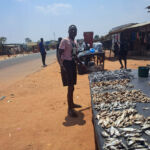
My first extensive experience was between 2013 and 2014, nine months in Wau, South Sudan. I learned a great deal, though not without setbacks, such as the language barrier: there were more than 200 languages spoken. The result: a translator was mandatory, and sometimes I needed two. Completing a medical history was a real ordeal. Some interpreters, after listening to the patient for a while, would stop translating and simply give their diagnosis: always malaria. Between the sexism and the conviction that they knew better than everyone else, I had to change translators several times until I found one who was even remotely respectful.
This language problem has been repeated almost everywhere. With some exceptions, French can be spoken in West Africa and English in East Africa, but only by educated minorities. The doctor – patient relationship becomes much more complicated.
The second major problem was security. It’s one of the reasons I didn’t return to South Sudan a second time. After three months, a very bloody civil war broke out. Luckily, Wau was difficult to access, so we learned about the war mainly through the refugees who arrived in terrible condition.
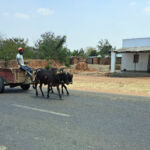
With over 100,000 inhabitants, dirt roads, no electricity or running water, on the banks of the Jur River, which happily overflowed during the rainy season, we solved the electricity problem with solar panels, and the water problem… however we could. At my house, there was a tank that filled a water truck, but other systems reminded me of my grandparents’ house, like selling water by the bucketful.
In pharmacies you could buy anything without a prescription, and there were private clinics and even a Chinese hospital where all the reports were in Chinese (a detail of no importance to them, apparently). They didn’t accept euros or exchange them at banks: you had to go to the black market, disguised as a small supermarket.
Food was expensive, unemployment was rampant, and street children were everywhere: some addicted to drugs, others surviving by recycling plastic. Alcoholism was widespread, with high-proof drinks made from whatever was available: rice, corn…
There were more than 200 ethnic groups. The Dinka and Nuer, very tall and cattle owners, were the wealthiest; but the Arabs controlled the businesses. I was impressed by the respect that civilians and soldiers showed to the missionaries, and by the solidarity among the children.
I especially remember three younger siblings; one of them almost certainly had malaria. They would take my hand and place it against his forehead so I could feel his fever. I discovered that their mother had died, and their alcoholic father gave me permission to take them under my care.
The healthcare system was in complete disarray. The hospital was run by two sisters who were doctors and were reluctant to accept help from others, including myself. Malaria was endemic and killed many, especially infants and pregnant women. There was no control over treatments or preventative measures, so resistance ran rampant.
I also saw very advanced tuberculosis, AIDS, severe hypertension, heart disease, asthma, parasitic infections, onchocerciasis, schistosomiasis, and other filarial diseases. It’s where I’ve seen the most parasitic diseases, many of them preventable. I had to treat many people on my own, in the streets, without basic necessities, because of the war.
Two years later you went to Malawi.
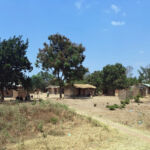
Malawi is small, landlocked, with a large lake that provides its main source of protein through fish. Agriculture is very rudimentary and entirely dependent on rainfall: too little or too much rain guarantees famine.
I worked in Kapiri, a village with a small hospital offering general medicine, pediatrics, and obstetrics, a basic laboratory, radiology, ultrasound, and, if I was lucky, blood for transfusions. Everything is very closely monitored by international organizations, and malaria, tuberculosis, and AIDS have strict protocols.
We volunteers are also monitored: I had to get my medical degree from Malawi after six weeks at the Lilongwe referral hospital, and now I go back every year for a month. The Carmelite Missionaries are my support. Sister Jovita, who earned her nursing degree in London, is very well-prepared and is the heart and soul of the hospital. The congregations take great care in preparing the young nuns.
In Malawi, women work a lot, too much; men are seen less; there is a lack of social organization and schools to accommodate so many children who just roam the streets continuously, and there is an excess of malnutrition, alcoholism, chemical dependencies, abuse of power, corruption, prostitution…
They bring many children into the world, but their education and upbringing is a challenge without profound cultural changes. This lack of culture is usually the root of endemic problems in healthcare, nutrition, and religion. I work in the hospital, but I dedicate a large part of my resources to education, because without it there is no future.
There are even religious factors that complicate everything. In Androy, Madagascar, the belief that death is worth more than life is widespread, and many families prioritize saving for their funerals rather than caring for their living relatives.
How was your experience in Madagascar ?
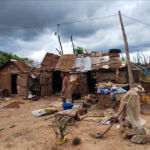
I have gone to Madagascar for six years, two months each year, although this 2026 I’ll be spending three. I go to a small but very active dispensary in Tsihombe, in the Androy region, one of the poorest and driest areas. Here, they gave me their complete trust, and I maintain a close relationship with Sister Inmaculada Fernández, from Palencia, the driving force behind the center. They have twelve inpatient beds and twenty isolated houses for tuberculosis patients. Patients pay according to their means, except for those with tuberculosis, who receive free care and meals.
The healthcare system is very poorly organized: there are no prevention programs, vaccinations are incomplete, and malnutrition is severe. We have minimal resources: hemoglobin, glucometer, pulse oximeter, basic sputum and stool tests, and, when I go, a small ultrasound machine. It’s a very clinical approach to medicine, focused on examination, thought, and decision-making, very similar to that of my early professional years. Leprosy still exists, although it’s being diagnosed earlier and is more effectively treated.
What would you say to those who are considering becoming volunteers?
Any volunteer, especially if they are a person of faith, faces a challenging world in need of humanization and evangelization.
In all the missions I’ve been on, the volunteer accommodations have been good, although power outages, the heat, or mosquitoes sometimes make it difficult to get a good night’s sleep. Even so, I’ve always felt very well cared for by the nuns who have hosted me.
I’ve learned that volunteering requires good preparation and humility, respecting local customs, and with a lot of patience. But I’ve also learned that it’s absolutely worthwhile.