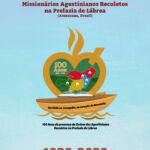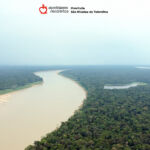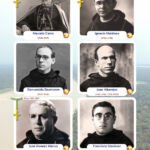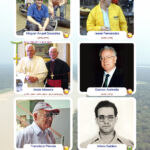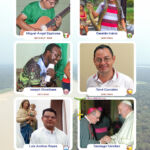


Within the centenary of the presence of the Augustinian Recollects in the Amazon (1926-2026), we publish today in the documents section of the website a small commemorative album with the photographs of the 116 Augustinian Recollect religious who at some point in history have lived their religious and missionary vocation in one of the four municipalities (Lábrea, Canutama, Pauiní or Tapauá) of the Prelature.
Within the centenary of the presence of the Augustinian Recollects in the Amazon (1926-2026), we publish today in the documents section of the website a small commemorative album with the photographs of the 116 Augustinian Recollect religious who at some point in history have lived their religious and missionary vocation in one of the four municipalities (Lábrea, Canutama, Pauiní or Tapauá) of the Prelature.
The average missionary arrived in Lábrea when he was 33 years old and spent eight and a half years in the mission; but it is a somewhat distorted picture, given that the differences among the 116 have been large, both in origin, as well as in age, as well as in the number of years they have served in the mission.
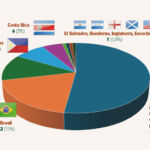
The Recollect missionaries in the Prelature of Lábrea have come from as many as ten different nationalities. The largest group has been Spanish (60 missionaries, almost 52% of the total). However, although they represent half, their percentage is expected to decrease in the coming years.
In fact, until 1990, three out of every four new missionaries arriving in Lábrea were Spanish; from that year until 2019, it was one out of every three; and so far this decade, it has been zero out of six.
Until 1990, of the 60 new missionaries, 44 were Spanish (73.33%) and the rest Brazilian or Mexican (and only one American). Since 1990, the number of nationalities of the missionaries has increased considerably; since then, less than 30% come from Spain, and Scotland, the Philippines, Costa Rica, England, Honduras, and El Salvador appear on the list.
Throughout the mission’s century of existence, the Spanish missionaries were followed by Brazilians (22, almost 19%), Mexicans (14, 12%), Filipinos (9, 7.75%), Costa Ricans (6, 5%) and only one (0.86%) from each of these countries (in order of arrival): United States, Scotland, England, Honduras and El Salvador.
Almost all the Provinces of the Order of Augustinian Recollects have contributed missionaries. On the one hand, this mission has changed hands several times; it began with Saint Thomas of Villanova (which contributed 23 religious, almost 20%), followed by Saint Rita (with 18 missionaries, 15%), and since 1980 it has been Saint Nicholas of Tolentine (which has contributed 64, 55%), which had already been contributing volunteer missionaries since 1966.
And indeed, at various times, missionaries from other Provinces arrived as volunteers. Of particular note is the agreement that the Provinces of San Nicolás de Tolentino and San Ezequiel Moreno maintained for decades to share personnel in their mission territories. As many as nine members from the Philippine Province (7.75%), one from Candelaria (who also became a bishop), and one from San Agustín, an American, went to Lábrea.
Of the 116 missionaries, 110 are priests and six are religious brothers. One of these is currently the only religious brother prior of a community in the Order, and he was also the oldest missionary to arrive in Lábrea: Alfonso Lázaro, who began his missionary ministry in Pauiní at the age of 66.
La Prelatura ha estado dirigida en este tiempo por ocho prelados, cinco de ellos obispos, siete españoles y un estadounidense: Marcelo Calvo (1926 a 1929), Ignacio Martínez (1930-1942), Francisco Martínez (1942-1944), monseñor José Álvarez (1944-1967), monseñor Mário Roberto Emmett Anglim (redentorista, obispo de Coarí y administrador de Lábrea 1967-1971), monseñor Florentino Zabalza (1971-1994, monseñor Jesús Moraza (1994-2016) y monseñor Santiago Sánchez (2016 hasta hoy).
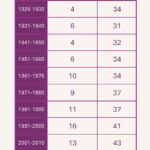
If we divide this century of the presence of the Augustinian Recollects in the Purús valley into decades, we see that the average number of missionaries in the Prelature is always less than ten until 1969 and from 1986 onwards it always exceeds ten, with the period between 1991 and 2000 being the one in which the most missionaries worked at the same time with an annual average of almost 16.
The year in which the most Augustinian Recollect missionaries were sent to Lábrea was 1970, with as many as eight new ones. This was a reaction to a serious crisis in which the Augustinian Recollect Family had to make a clear decision regarding Lábrea, or admit that it would have to leave the mission in other hands. This coincided with the appointment of the bishop of neighboring Coarí as administrator of Lábrea; he was the only non-Recollect to have led the Prelature, and was a Redemptorist.
Three other periods of significant reinforcement were 2018 (five new missionaries), and 1976 and 1988 (four more missionaries each year). However, the lack of personnel has been a recurring problem both for the exercise of the ministry and for maintaining the minimum necessary for the life of the Augustinian Recollect community in Lábrea, causing serious problems of loneliness.
The average age of the Recollect friars in Lábrea has also increased, with the trend becoming more pronounced in the present century; until 1990 it was always between 30 and 39. years of age; from 1990 to 2020 it is always above 40, and in the current decade it has not gone below 50 years.
The average stay of missionaries in Lábrea, as we mentioned earlier, is just over eight years. The region has specific living conditions that make it particularly harsh, especially for people arriving from other backgrounds.
This specificity includes the climate (humid and hot, exhausting), access to basic issues (today more normalized, but for years with serious difficulties in terms of accessibility of drinking water, sanitation, electricity), the proliferation of diseases, especially those of a tropical or infectious nature such as malaria, filaria, hepatitis, hanseniasis), isolation (both for transport and for personal communications as well as for trade and the arrival of basic products, all imported from outside: food, hygiene and cleaning, etc.).
Another factor is psychological, with two potentially serious risks for the missionaries: loneliness and a lack of prospects. In the first case, even though the missionary communities nominally had three religious members, this actually forced the missionaries to spend a great deal of time alone.
The slowness of river transport; the need to attend to the rural communities, river dwellers, and indigenous people, with long weeks spent on the boat; the bureaucratic procedures required for legal residency, as almost all the missionaries were foreigners; the medical treatments themselves, or the necessary rest periods; all these reasons meant that, in reality, it was very common for one missionary to remain in the urban area, another to be on the rivers and tributaries attending to the riverine communities, and yet another away from the mission on various errands. The result: solitude for weeks or, sometimes, even months.
Regarding the question of prospects, many missionaries at some point in their ministry succumbed to the idea that nothing was progressing in religious, social, economic, educational, human rights, or general welfare matters. It was difficult to work diligently and see no results, not even in the long term. For example, not a single Augustinian Recollect is native from the Prelature; and only one member of its own clergy was born there since 2023. This has created a certain sense of a wasteland for vocations.
Faced with these difficulties of loneliness, difficulties of inculturation and lack of prospects, the ten religious who have been in the mission for more than 20 years are especially noteworthy; the one who stands out with 50 years of service is the now emeritus bishop, Jesús Moraza, who continues to add more; with 35 years there is Miguel Ángel Peralta, with 32 years Cenobio Sierra, with 29 the bishop José Álvarez (†), with 28 Isidoro Irigoyen (†), with 27 Luis Antonio Fernández, with 26 Saturnino Fernández (†) and Juan Antonio Flores, with 25 monsignor Florentino Zabalza (†) and with 21 Juan Cruz Vicario.
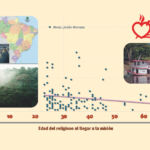
Also, given these conditions, it is important to highlight those religious men who arrived in Lábrea for the first time at over 50 years of age. Acclimatizing and becoming inculturated was an extra effort for them, especially since it was also their first time in contact with a mission. From youngest to oldest, they were Marcelo Calvo (†) and Alfredo Arambarri (†) at 53 years old, Jesús María López Mauleón at 56 (today he is bishop of Alto Xingú- Tucumã, in Pará, with a similar Amazonian context), Manuel Silva (†) and Monsignor Santiago Sánchez at 59 (the bishop, moreover, arrived directly to assume the role without having previously served in the region), José García Corcuera at 61, and Alfonso Lázaro at 66.
Since 1988, no missionaries under the age of 25 have arrived in Lábrea. Of the 116 missionaries who have come, 22 arrived practically newly ordained and in their early youth. Almost half, 57, arrived between the ages of 26 and 35; 30 between 36 and 50; and seven over 50 (mentioned in the previous paragraph).