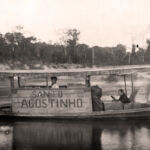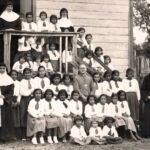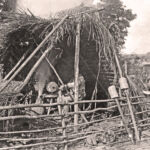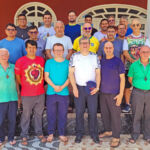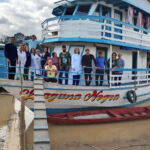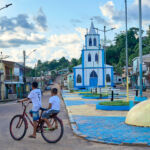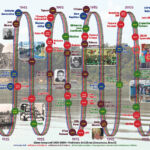

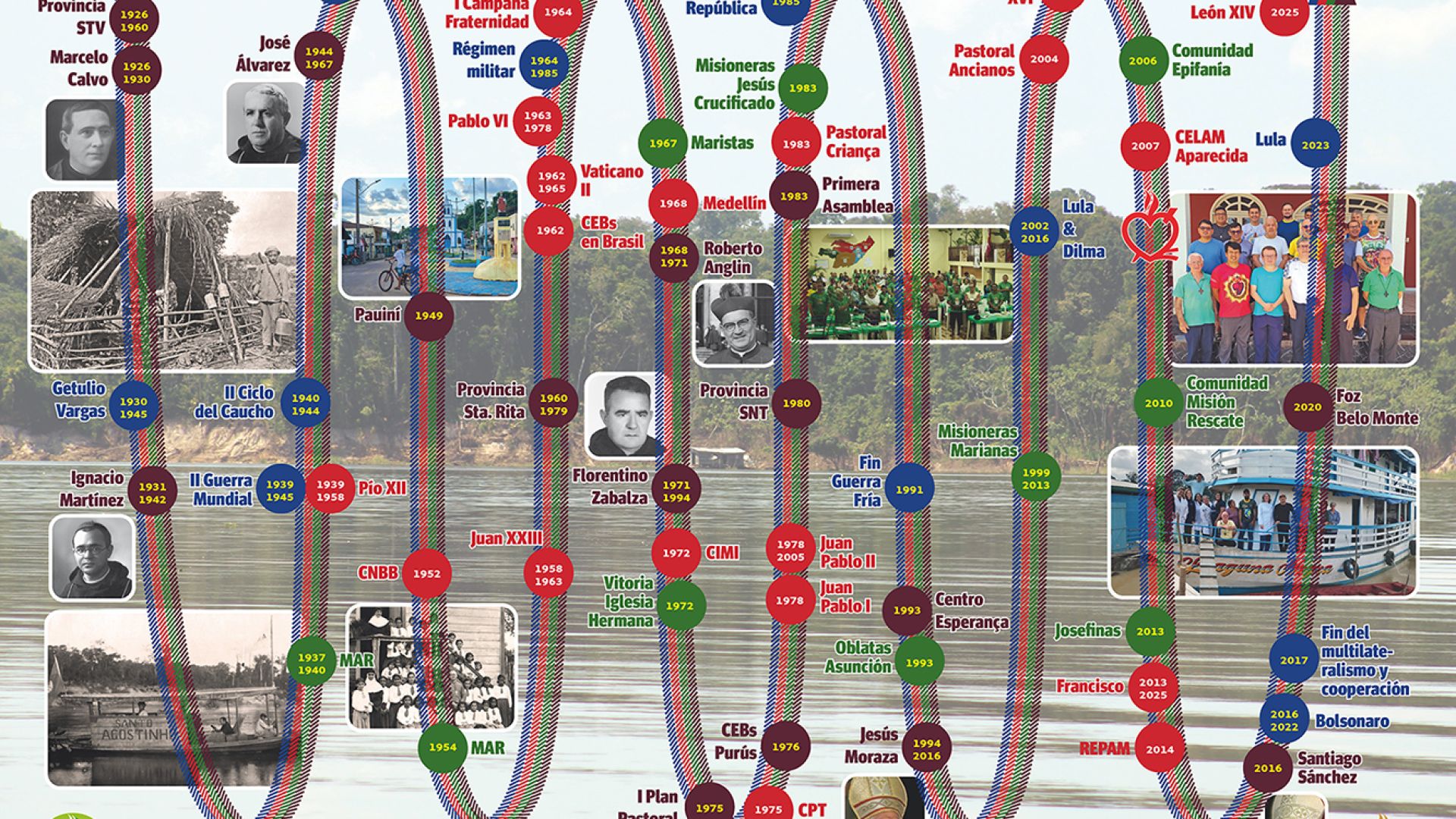
- In celebrating the first centenary of the presence of the Augustinian Recollects in the Brazilian Amazon, in the Prelature of Labrea, a timeline allows us to trace in broad strokes and put in its general context the history of that union between a charism of the Catholic Church, that of the Augustinian-Recollect Family, and the People of God scattered throughout the Amazon rainforest in the valley of the Purus River, a tributary of the Amazon.
By observing the broader context of what the world, the country, the Church, and the Recollect Family itself were experiencing, each piece fits more clearly into its context. The magazine Canta y Camina (Sing and Walk) of the Province of St. Nicholas of Tolentine has published this brief visual history:
The Augustinian Recollects have lived alongside the inhabitants of the Purus River for the last century, during which major events took place: the interwar period, World War II (with the second Amazonian rubber boom), the Cold War, the years of international cooperation and multilateralism, and the current nationalist and populist period.
The historical context has direct consequences. For example, most of the Recollects have been foreigners, which complicated their situation during the Getúlio Vargas era (1930-1945), during the military regime (1964-1985), or with the more nationalist or populist governments (1985-2002 and 2016-2022).
Regarding the Church, the Recollects arrived during the period of Christendom, then they lived with hope the opening of Vatican II and the internationalization promoted by the Latin American Episcopate (CELAM) and its meetings (especially influential for the Amazonian missions were those of Medellín -1968- and Aparecida -2007-).
Pope Francis is the one who looked most directly towards the Amazon, with a Synod dedicated entirely to it; but the Recollects in the Amazon have prayed daily in their Eucharists for nine popes: Pius XI, Pius XII, John XXIII, Paul VI, John Paul I, John Paul II, Benedict XVI, Francis and Leo XIV.
Also of great importance to the local Church have been the social pastorals developed by the Church in Brazil: the Indigenous Missionary Council (CIMI, 1972), the Pastoral of the Land (CPT, 1975), the Pastoral of Children (1983); and the inter-ecclesial collaborations of the Pan-Amazonian Ecclesial Network (REPAM, 2014).
Regarding the prelates, Marcelo Calvo (1926-1930) and Ignacio Martínez (1931-1942) paved the way; José Álvarez (1944-1967) organized the Prelature; Roberto Anglin (1968-1971) managed one of its worst crises; and Florentino Zabalza (1971-1994) restored normalcy and encouraged post-conciliar work. Jesús Moraza (1994-2016) brought the Prelature into the 21st century, and the current bishop, Santiago Sánchez, guides the Church amidst the challenges of profound contemporary changes.
The Church in Labrea has grown: the Recollects received two parishes (Labrea and Canutama, founded in 1919 but vacant until 1942); then Pauiní (1949), Tapauá (1965), and Belo Monte-Foz de Tapauá (2020) were created. Since 1983, the Assemblies have set the pastoral direction and priorities in a synodal manner.
The timeline shows the arrival of the various Orders, Congregations, Associations and Movements to the mission: the Augustinian Recollects have managed the mission from three Provinces: Saint Thomas of Villanova (1926-1960), Saint Rita (1960-1979) and Saint Nicholas of Tolentine (since 1979); the Augustinian Recollect Missionaries in two stages (1937-1940 and since 1954); the Marists (1967-2003); the Missionaries of Jesus Crucified (1983); the Oblates of the Assumption (since 1993); the Marian Missionaries (1999-2013); the Epiphany Community (since 2006); the Rescue Mission Community (since 2010); or the Josephines (since 2013).
The Brazilian Church has supported the mission, especially since the creation of the National Conference of Bishops (CNBB, 1952) and the interdiocesan twinning system. The Dioceses of Vitória (ES), 1972; Crato (CE), 2010; Campina Grande (PB), 2014; and Ponta Grossa (PR), 2020, have all been present in Labrea in one way or another.
The magazine Canta y Camina is dedicating its issues until May 2026 to this centenary. Two have already been published and are available digitally: