

On December 23, five indigenous peoples from the Brazilian Amazon appeared before the Supreme Federal Court of Brazil to denounce the serious situation of unrest, threats and invasion of their lands by those who promote illegal logging and gold mining, or use the jungle for the transport of illegal substances.
Kokama, Kambeba, Kaixana, Apurinã, and Tenharim peoples advocate for land demarcation as the only solution to limit invasion and depredation, including in the Itanury Pupykary area, in the final channel of the Seruini and Tumiã rivers, between the municipalities of Lábrea and Pauini, belonging to the Apurinã people.
These demarcations have been hampered by Law 14.701/2023, or the “Temporary Framework Law,” which establishes that indigenous peoples can only claim the territories they physically occupied when the Constitution was approved in 1988. If an indigenous people did not have a presence on those lands at that time, they could not legally obtain their return or official demarcation.
This law, however, fails to consider forced expulsions prior to 1988; and by that year, almost all the usurpations of Indigenous territory and the largest massacres of Indigenous peoples had already taken place. Requiring proof of occupation from 1988 onward makes it virtually impossible to recover ancestral lands that, by that year, had already been stolen through violence.
The Supreme Federal Court (STF) declared last December that it was unconstitutional to apply this time frame criterion for land demarcation, but the debate continues both in courts and in Parliament.
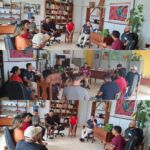
In the Prelature of Lábrea, there have been many awareness-raising and denunciation events. The Organization of the Apurinã and Jamamadi Peoples of Pauini has explained to their non-indigenous neighbors that their rights “are not negotiable, our lands are not currency, our lives do not fit into those colonial theories that try to erase history.”
The indigenous youth of Pauiní have remarked that “it is unbelievable that in the 21st century we still need to fight for the Brazilian Constitution to be upheld. We, the indigenous youth, stand firm, aware that our strength, our memory, and our responsibility are essential for future generations.”
Erick Deni, a young man from the Madiha Deni community on the Cuniuá River in Tapauá (Amazonas), also shared his message: “This law violates our land, our way of life. Demarcation now!”
And the Apurina village Morada Nova, in Acimã, has sent messages on social media reminding everyone that “the timeframe thesis attempts to erase the history of our peoples,” but “our rights did not begin in 1988; they existed before the State, before the Constitution, before this land was even called Brazil. Our territories are not just a physical space; they are part of ourselves, they are the memory of those who came before us and the hope of those who will come after”.