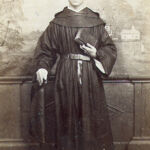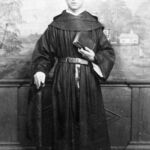

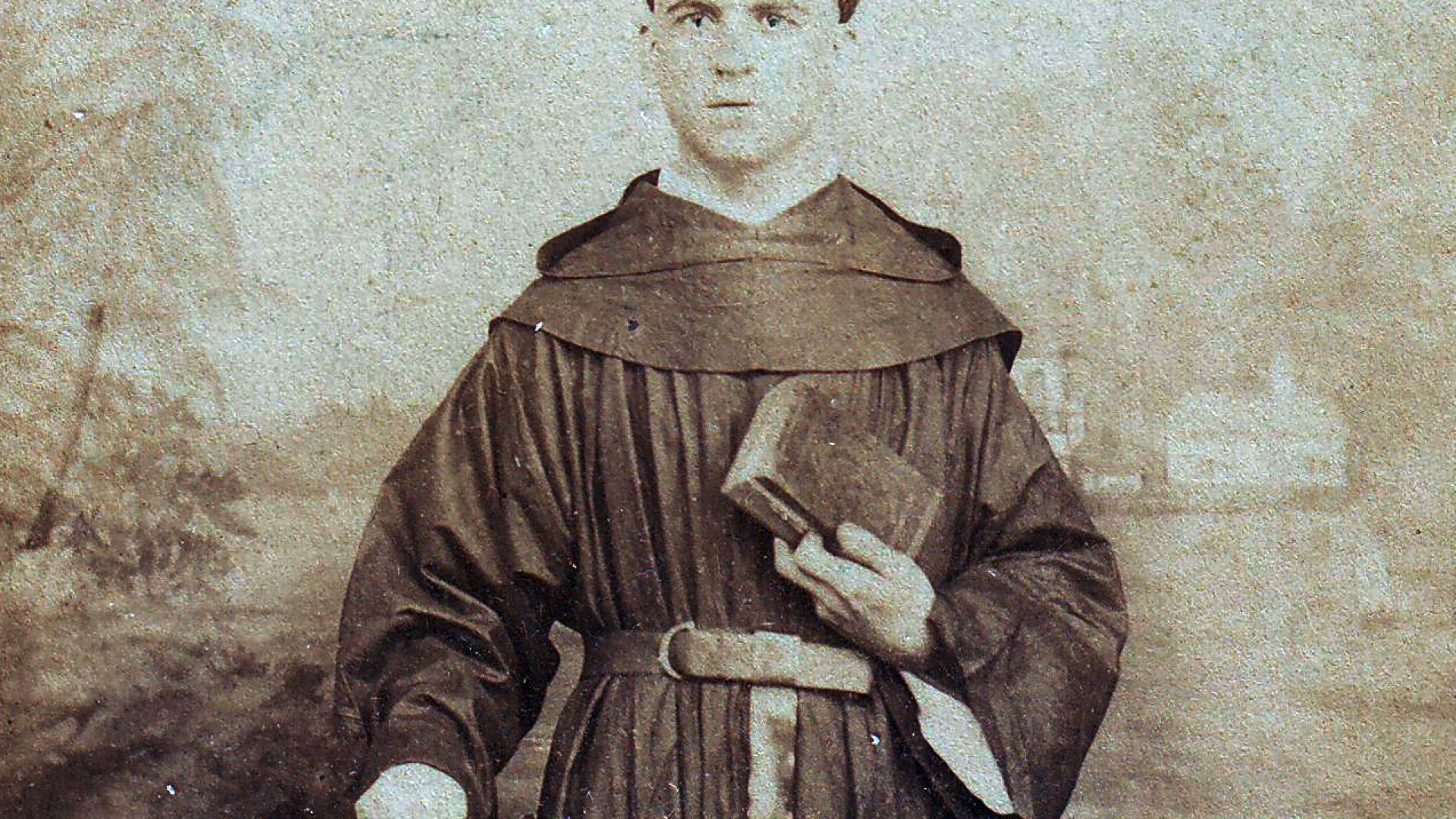
Father Patricio was born in Andorra (Teruel, Spain) and was orphaned at the age of three. His father then moved to Forcall (Castellón). At the age of 17, Patricio entered the novitiate of the Augustinian Recollects in Monteagudo (Navarra) and professed as a religious in 1860.
After completing his ecclesiastical studies, Patricio left Spain and arrived in Manila (Philippines) on April 12, 1865. In September he was ordained a priest and the following year was assigned to the island of Siquijor to learn Bisaya so he could serve in Negros Oriental. In 1868 he was appointed parish priest of Lacy (Siquijor), where he built the cemetery and an irrigation canal to improve local agriculture.
In 1874 he was appointed subprior of the Manila convent and master of novices. In 1876 he became prior of Cavite, and three years later he was sent back to Spain to be prior of the novitiate in Monteagudo (Navarre), where new missionaries were trained. He worked to strengthen the importance of study time, a novel approach at the time compared to those who placed little importance on intellectual and theological formation.
He returned to the Philippines as parish priest in Romblon and provincial vicar of the district between 1882 and 1889, the year in which he moved to Silay, Negros Occidental, where he remained until 1895. In this parish he worked tirelessly for all the neighborhoods and denounced the abuses of the rich and the misappropriations of the landowners.
At the Provincial Chapter of 1894, he was elected provincial definitor, and in 1897 he was appointed prior of the San Sebastián convent in Manila. Following the American occupation, on August 3, 1898, Adell left the Philippines with seven other religious, some of whom he had recruited himself. His mission was to find places where the Augustinian Recollects could find suitable fields of work.
The turbulent 19th century in Spain (War of Independence, Confiscation of Church Lands, revolutions, and liberal wars) had left religious life at a bare minimum. For this reason, the center of activity of the Augustinian Recollection was moved in 1835 to the Philippines, where the friars could still pursue their vocational community project and work in the pastoral field.
But the Philippine revolution at the end of the century once again called consecrated life into question. Missionaries suffered violence and persecution, and their communities were closed. With only a few overcrowded convents serving as refuges, it became necessary to find new fields of action where they could freely carry out their religious and community life.
Adell had already embraced the idea that the Province of St. Nicholas of Tolentino should not limit its apostolic presence to the Philippines. When the time came, he wholeheartedly volunteered and became the principal architect of this new presence of the Province on American soil.
On August 25, 1898, after a perilous journey, Adell’s group arrived in Panama. Bishop José Alejandro Peralta received them and offered them the Darién missions and the church of San José, from where the Colombian Recollects had departed in 1833, also forced out by General Santander’s disentailment laws.
In In Panama, six religious members of the group remained, taking charge of the new ministries, and Adell, following instructions, continued his journey to La Guaira, Venezuela, where he arrived on December 7, 1898. He established his residence in Ciudad Bolívar and from there worked to implement and organize Augustinian Recollect life in unfamiliar environments with scarce resources.
During Adell ‘s short stay in Latin America, the communities of Panama City, Ciudad Bolívar, La Victoria, Coro and Maracaibo were founded, in addition to numerous ministries in Darién, Tumaco and La Guaira.
In 1901 he was appointed Definitor General based in Madrid, a position he held for seven years. He returned to his native Aragon for the last days of his life, passing away on August 2, 1908, at the Provincial Hospital of Zaragoza.
Behind the many positions and responsibilities he held lay his exceptional worth and the influence he enjoyed in his time. He was deeply devoted to his vocation, possessing a strong spiritual character, extraordinary practical intelligence, a visionary spirit, intrepidity, a belief in divine providence, and a willingness to overcome adversity and make sacrifices for the good of the community.
Adell, with his “wretched body and giant soul, his great and fruitful heart,” was portrayed in verse by the Augustinian Recollect poet Julián Moreno. With delicate strokes, he delves into the soul of the pioneering missionary and founder to sing of his testimony and example:
“He loved you with profound faith,
Discalced, dear mother,
he loved you with all his life,
giving you life and soul;
for if there is another I do not know
who would love you better;
he was your beautiful splendor,
splendor of your happiness;
and in your hours of bitterness
a comforting angel.”
In the following stanza, a tenth, belonging to the same poem, the poet sings of the bravery of Adell, who risks his life to give life and future to the Recollection.
“For you the pilgrim of the seas
crossed the seas;
for you he raised a hundred temples
and altars in two worlds;
for you he raised banners
wherever he went, a pilgrim
and angel of heaven, divine
more than mortal,
carried the glory of the children of Augustine
to the worlds.”
The complete poem, written in La Victoria (Venezuela) in 1908, the year of Adell’s death, consists of eight ten-line stanzas, in which the poet reviews what he considers Patricio’s extraordinary qualities, such as his pioneering role in the field of educational pastoral work and his ability to summarize valuable information in reports and letters that has helped to better understand the history of the Recollection.
Father Patricio Adell
Flower of virginal cloister
where I too was born,
where I saw the light
of the celestial homeland;
angel of mortal flesh
whose existence on earth
was that of an angel of heaven
dressed in beautiful finery
who only awaits wings
to take flight.
A wretched body and a giant soul,
a large and fertile heart
in which a world fits
and there is still plenty of room;
beneath his austere countenance
of a penitent hermit,
he carried a blessed soul
so luminous and so beautiful
that it seemed like a star
enclosed in a hermitage.
I saw the elegant rose,
queen of the cool garden, displaying
her sovereign beauty
among a thousand flowers.
Such was Patricio
Adel among the Augustinian family,
flower of their cool garden,
ray of a divine star,
son of the great Augustinian,
humble and great like him.
His life was preserved
like the chalice of flowers;
he was good among the best,
and he thought himself nothing.
His refined virtue,
hidden in his heart,
was like a continuous prayer
rising to heaven
from the heart of a cloud
of profound adoration.
He loved you with deep faith,
Discalced, dear mother,
he loved you with all his life, giving you
his life and soul;
for if there is another I do not know
who would love you better;
he was your beautiful splendor,
splendor of your happiness;
and in your hours of bitterness
a comforting angel.
For you the pilgrim of the seas crossed
the seas;
for you he raised a hundred temples and altars
in two worlds;
for you he raised banners
wherever he went, a pilgrim
and angel of heaven, divine
more than mortal, carried the glory
of the sons of Augustine to the worlds.
You died, at last, like the sun,
full of radiance;
you died with your loves
like it with its sunset;
next to the Spanish pillar,
where its faith is treasured,
the last hour caught you,
and you finished the game
next to your beloved mother,
the enchanting Virgin.
Nothing was lacking in your destiny,
nothing in your love or your faith; you fell as
a good Augustinian
is seen to fall.
You died like a pilgrim
going to heaven on pilgrimage
alongside the Virgin Mary
who was your eternal desire:
and thus you said as you fell:
“I die as I wished.”