

Spain has a Master Plan for Coexistence and Improvement of Security in Educational Centers and their Environments that deals with the risks of the Internet, bullying and cyberbullying, gender violence, youth gangs or chemical dependencies (drugs and alcohol).
The National Police has specialized personnel who tailor training to real needs and specific situations. Students thus acquire tools to protect themselves, better assess those around them in physical and virtual environments, and identify adults willing to listen and support them.
They are also encouraged not to remain silent when they witness harassment or aggression, to speak up and listen to family and teachers, to be alert to dependencies and risks to physical and mental health from drugs, alcohol or gambling, to know how to deflect pressure from violent groups that drag them into committing crimes, to always create healthy and trustworthy relationships and establish safe spaces without violence where everyone is treated with dignity.
Regarding the Internet, they are advised not to trust those they do not know, to make sure who the person ‘on the other side’ really is, not to share private information or intimate images, to protect their passwords and data, not to participate in criminal acts, not to meet physically and even less to organize long absences from home with people they only know virtually.
They also learn about diversity and tolerance, equality and dignified treatment, forms of discrimination and dehumanization, road safety, environmental care, recycling, responsible consumption… It’s a completely interdisciplinary approach. Teachers are also trained to identify risk situations and recognize when a minor is a victim of a crime.
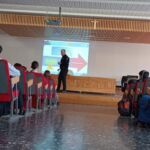
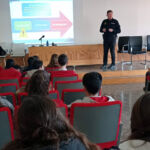
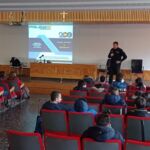
The training was conducted by the National Police’s Citizen Participation Unit, which has the best understanding of the problems and concerns in the immediate social environment. Its representative is always in contact with many groups, and his meeting with the students was professional, approachable, and very enlightening.
He addressed bullying in a comprehensive way, pointing out its legal consequences, the dynamics and emotions it provokes, and what its greatest enemy is: “Silence is the bully’s best ally. Breaking that silence is the first step, and the bravest, to solving the problem.”
The students learned to identify bullying and cyberbullying behaviors, to differentiate between occasional conflicts and systematic bullying; and they discovered how the group has the power to stop bullying by supporting the victim and reporting it through the appropriate channels.
The students’ response was very positive; they actively participated and showed their commitment to building, together, a school free of bullying.