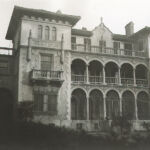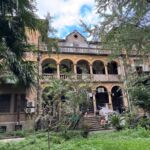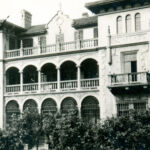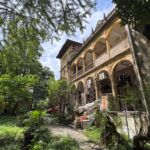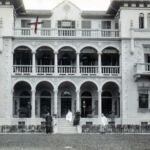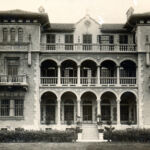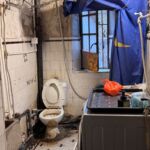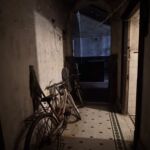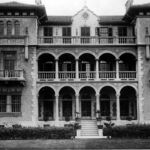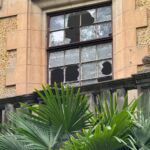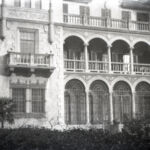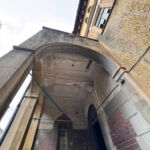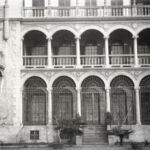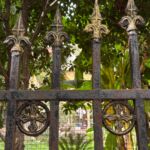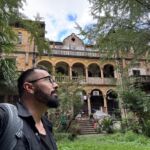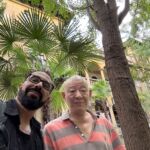

Raúl García is a former seminarian of the Augustinian Recollects who works in the tourism sector. During a work trip to Shanghai, he discovered with astonishment that, “among the enormous buildings of this city, the old Procurator’s Office of the Augustinian Recollects still stands.”
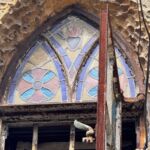
Excited, he wanted to see it and they even let him go inside and film the exterior and interior of the building: “I went inside and I’m very, very excited.” He was thrilled to discover the remains of the chapel’s old stained-glass windows, deteriorated, but with the Augustinian heart and book still clearly visible.
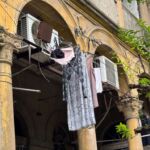
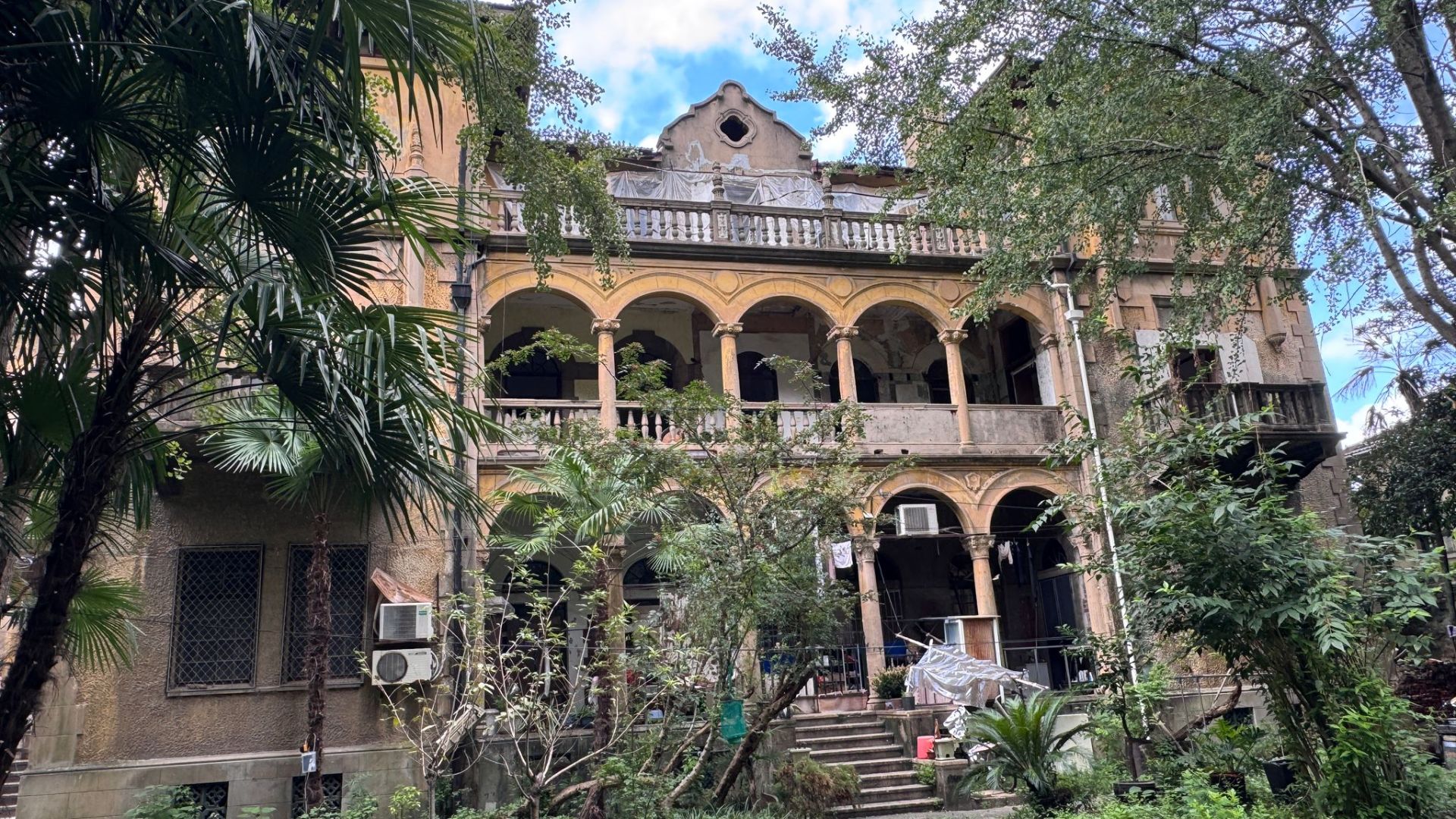
The place looks neglected, but the main features of the building remain standing.
Number 6 Xiangshan Road is listed as a historic building by the municipality of Shanghai, and is also featured in local historical articles and blogs that describe it as a former headquarters or residence of the Augustinian Recollects.
- No. 6 Xiangshan Road, former headquarters of the Augustinian Church.
- Former office and missionary residence of the Spanish Augustinians.
- Historic buildings on Xiangshan Road.
Some of these records mention that the property suffered losses and partial disappearance of important elements of its architecture around the year 2000.
The former French Concession district was one of Shanghai’s most aristocratic areas in the 19th and 20th centuries. Its tree-lined streets are lined with old villas and mansions in eclectic styles, some with French and Renaissance influences, others with Spanish features, all designed by foreign architects who worked in the city in the 1920s.
At number 7 Xiangshan Road is the house of Sun Yat-sen, physician, politician, military leader, statesman, philosopher, and ideologue who was the first president of the Republic of China and founder of the Kuomintang. Other points of interest near the former Procurator’s House of the Recollects are Wukang Road and Huaihai Middle Road and several historical parks.
This plaque now stands at the entrance to the former Recollect complex:
| 优秀历史建筑
香山路6号 法国文艺复兴式花园住宅,砖木结构。建于1930年代。 现为优秀历史建筑予以保护。 上海市人民政府 一九九四年九月二日公布 |
Which, translated, means:
Outstanding historical architecture
No. 6, Xiangshan Road
French Renaissance-style residence with garden, featuring a mixed brick and wood structure. Built in the 1930s. Currently listed as a protected historical building.
Shanghai Municipal People’s Government
Declared on September 2, 1994.
The building is classified by public authorities as a Mediterranean Renaissance-style villa with Hispanic elements. Its most notable features are its arched porch, symmetrical façade, gardens, and the use of imported materials in its construction.
In 1910 the Province of Saint Nicholas of Tolentine, after overcoming many difficulties, was able to settle in Shanghai, where a religious procurator managed its material interests; in fact, it was only in March of 1921 that it opened a public oratory.
The religious had gone through the ordeal of almost losing all their resources during the Philippine Revolution: confiscations, robberies, expulsions without the right to compensation… Many Catholic Orders and Congregations from the Philippines opened procurator houses in Shanghai to keep their assets and investments safe.
On February 7, 1907, two Augustinian Recollects, Félix Garcés and Jacinto Marticorena, disembarked in the Chinese metropolis to acquire a residence to serve as a procurator’s office, infirmary, and support center for the opening of a future mission in China. Their task was not easy, because the bishop refused to authorize the opening for three years and only relented in December 1910 after direct intervention from the Holy See.
However, the initial experiences with this Procuratorship were very negative. The first procurator acted unprofessionally and without following basic rules of both economic administration and Church procedure. It was a major scandal at the time and caused considerable unrest throughout the Province. The following procurators were Jacinto Marticorena (1913-1919), Tomás Cueva (1919-1934), and Leoncio Sierra (1934-1945).
Lacking knowledge of the Chinese language and environment, these procurators were unable to adequately navigate such a complex and competitive financial center, and, finding themselves overwhelmed, they turned to advisors who were not always selfless. Cueva, for example, could not even express himself freely in English.
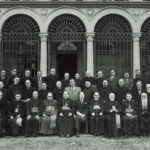
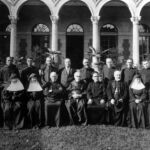
Procurator’s building was inaugurated in 1919 and is the work of Abelardo Lafuente, a Spanish architect based in Shanghai. Two Recollect friars normally lived in this house until the opening of the mission in Shangqiu (then called Kweiteh) in 1924, which increased the community and the number of visiting friars. By 1933, the community had four members.
The Procurator’s Office managed urban properties and rental buildings, as well as various investments that were difficult to value due to currency instability and constant depreciation. It even supported the mission and sent money to the formation houses in Spain for their upkeep, but from 1949 onwards its activities were heavily restricted by the new communist government, which eventually seized its funds and expelled, in December 1955, the Recollect friar Francisco Sanz, the last procurator (1949-1955).
Spanish consul in Shanghai was expelled by the authorities before Fr. Francisco, so the Recollect friar took charge of the Spanish Legation Archives and arranged for their transfer to Spain via diplomatic mail. The Spanish government rewarded his services with the Order of Isabella the Catholic.
In the Province of Saint Nicholas of Tolentine, there was always distrust of the Shanghai Procuratorship. The valuable services rendered to the mission temporarily slowed this distrust, but the embezzlements of the first three years, the 1929 crisis, the mismanagement of the procurators, the Japanese occupation of Manchuria, the bombing of Shanghai (1932), and the devastating Sino-Japanese War (1937-1945) ultimately prevented any possible success and any positive perception of the mission.
In 1928 it barely yielded enough to cover the needs of the house and the mission; in 1934 it was able to send resources to the Ivybridge convent and contribute to the purchase of the Kansas monastery; in 1936 it needed help from Manila to survive; many of the properties where it invested were destroyed by bombers, up to 15 houses; and in 1947 it still owned seven farms and several shares, but the currency was so devalued that it barely yielded enough to sustain anything.