
Friar Alfonso helps us to pause on the path of Advent, showing us Mary as a mother and teacher of hope. Not a naive or evasive hope, but a hope that knows how to wait, that perseveres through weariness and silence, and that is patiently nurtured until it gives birth to new life.
Mary, teacher who learns to wait
After a year in which hope has marked the rhythm of our lives for many—sometimes as longing, other times as resistance, almost always as learning—today I would like to pause to look at Mary as the mother of hope.
Not as just another pious title or as an image inherited by custom, but as a deeply human and believing key to interpreting this time we are going through. Because to speak of Mary is to speak of a hope that does not flee from the world, that does not take refuge in easy optimism or ignore pain. It is to speak of a hope that knows how to wait.
Perhaps that is why hope and waiting share a root and a destiny. Hope is, at its core, the mother of waiting: the one who conceives it, sustains it, and educates it. And no one like Mary can teach us that difficult art of waiting without despairing, of waiting without giving up, of trusting when nothing is yet clear.
Advent, a fragile territory of constancy
Advent places us in that fragile territory each year. We begin with enthusiasm: we light the first candle, formulate resolutions, and promise ourselves to live these days with more depth, more silence, more prayer. But—as so often happens in life—the temptation arises to start very well and lose strength as the days go by.
The waiting lengthens, weariness prevails, and hope runs the risk of fading.
Mary and waiting as real gestation
Mary does not experience Advent as a spiritual parenthesis, but as a real gestation. In her body, in her history, in her faith. She does not wait for ideas or administer liturgical times: she waits for a Person. She welcomes a mystery that overwhelms her.
That is why her hope is not naive. She knows that this Son will bring light, but also a sword; promise, but also a cross.
Maintaining the rhythm of waiting
The Church rightly recognizes her as a sign of sure hope and comfort for the People of God. Not because she avoids suffering, but because she goes through it without letting it have the last word.
Mary remains when everything seems to collapse. She keeps when she does not understand. She trusts when she does not control. She waits when everything invites her to abandon.
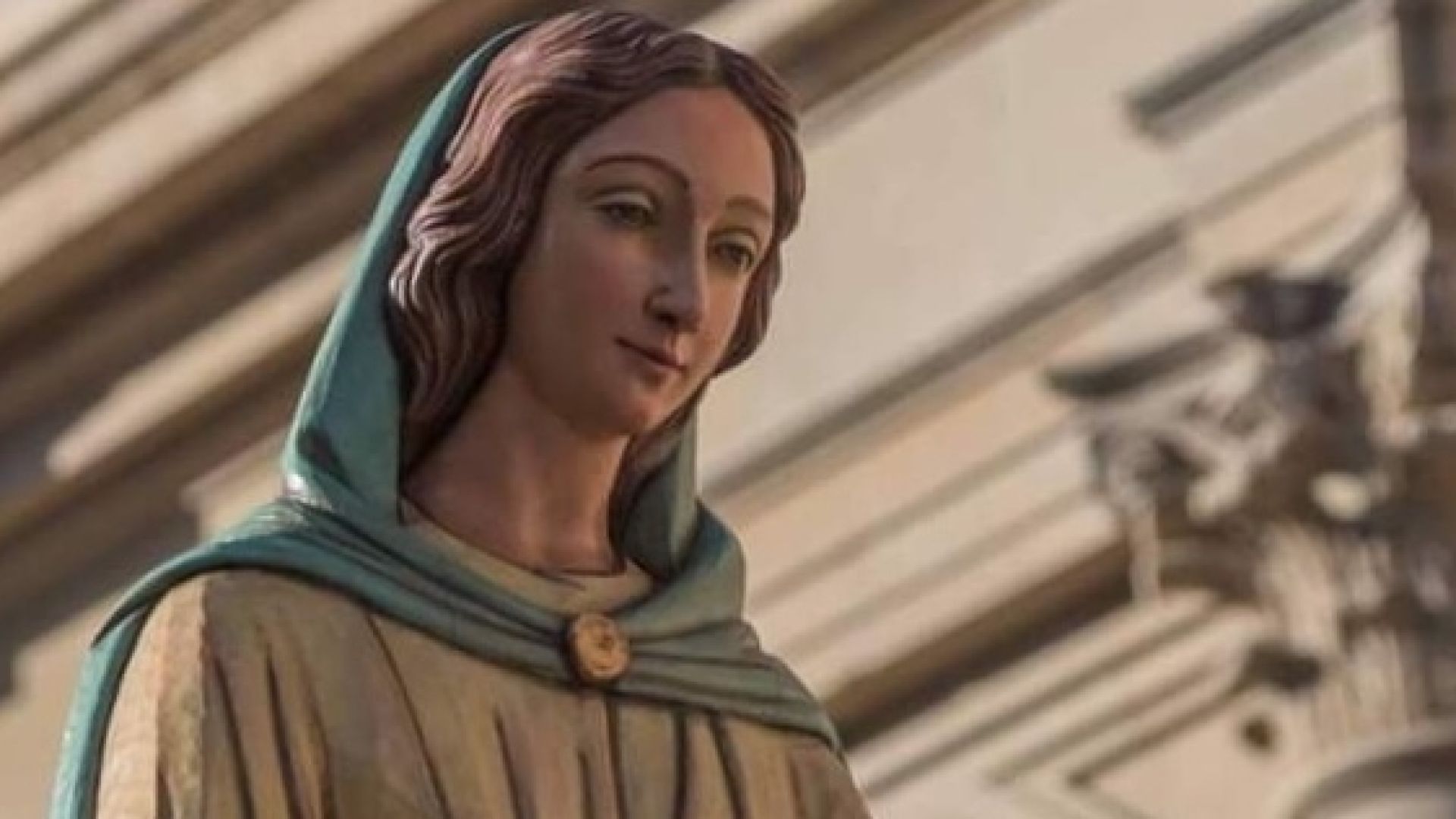
Perhaps that is why popular piety has understood her so well. The images of Hope—with their contained tears, their raised gaze, their green symbols, their firm anchor—are not aesthetic evasion. They are a silent catechesis on a hope that does not deny pain, but neither does it dwell in it.
In this Advent, Mary teaches us something decisive: that hope needs rhythm. An initial impulse is not enough; constancy is needed. As the Advent song sings:
Holy Mary of Hope, maintain the rhythm of our waiting.
Maintain it when enthusiasm fades, when the promise is delayed, when the night seems long.
A hope that allows Christ to be born
Because Christian hope does not consist only in something good arriving one day. It consists in allowing Christ to be truly born in our lives and transform them. And that requires patience, fidelity, and time. It requires letting God act in His own way and in His own time.
Mary, Mother of Hope, does not rush deadlines or demand guarantees. She trusts. And by trusting, she opens space for God to do His work.
Perhaps, after all that we have experienced this year, what we need most is not a noisy hope, but a hope nurtured in silence, cared for day by day, sustained even when we feel nothing special.
May she help us not to abandon the waiting, not to slow down the rhythm, to believe that God continues to come even when He seems to delay. And may her Son, by being born in us, make all things new.