


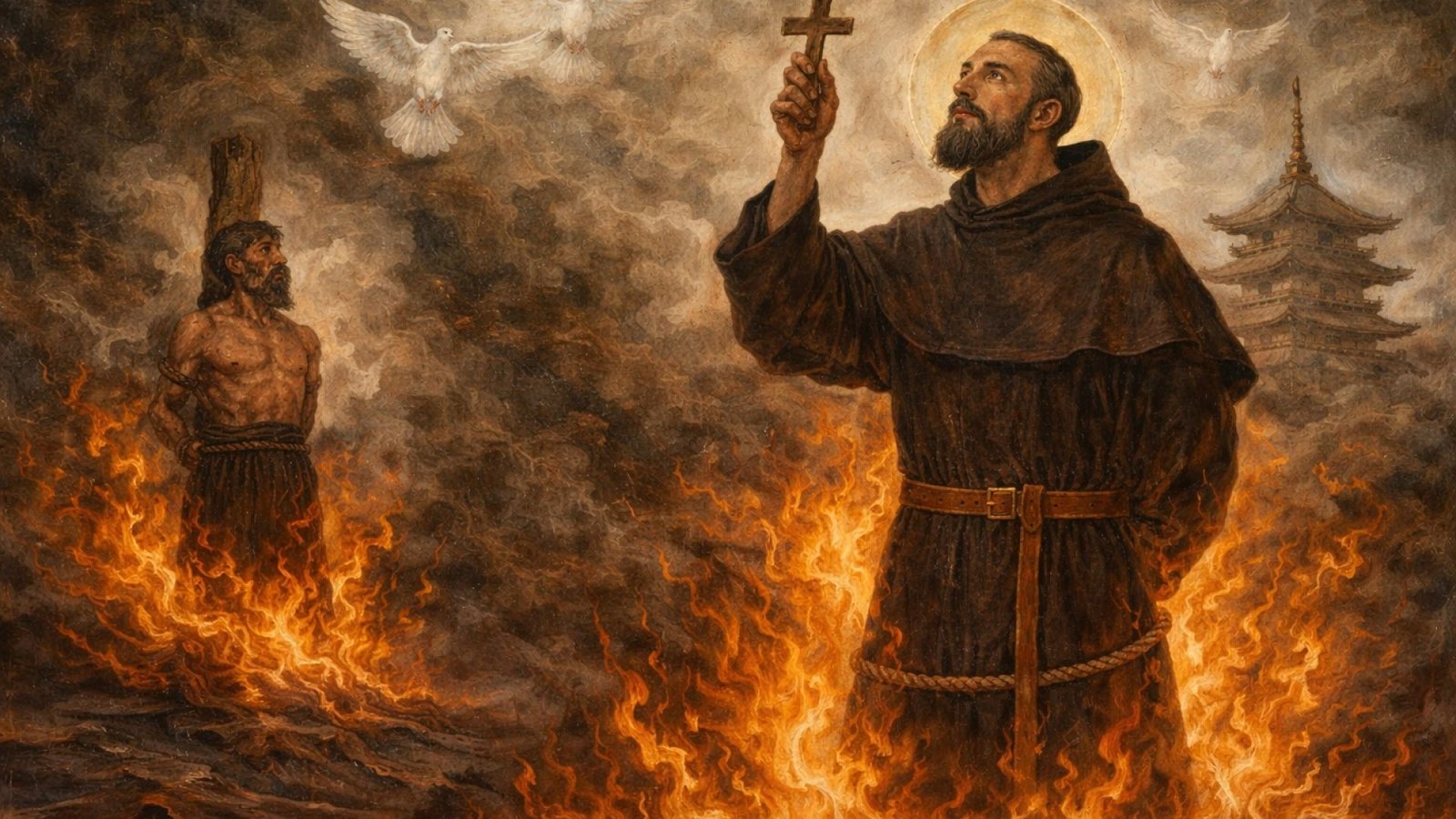
The story of Blessed Vicente de San Antonio, an Augustinian Recollect and martyr in Japan, is part of the witness of the Japanese martyrs of the 17th century, Christians who kept the faith alive amid one of the harshest persecutions in the history of the Church. In this text, Aurora Campos vividly recreates the journey of this Portuguese missionary who, from Mexico and the Philippines, made his way to Nagasaki to proclaim the Gospel and ultimately give his life for Christ.
Missionary vocation: from Portugal to Japan
The hurricane roared furiously over the China Sea. The wind whistled through the masts like a piercing lament, and the drenched deck gave off a pungent smell of salt, crushed seaweed, and damp wood. Waves as high as liquid walls crashed against the fragile vessel, making the planks creak and the ropes strain to their limit. In the midst of that din of foam and lightning, Blessed Vicente de San Antonio could not help recalling another storm, some three years earlier, around 1620, when, in the middle of the Atlantic on the way to Mexico, another tempest had placed the ship he was travelling on in grave danger.
Then, too, the sky had suddenly darkened, and the air smelled of hot tar and fear. Amid thunder tearing through the night and sailors running about soaked, he had promised God that, if He delivered him from that storm, he would enter religious life as soon as he reached Mexico. Neither storm managed to sink the ships. And after each one, a decisive horizon opened. At the end of the Atlantic storm, the Augustinian Recollect habit awaited him, which he received in Mexico City in 1621. There he began his novitiate, wrapped in the silence of the cloister and the scent of burning wax, before embarking shortly afterwards for the Philippines. At the end of the storm in the China Sea, clandestine apostolic work in Japan awaited him, persecution, and finally glorious martyrdom in Nagasaki on September 3, 1632.
Clandestine apostolic work among persecuted Christians
In 1623, when he landed near Nagasaki, sea mist shrouded the coast, and the air carried the aromas of dried fish and burning charcoal. He had to separate from his companion, Blessed Francisco de Jesús, because that year the Japanese authorities had expelled Spanish merchants. Francisco, being Spanish, had to take refuge in the mountains. Vicente, however, disguised as a merchant, was able to blend in among the Portuguese who frequented the port. Not without reason: he had been born 33 years earlier in Albufeira, Portugal, around 1590, the son of Antonio Simôes and Catalina Pereira.
In Nagasaki he found an underground Christian community that, despite persecution, burned with steadfast faith, like an ember beneath the ashes. In discreet homes, lit by oil lamps whose smoke hung in the air, he celebrated Mass at dawn, after spending the night hearing confessions and preaching. He learned Japanese—“terrible,” he would write—and, constantly changing refuge, eluded the emperor’s spies. At times he disguised himself and played the guitar; his clear voice floated into the night, deflecting suspicion.
By 1627 the fruits were abundant, but the persecution intensified. Two years later, betrayed by a Christian under torture, he was surrounded on an island near Nagasaki. It took 36 boats, 600 men, and setting the island on fire. For six days he held out amid cold rain and acrid smoke, sustaining himself only on the three hosts he carried with him. He was arrested on November 25, 1629, after six years of intense pastoral activity.
Imprisonment, persecution, and martyrdom in Nagasaki
In the Nagasaki prison he was reunited with the Mexican Augustinian Fr. Bartolomé Gutiérrez, with Fr. Francisco de Jesús, and with the Japanese Jesuit Antonio Ygida; later a Franciscan would join them. Two weeks later, on December 11, 1629, they were transferred to the Omura prison: narrow wooden cages suspended over a damp, foul-smelling hollow, where the stench of rot was such that “even with one’s nose covered, one could not pass outside.” They remained there for almost two years.
The cage became a pulpit. In another large cell they confined numerous faithful—men, women, and children—whom they encouraged day and night. Almost all were martyred on September 28, 1630. From those cages they wrote letters to Manila; twenty-five of the thirty preserved date from that time.
On November 28, 1631, they were taken to Unzen of Arima, an “hell” of sulfurous waters at the foot of snow-covered mountains. The smell of sulfur burned their nostrils. Bound and stripped of their habit, they slowly poured acidic water over their shoulders and back, like a tongue of fire descending to their heels. To the burns were added the cold and snow of that winter of 1631. Vicente endured five days; Francisco, seven. After 31 days in that “hell,” they returned to Nagasaki in early 1632. Vicente was so covered in sores that he could not ride a horse; he was carried on a stretcher, a “reed tomb.”
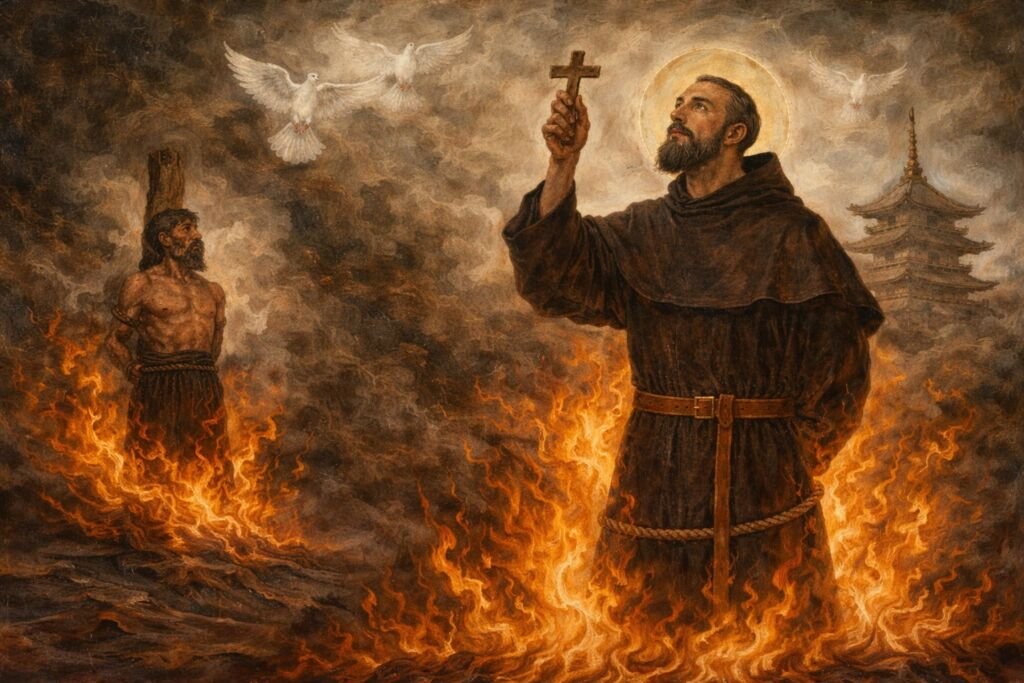
Nine more months in prison, one sardine a day—at most two—and a black rice “not even fit for dogs.” Finally, on September 3, 1632, on the hill of the martyrs of Nagasaki, they were tied by a finger to a post and surrounded with damp wood. The thick smoke, smelling of green wood, soon suffocated them. Their bodies were burned and their ashes thrown into the sea.
The witness of Blessed Vicente de San Antonio
That sea which, with its storms, had led him to the Recollect habit, received his remains. Today, on the hill of Nagasaki, a great cross commemorates the martyrs. Among the engraved names is that of the young Portuguese who took the habit in Mexico, professed in Manila, and bore witness to Christ in Japan: Blessed Vicente de San Antonio.
From Blindness to Light: The Path of Faith in the Gospel of the Man Born Blind