

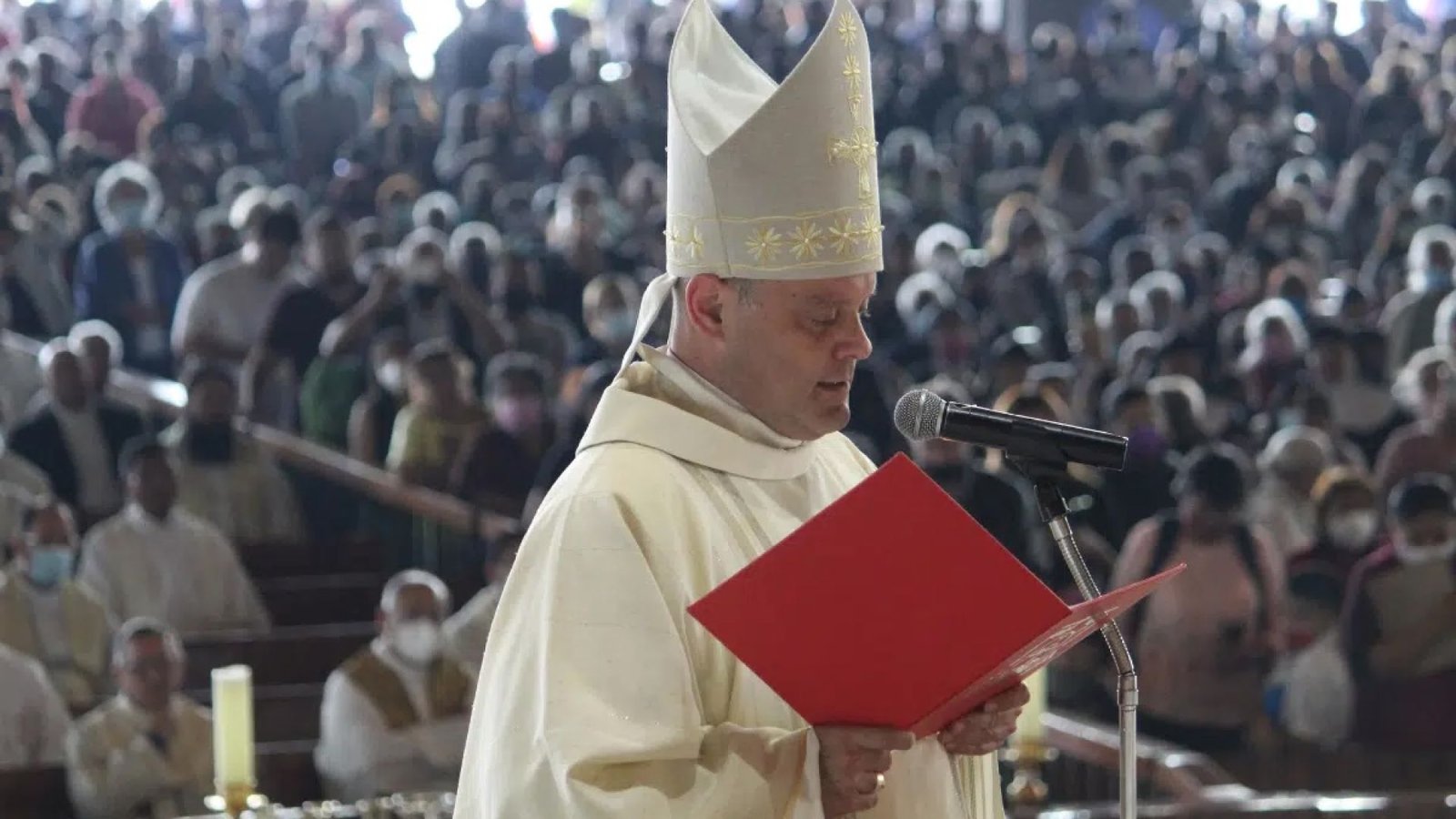
The information was published by COPE following an interview on TRECE with the auxiliary bishop of the Primate Archdiocese of Mexico, the Augustinian Recollect Bishop Francisco Javier Acero.
COPE has published an interview conducted on the programme Ecclesia es Domingo (TRECE) with Bishop Francisco Javier Acero Pérez, OAR, auxiliary bishop of the Primate Archdiocese of Mexico, in which he analyses the recent escalation of violence linked to drug trafficking in the country and underscores the role of the Church in building peace.
Bishop Acero is an Augustinian Recollect religious, born in Valladolid (Spain) and a missionary in Mexico since 1999. He is one of the signatories of the statement by the Mexican Bishops’ Conference in which the bishops call for calm, prudence and unity in the face of the events recorded in various states following the operation against the drug trafficker known as “El Mencho”.
In the midst of the moments of violence we are experiencing today in some regions of the country, as the Mexican Episcopate we want to draw close to every family, parish and community, accompanying them with our prayer and fraternal closeness.
May Our Lady of Guadalupe, Mother and… pic.twitter.com/E1Q2FCJ0MF
— CEM (@IglesiaMexico) February 22, 2026
“There is calm, but there is fear”
In statements reported by COPE, Bishop Acero explained that, although in Mexico City the situation has not been as serious as in other states, the general climate is one of unease: “There is calm, but there is fear. And now what we have to do is begin to overcome fear.”
Following the operation against the cartel leader, roadblocks were set up in as many as 20 states across the country, highlighting the operational capacity of these criminal organisations.
“Just imagine the ability drug trafficking has to start blocking the roads on the spot,” the bishop stated.
On the Sunday following the events, in some places Eucharistic celebrations were suspended for security reasons, both to protect the faithful and the priests.
Violence becomes normalised
In the interview broadcast by COPE, the auxiliary bishop lamented that part of the tragedy lies in the social normalisation of violence:
“We have become accustomed to tremendous violence.” Echoing an expression of Pope Francis, he spoke of the “globalisation of indifference”, to which he added a “globalisation of powerlessness”.
In some regions affected by drug trafficking, he explained, neighbours themselves warn one another when they anticipate movements by armed groups, to avoid leaving their homes. A dynamic that shows the extent to which violence has shaped daily life.
Bishop Acero also recalled that Mexican bishops had already been warning since 2000 about the growing penetration of drug trafficking into communities.
The Church’s commitment to peace
According to COPE, the prelate highlighted the Church’s commitment to accompanying victims and promoting social dialogue. Actions mentioned include fostering meetings between the government and the families of missing persons, as well as addressing other serious human rights crises, such as violence against women, migrants and Indigenous peoples.
“The Church accompanies where the State is not present. We are prophets of the people of God, not chaplains of any State,” he stated.
Bishop Acero stressed that building peace requires political consensus and genuine “social friendship”, and he even raised the possibility of having international observers, as has happened in other Ibero-American countries.
“Evil is overcome by the force of good”
Regarding a possible visit by the Pope to Mexico, the auxiliary bishop considered that it would be a great sign of hope, although he acknowledged the difficulty of the current context. “Here we need to calm down a bit, live more united so that the Pope can come,” he noted.
His final message, reported by COPE, went straight to the heart:
“Let us not forget that evil is overcome by the force of good.”