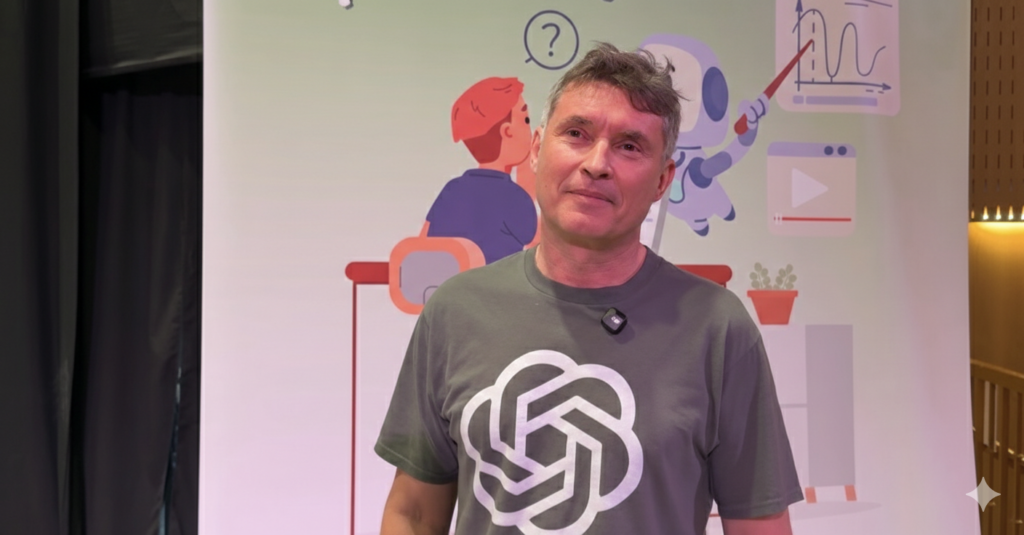

The XXXII Augustinian Education Forum 2026 continued its program with a presentation by Professor César Poyatos, a lecturer in Educational Technology at the Autonomous University of Madrid (UAM) and a specialist in pedagogical innovation. His talk, titled “Generative Artificial Intelligence in Education”, offered a rigorous reflection on the opportunities, risks, and integration criteria for AI in classrooms.
A Doctor of Education with extensive experience as a secondary school teacher, pedagogical advisor, and trainer in leading academic institutions, Poyatos approached the issue with a clear premise: artificial intelligence should neither be idealized nor demonized, but critically understood.
Banning does not educate
One of the central messages of his intervention was unequivocal: “Banning does not educate.” Faced with the proliferation of generative AI tools among students, the response cannot be solely restrictive.
The real challenge —he explained— is digital literacy and the development of students’ digital competence. This implies teaching an ethical, responsible, and safe use of technology, always oriented towards a clear pedagogical purpose.
Understanding how these systems work, what their limitations are, and what biases they may incorporate is an essential part of the educational process. AI cannot be presented as an absolute source of truth, but rather as a tool that requires discernment. In this task, the guidance of teachers and families is decisive.
Real risks: disinformation, biases, and inequality
Poyatos also warned of the risks associated with the uncritical use of generative artificial intelligence. Among these, he highlighted three particularly relevant in the educational field:
Disinformation, due to its ability to generate plausible but inaccurate content.
Algorithmic biases, which can reproduce prejudices present in training data.
Inequality, insofar as unequal access to these technologies can widen the educational gap.
These risks do not invalidate the tool, but they demand solid training. The teacher does not lose prominence; on the contrary, they become an essential mediator in teaching how to critically evaluate the results offered by AI.
Personalization as a pedagogical opportunity
In contrast to the risks, artificial intelligence opens up far-reaching pedagogical possibilities, especially in the field of learning personalization.
Poyatos clarified a fundamental idea: AI does not personalize on its own. It is the teacher who, supported by the tool, can adapt teaching to the specific needs of each student.
Among the practical applications he highlighted:
Adapting the cognitive load of exercises and tasks.
Generating content in multiple formats (text, audio, video, presentations) to cater to different learning styles.
Supporting the design of assessment instruments.
The possibility of anticipating learning difficulties in certain areas.
AI, in this sense, can become a strategic resource that expands the teacher’s capacity to accompany individual processes without sacrificing the communal dimension of the classroom.
Integrate, do not isolate
The final reflection pointed to a fundamental issue: digital competence cannot be treated as a marginal addition or an isolated subject. It must be integrated transversally into the curriculum and school culture.
In coherence with the spirit of the Augustinian Forum, technology is not proposed as a substitute for the educator, but as an instrument at the service of comprehensive education. The key is not technological fascination, but its critical and pedagogical integration.
Generative artificial intelligence is here to stay. The question is not whether it should enter classrooms, but how to do so responsibly, competently, and with educational purpose.