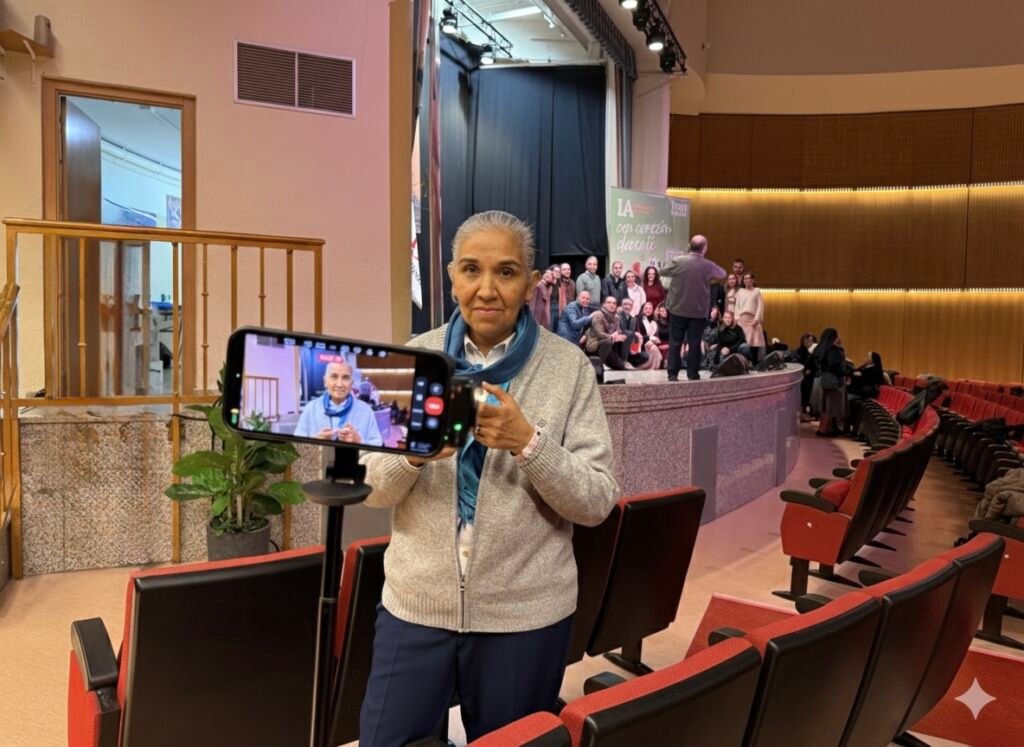


The XXXII Augustinian Education Forum 2026 began its educational journey with a compelling and necessary proposal: to reflect on ‘AI with an Educator’s Heart.’ The first presentation, titled ‘Educating in the Age of Algorithms: Humanism and Digital Transformation,’ was given by Mr. Tirso Maldonado, an expert in digital transformation and new business models.
From the outset, the speaker centered his intervention on a clear assertion: artificial intelligence is not, first and foremost, a technological matter, but a human one. After more than three decades of discussing digital transformation, its actual maturity in application remains low. The reason? An excessively tool-centric approach, rather than focusing on people or processes.
Beyond Technocentrism
Maldonado recalled that every major technological milestone has risked deficient implementation due to a failure to redesign processes beforehand or adequately train those who must use them. Technology, without a renewed organizational culture, ends up underutilized or generates resistance.
In the case of artificial intelligence, the phenomenon is particularly visible. Despite its rapid popularization over the past three years, it is still frequently used as if it were a simple search engine.
“Entering four or five sentences and expecting an optimal result is an unrealistic expectation,” he explained.
The key is not merely using the tool, but understanding how it works. Knowing how to design a good prompt, understanding the model’s limitations, critically verifying results, and framing its use within a coherent workflow are essential competencies for achieving real and sustainable value.
A Shared Educational Responsibility
Within the framework of the Augustinian Forums, this reflection takes on a particular dimension. Educators and students share a specific responsibility in this new cultural stage.
On one hand, teachers need rigorous training to integrate AI into pedagogical practice without losing professional judgment or the centrality of educational guidance. On the other hand, students must learn to use it purposefully, with critical thinking and academic ethics.
It is not merely about permitting or prohibiting its use in the classroom, but about educating for its responsible management. The debate on AI governance no longer belongs solely to technology companies or corporate environments; it is a transversal issue that affects the comprehensive formation of new generations.
Responsible Guidance and Augustinian Values
One of the most compelling points of the presentation was the connection between responsible technology and Augustinian values. The Augustinian family’s educational tradition—focused on the search for truth, interiority, community, and holistic formation—offers a solid framework for guiding the adoption of AI.
Speaking of ‘AI with an Educator’s Heart’ implies precisely that: not reducing education to automated processes, but integrating technology in service of human growth. Artificial intelligence can become a powerful tool for personalizing learning, supporting creativity, or improving academic management, provided it is guided by clear ethical criteria.
The proposal outlines a concrete roadmap: organizational diagnosis, differentiated training by roles, design of quality standards for prompt usage, clear data protection policies, and continuous evaluation of pedagogical impact.
Accelerating with Purpose
The goal is not to repeat the errors of the last thirty years or to indefinitely prolong the gap between expectations and results. Digital transformation, if it is to be authentic, must place people, not algorithms, at its center.
The XXXII Augustinian Education Forum 2026 thus opens a space for strategic reflection for the educational centers of the Augustinian Recollect Family. The question is not whether artificial intelligence will be present in our classrooms—because it already is—but how to accompany it with discernment, competence, and responsibility.
Educating in the age of algorithms demands more humanism, not less. And perhaps that is the most urgent task: ensuring that technological innovation always has an educator’s heart.