

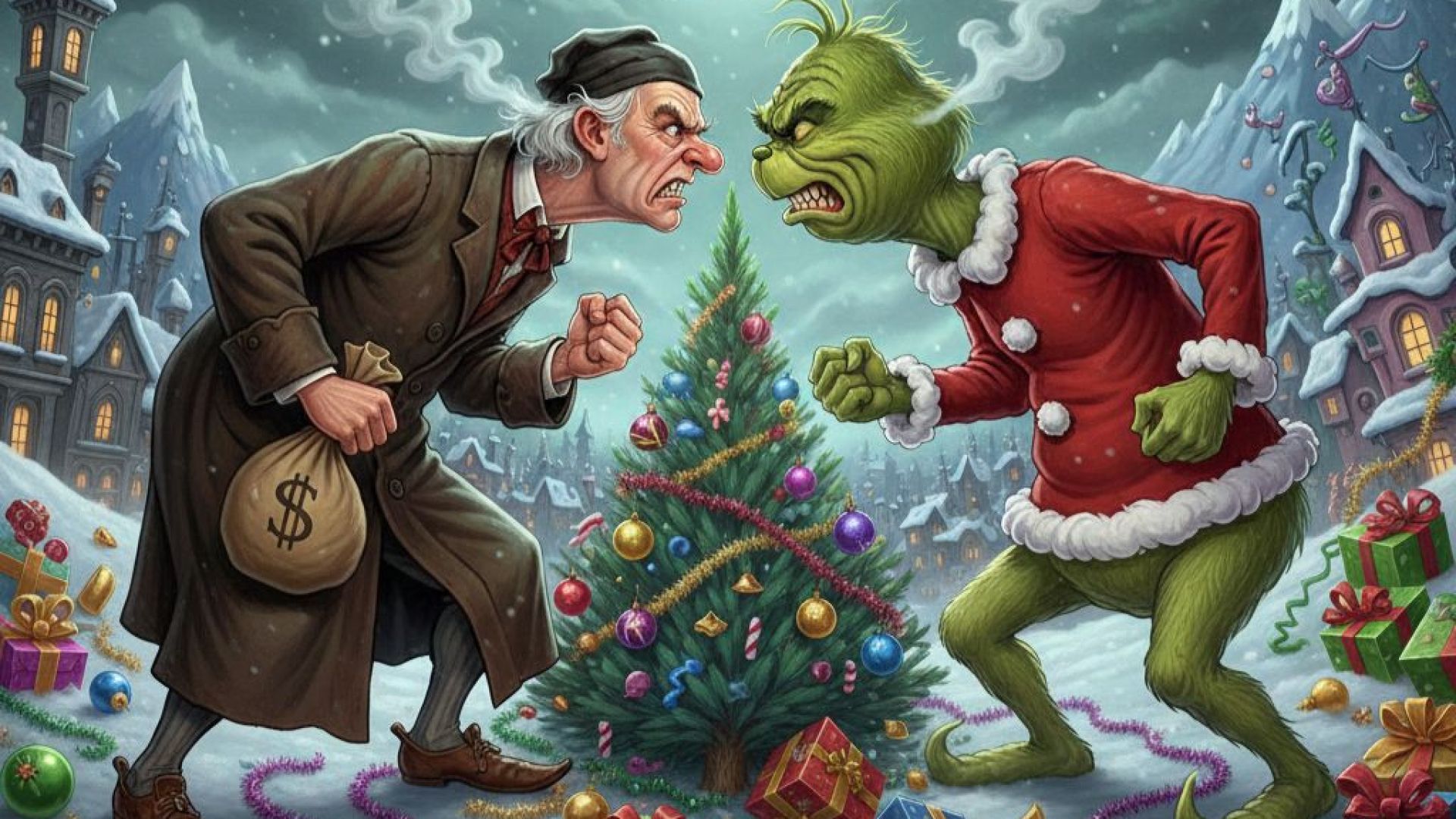
Friar Alfonso Dávila invites us to rethink two classic Christmas villains—the Grinch and Ebenezer Scrooge—to discover how their stories reveal a very current temptation: to distance ourselves from the true meaning of the holiday when we focus on our own pain or on money, forgetting what really matters.
Two villains and the same conversion
I recently discovered Sandra Cantalejo on LinkedIn thanks to a post about the so-called Grinch effect. It wasn’t talking about Christmas, but about perspective: how we judge a reality when we observe it from the outside, without inhabiting it, without understanding its rhythms or its connections. And I thought that perhaps something similar happens to Christmas. That many times we look at it from afar—with weariness, irony, or suspicion—and, in doing so, we lose the essential.
Because Christmas has villains. These “bad guys” don’t wear capes or swords, but they are disturbingly familiar. The Grinch and Ebenezer Scrooge were born from the imagination of Dr. Seuss and Charles Dickens, separated by more than a century, but united by the same mission: to unmask the selfishness that empties the holiday of meaning and, above all, to help us rediscover the true meaning of Christmas.
The Grinch: looking at Christmas from the outside
The Grinch, protagonist of How the Grinch Stole Christmas!, does not hate Christmas for what it is, but for how he contemplates it. He lives isolated, on top of the mountain, observing Whoville from a distance. Everything seems like noise, consumption, exaggeration to him. He judges without inhabiting. He believes that Christmas is about things and not people.
His conversion comes when he discovers something disconcerting: even without gifts or decorations, people continue singing. The holiday endures because it does not depend on what is bought, but on what is shared. Then he comes down. Not to distribute from above, but to sit at the table. His heart does not only grow in size; it grows in communion. He stops being a spectator to become part of the us.
Scrooge: living inside without loving
Scrooge, the protagonist of A Christmas Carol, does not live outside, but too much inside the system. He is in the city, in the center of economic activity, but locked in himself. His problem is not distance, but the hardness of his heart. He has reduced life to accounting and profit.
Christmas bothers him because it reminds him that there are bonds, fragility, and responsibility. His path of conversion is rougher: he needs to look at his past, assume the present damage caused by his greed, and face a bleak future. And when he changes, he does so with concrete actions: wage justice, care for the weak, generosity with proper names. His redemption involves taking charge of the other.
A lesson for today
Therein lies the key. Scrooge converts by helping a specific community. The Grinch converts by entering into community. One learns justice; the other, belonging. Both remind us that Christmas is not understood from the outside nor is it lived in solitude.
Perhaps that is why they are still relevant today. Because we continue to run the risk of reducing Christmas to consumption, to noise, or to an emotional obligation that we do not know how to sustain. Perhaps the problem is not the holiday. Perhaps it is the perspective. And Christmas, like them, continues to wait for us: until we come down from the mountain, until we open the door, until we stop counting and start sharing.